Carpenter Bee Removal Michigan — Stop Wood Damage Before It Spreads
Carpenter bees bore into fascia boards, soffits, deck railings, and porch ceilings across Southeast Michigan — and the damage compounds every season. Hi-Tech Pest Control treats active galleries, eliminates the colony, and protects the wood. $0 inspection. Same-week service.
Carpenter Bees Are a Structural Problem — Not Just a Nuisance
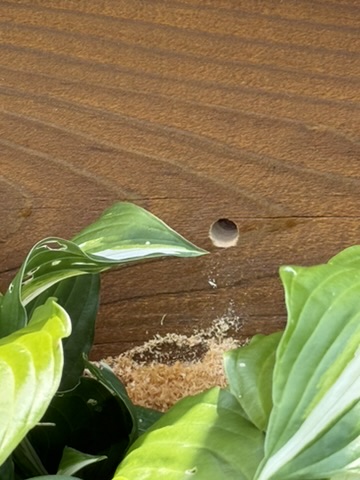
Most homeowners see the hovering bee and think it's a bumble bee. But carpenter bees aren't building a colony in your yard — they're boring into your wood. Every female drills a perfectly round 1/2-inch entry hole and excavates a gallery tunnel 6 to 10 inches deep inside your fascia board, soffit, deck railing, or porch ceiling. She lays eggs inside, seals them with pollen and wood pulp, and overwinters in the same gallery. Next spring, she comes back to the same wood and extends the tunnel — or her offspring emerge and start boring nearby.
One carpenter bee in April becomes a network of intersecting galleries by August. Two or three seasons of activity in the same fascia board can compromise its structural integrity. Worse, woodpeckers follow the scent of carpenter bee larvae and begin excavating the wood from the outside — causing far more visible damage than the bees themselves. By the time most homeowners notice the problem, the board needs replacing, not just treating.
Hi-Tech Pest Control treats active carpenter bee galleries with professional-grade dust insecticide, plugs entry holes after treatment, and advises on the painting and staining that makes wood unattractive to future females. We've protected Southeast Michigan homes from carpenter bee damage for more than 40 years.
If you have a bee nest in the ground, inside a wall, or a large cluster on a branch — that's likely a bumble bee or honey bee, not a carpenter bee. See our Bee Removal page for bumble bee and honey bee situations. Carpenter bees are identified by the round 1/2-inch holes they drill into wood — that's the defining sign.
How Carpenter Bees Damage Your Home — Season by Season
Carpenter bee damage is cumulative. What starts as a cosmetic annoyance in the first season becomes a structural repair bill by season three or four.
Carpenter Bee vs. Bumble Bee — How to Tell Them Apart
These two species look nearly identical at a glance — but their behavior, nesting habits, and required treatment are completely different.
| Feature | Carpenter Bee | Bumble Bee | Yellow Jacket |
|---|---|---|---|
| Abdomen | Shiny, smooth black — no fuzz on the abdomen | Fuzzy all over — yellow and black bands on abdomen | Smooth, compact, bright yellow and black |
| Size | 3/4 inch — large | 1/2–1 inch — large and robust | 1/2 inch — compact |
| Nesting | Bores into wood — fascia, soffits, railings, trim | Underground — abandoned rodent burrows, dense grass | Ground burrows or wall voids — enclosed paper nest |
| Colony | Solitary — each female nests alone | Social colony — 50–500 workers | Social colony — 1,500–15,000 workers |
| Male Sting | Males cannot sting — only hover aggressively | Both males and females can sting | Workers sting repeatedly — swarm response |
| Key Sign | Round 1/2-inch holes in wood, sawdust below entry, yellow staining | Ground activity near dense vegetation or mulch | Ground hole or wall void entry; high-volume flight |
| Primary Threat | Structural wood damage — worsens each season | Sting hazard when nest disturbed | Sting hazard — aggressive foragers in late summer |
Where Carpenter Bees Nest in Michigan Homes
Carpenter bees prefer bare, weathered, or lightly painted wood. These are the most common nesting sites we find across Southeast Michigan properties.
Fascia Boards
The most common carpenter bee target in Michigan. Horizontal fascia boards — especially on the south and west sides of the home — take the most sun exposure and weather first. Bare or peeling paint is the primary attractant.
Soffits
Wooden soffits offer protected overhead wood that's difficult for homeowners to inspect regularly. Carpenter bees favor the underside of soffits near the eave line — entry holes here are frequently missed until woodpecker activity draws attention.
Deck Railings
Pressure-treated or cedar deck railings and posts are prime carpenter bee habitat — especially when the wood is unfinished or the stain has worn off. End-grain wood is particularly vulnerable because it's the softest entry point.
Porch Ceilings
Traditional tongue-and-groove wooden porch ceilings are an ideal carpenter bee site — horizontal, protected from weather, and typically painted infrequently. Multiple entry holes in a porch ceiling often go unnoticed until the ceiling panel weakens.
Window & Door Trim
Wide wooden trim around windows and doors — particularly on older Wayne County homes — offers a flat, accessible wood surface. Trim boards that have cracked, checked, or lost their finish coating are the first to be targeted.
Wooden Siding
Cedar, pine, and redwood lap siding — common on older Southeast Michigan homes — is vulnerable anywhere paint has peeled or the surface has weathered. End-grain exposed at butt joints is especially susceptible.
Pergolas & Arbors
Outdoor structures with exposed structural timber — pergolas, arbors, trellises — are frequent carpenter bee targets because they're built from unpainted or minimally treated wood and rarely inspected closely.
Outbuildings & Garages
Detached garages, sheds, and barns with wooden soffits, fascia, or exposed rafters are common secondary infestation sites — often worse than the main house because they receive less maintenance attention.
Fence Posts & Landscape Structures
Wooden fence posts — especially post tops and end-grain cuts — are ideal entry points. Carpenter bees nesting in fence posts adjacent to the home often expand to the structure itself within a season or two.
Warning Signs You Have Carpenter Bees
Round 1/2-Inch Holes in Wood
The most definitive sign. Carpenter bee entry holes are perfectly round, approximately 1/2 inch in diameter, and typically drilled into the underside or end-grain of wood members. A single female can drill a new entry hole in 1–2 days.
Sawdust or Frass Below Entry
Fresh boring produces coarse wood shavings — frass — that falls and accumulates directly below the entry hole. New frass is a sign of active excavation. Old, weathered frass with no fresh addition may indicate a dormant or abandoned gallery.
Yellow-Brown Staining Around Holes
Excrement from adult bees inside the gallery stains the wood surface yellow-brown around the entry hole. This staining is often the first cosmetic sign homeowners notice — and it's a reliable indicator of an active, occupied gallery.
Hovering Males Near Eaves
Male carpenter bees hover aggressively near entry holes and dive-bomb anyone who approaches. They are completely harmless — males have no stinger — but their behavior draws attention to the exact location of active galleries. If you see a large bee hovering persistently in one spot, look for holes nearby.
Woodpecker Activity on Siding
Woodpeckers excavate wood to reach carpenter bee larvae inside galleries. Irregular holes, splintered wood, and vertical excavation marks on fascia or siding are signs of secondary woodpecker damage driven by an established carpenter bee infestation underneath.
Buzzing Inside Wood Members
In an established, multi-season infestation, the gallery network can be extensive enough that movement inside the wood is audible. If you hear buzzing or scratching from inside a fascia board or porch ceiling, the infestation has likely been active for more than one season.
DIY Carpenter Bee Treatment vs. Professional Removal
DIY Attempt
Hi-Tech Professional Treatment
Seeing Woodpecker Damage Alongside the Bee Holes?
That's a sign the infestation has been active for multiple seasons. The longer you wait, the more wood is involved. Same-week service across Wayne, Oakland, and Macomb counties.
Call 248-569-8001 — Same-Week ServiceOur 4-Step Carpenter Bee Treatment Process
Every step matters — skipping any one of them means the bees return next spring.
Free Inspection — Find Every Entry Hole
We walk the full exterior — fascia, soffits, porch ceilings, deck railings, window trim, outbuildings — and mark every active and dormant entry hole. Most homeowners know about 2 or 3 holes; we typically find significantly more. We also assess wood condition and document woodpecker damage so you know what needs replacement versus treatment.
Gallery Treatment — Dust Insecticide into Every Hole
Professional-grade insecticidal dust is injected directly into each entry hole. Dust penetrates around the 90-degree gallery turn — the bend that blocks aerosol sprays — coating the entire tunnel interior and nest chamber. Bees that contact the treated dust carry it deeper into the gallery. Returning females contact the residual at the entry and are eliminated before they can re-nest.
Hole Plugging — Seal After Treatment, Not Before
After the dust treatment has had time to work, entry holes are plugged with wood filler or caulk appropriate to the substrate. Sealing before treatment traps larvae inside — they emerge by chewing a new exit hole. Sealing after treatment eliminates the visual attractant and reduces the chance of new females selecting the same holes next spring.
Wood Protection Recommendations — Prevent Next Season
Painted and fully stained wood is dramatically less attractive to carpenter bees than bare or weathered wood. We identify every surface where paint or finish has degraded and provide a specific recommendation for sealing and repainting before next spring. Hardwood trim and composite fascia are also significantly more resistant than softwood — we'll advise when replacement makes more sense than repeated annual treatment.
Carpenter Bee Treatment Pricing — Southeast Michigan
Pricing is based on the number of entry holes, structures involved, and access difficulty. All pricing confirmed at inspection — no surprises. $0 inspection fee, no trip charge.
| Situation | Typical Range | Notes |
|---|---|---|
| Early infestation — 1–5 holes, single structure | $150–$250 | Season 1 activity; accessible from ground or low ladder |
| Moderate — 6–15 holes or multiple structures | $200–$375 | Main house + garage/shed; Season 2 activity beginning |
| Extensive — 15+ holes, elevated access | $300–$500 | Multi-season infestation; may include fascia board assessment for replacement |
| Annual prevention program | Custom | Early-season treatment before females begin boring — most cost-effective long-term approach |
| Commercial properties | Custom Quote | Multi-building properties, HOAs, property management companies |
Prices reflect typical Southeast Michigan jobs. Final pricing confirmed at inspection before any work begins. Wood replacement, if needed, is a separate scope — we coordinate with contractors and provide documentation.
Who We Serve
Homeowners
Fascia boards, soffits, decks, porch ceilings, and wooden trim across Wayne, Oakland, and Macomb counties.
Landlords & Property Managers
Rental properties with recurring carpenter bee damage. Annual program pricing available.
Real Estate Agents
Pre-listing carpenter bee treatment and wood damage documentation for buyers and inspectors.
HOAs & Condo Associations
Multi-building associations with shared wood structures — coordinated treatment and documentation provided.
What Michigan Homeowners Say
"I had been trying to deal with carpenter bees on my deck for two years — spraying, plugging holes, everything I read online. Hi-Tech came out, found 23 holes I hadn't seen including ones behind the fascia, treated all of them properly, and explained why everything I'd tried wasn't working. First spring with no new holes."
"Woodpeckers had torn up my south fascia board looking for the carpenter bee larvae inside it. Hi-Tech treated the infestation, documented the extent of the damage, and gave me a clear report to take to my contractor for the board replacement. Professional and thorough — they know exactly what they're doing."
"I manage 14 single-family rentals in the Dearborn area and carpenter bees show up every spring. Hi-Tech handles all 14 properties on an early-season schedule — treat before the females bore, plug and paint recommendations included. The annual program has basically eliminated the problem across my whole portfolio."
Carpenter Bee Treatment Service Area — Southeast Michigan
Serving Wayne, Oakland, and Macomb counties. Same-week service available across our full coverage area.
Carpenter Bee Removal — Frequently Asked Questions
How do I know if I have carpenter bees or bumble bees?
Look at the abdomen and look for holes. Carpenter bees have a shiny, smooth black abdomen — bumble bees are fuzzy all over with yellow banding. More reliably: if you see round 1/2-inch holes drilled into wood with sawdust below them, those are carpenter bees — bumble bees don't bore into wood. If you see heavy flight activity near the ground or under shrubs with no holes in your wood, that's more likely bumble bees.
Can I just plug the holes myself?
Plugging without treating first is one of the most common mistakes we see. If larvae are inside when you plug the hole, they will chew a new exit hole — sometimes through the opposite side of the board, causing more damage than the original entry. The correct sequence is: treat first with insecticidal dust, wait for the dust to eliminate activity in the gallery, then plug. We always treat before we plug on every job.
Why do carpenter bees keep coming back to the same spots every year?
Because carpenter bees overwinter as adults inside their own galleries and emerge in the same location the following spring. Offspring also return to the same wood — either extending existing tunnels or boring nearby. The galleries release chemical cues that attract future females to the same site. Treating the gallery, plugging holes, and finishing the wood surface with paint or stain removes both the harborage and the attractant that draws new bees back.
What wood do carpenter bees prefer, and how can I make my home less attractive?
Carpenter bees strongly prefer bare, weathered, or softwood — cedar, pine, redwood, and Douglas fir that is unpainted or has lost its finish coating. Painted and fully stained wood is significantly less attractive; carpenter bees will bypass finished surfaces to find bare wood. The most effective long-term prevention is maintaining complete paint and stain coverage on all exterior wood, paying particular attention to end-grain cuts, fascia board ends, and areas where finish regularly peels.
Are carpenter bees dangerous? Do they sting?
Male carpenter bees are aggressive and territorial — they will hover in your face and dive-bomb you near entry holes. However, males have no stinger and are physically incapable of stinging. Female carpenter bees can sting but are docile and rarely do unless directly handled or trapped. The real danger from carpenter bees is structural, not medical — an established infestation causes significant cumulative wood damage and attracts woodpeckers that accelerate the destruction.
What is the woodpecker damage I'm seeing near the bee holes?
Downy and hairy woodpeckers detect the vibration and scent of carpenter bee larvae inside gallery tunnels and excavate the wood to reach them. Woodpecker damage looks different from bee damage — irregular, splintered holes and vertical excavation gouges versus the clean round bee entry holes. Woodpecker damage indicates a multi-season carpenter bee infestation and means the gallery network is extensive. Eliminating the carpenter bee infestation removes the food source and stops woodpecker activity.
When is the best time to treat for carpenter bees in Michigan?
The most effective treatment window is late April through early June — when females are actively boring and returning to galleries. Treating in early spring, before eggs are laid, prevents the next generation entirely. Late season treatment (August–September) is also effective for reaching the new generation before they overwinter. Treatment in either window, combined with hole plugging and wood finishing, provides protection through the following season.
Do you serve my city in Southeast Michigan?
We serve all of Wayne, Oakland, and Macomb counties — including Detroit, Livonia, Dearborn, Westland, Southfield, Warren, Sterling Heights, Troy, Farmington Hills, Royal Oak, Taylor, Lincoln Park, Canton, Novi, and surrounding communities. If you don't see your city listed, call us — we most likely cover your area.
Related Pest Control Services
Wayne · Oakland · Macomb County · Same-Week Service
Carpenter Bee Damage Getting Worse?
Every season you wait adds more galleries and more wood to replace.
7 days a week · 8:30 AM–10 PM · Locally owned since 1986