
How Fast Do Bed Bugs Reproduce? | One Visit Elimination
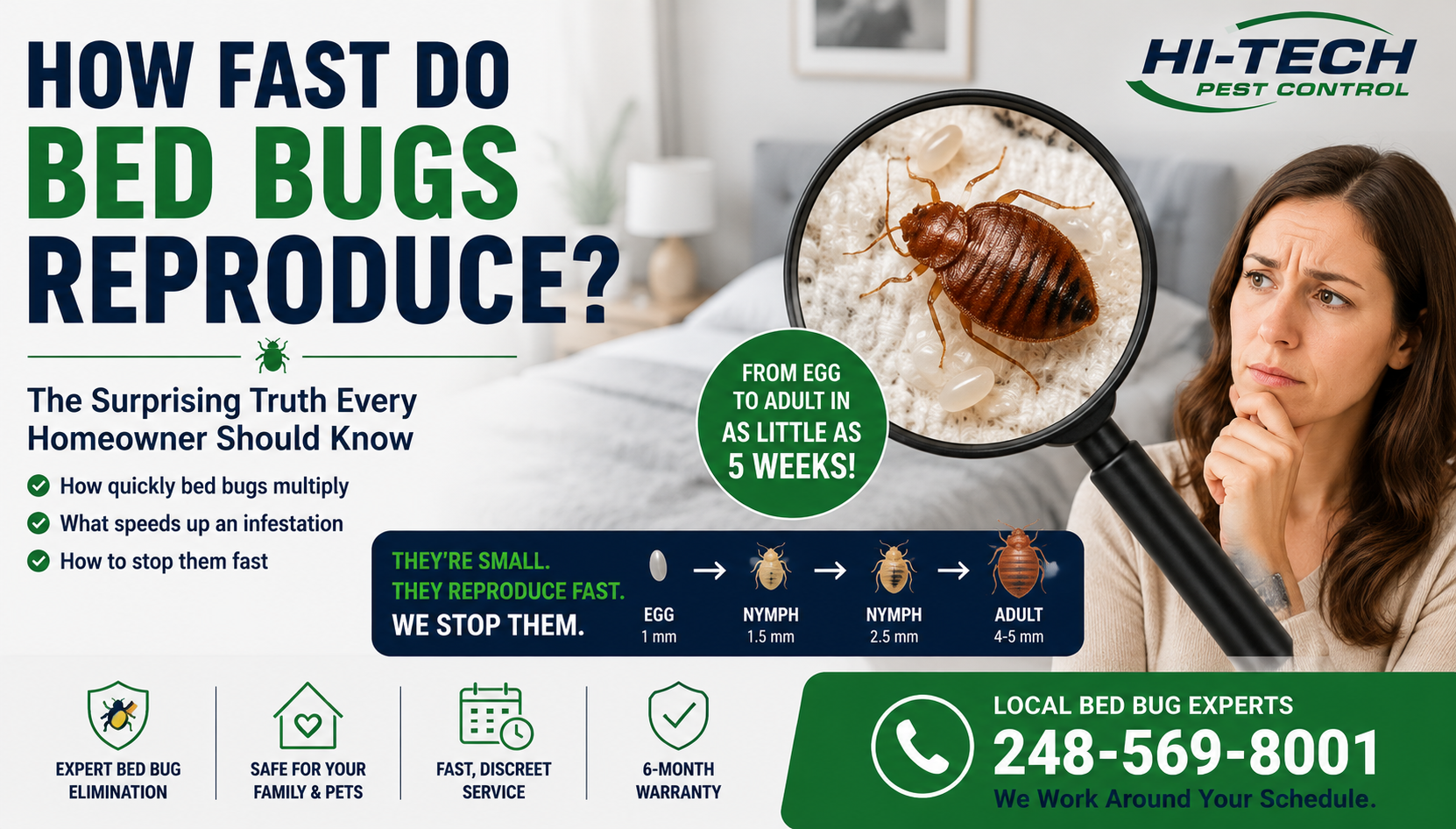
How fast do bed bugs reproduce in Homes and Businesses

Bed Bug Education · Hi-Tech Pest Control · Southeast Michigan

How Fast Do Bed Bugs Reproduce?
The Numbers That Make Waiting a Costly Mistake

One female bed bug introduced into your home today can produce a colony of hundreds within two to three months — all without a single visible bug ever being seen. Understanding the reproductive math changes everything about when to act.

1–5
Eggs Per Day Per Female
6–10
Days to Hatch
5 Wks
To Reproductive Maturity
500
Eggs Per Female Lifetime
$0
Hi-Tech Inspection Fee

The Reproductive Math That Makes Every Day Count

Most homeowners who call Hi-Tech Pest Control ask the same question after we complete our inspection: "How did this get so bad so fast?"

The answer is almost always the same. The infestation didn't get bad fast — it was growing quietly for weeks or months before the first bite was noticed. Bed bugs are extraordinarily good at remaining hidden during the early stages of an infestation. But they are not good at staying small. Their reproductive capacity is one of the most misunderstood aspects of bed bug biology — and it is the single most important reason why waiting to treat is one of the most expensive decisions a homeowner can make.

Understanding how bed bugs reproduce — and what that math means for a real infestation in a real home — changes everything about how urgently treatment needs to happen.

Already getting bitten?

Hi-Tech Pest Control offers same-day inspections throughout Southeast Michigan — free of charge. Every day without treatment is another day the population grows. Call 248-569-8001 now.

The Bed Bug Reproductive Cycle — Step by Step

Every number in this cycle is documented biology — not an estimate. This is what happens inside a mattress seam, a box spring, or a couch cushion while a homeowner waits to call.

Day 1
Introduction
A Single Mated Female Enters Your Home

She arrives in luggage, used furniture, clothing, or through a shared apartment wall. She is already mated — bed bugs mate before dispersal. She needs no male to reproduce. She is carrying viable sperm that will fertilize eggs for weeks to come. She immediately begins searching for a harborage within 5 to 8 feet of a sleeping human. Within 24 hours she has found one — a mattress seam, a box spring corner, or a headboard joint. She settles in. The infestation has begun.

Days 2–7
First Eggs
1 to 5 Eggs Deposited Daily — All Hidden

The female begins laying eggs within 3 to 5 days of her first feeding. She deposits 1 to 5 eggs per day — each one coated in a sticky substance that adheres it to fabric fibers, wood grain, and rough surfaces deep inside harborages. Eggs are 1 millimeter in size — smaller than a sesame seed. They are completely invisible without knowing exactly where to look. By the end of the first week, 5 to 25 eggs are already laid and hidden throughout the harborage.

Days 6–10
Hatching
First Generation Nymphs Emerge

The first eggs hatch in 6 to 10 days depending on temperature. Warmer conditions — like a bedroom at 70°F — accelerate hatching significantly. Newly hatched nymphs are translucent white and approximately 1.5 millimeters in size — invisible to anyone not conducting a systematic inspection. They immediately begin feeding and growing. The population is now multiple generations: the original female still laying eggs daily, and her first nymphs beginning to develop.

Weeks 5–6
Maturity
First Generation Reaches Reproductive Maturity

Nymphs pass through five molts in 5 to 6 weeks and reach full reproductive maturity. The first generation of offspring — all descended from the original single female — are now adults capable of laying their own eggs. The original female has been laying eggs continuously for 5 to 6 weeks. The population has grown exponentially: the original female plus dozens of first-generation adults, all producing eggs daily. The colony is now large enough to begin feeling pressure in the primary harborage.

Month 2
Expansion
Population Reaches 50 to 200 — Spreading to New Harborages

By the end of the second month, the population has grown to 50 to 200 individuals depending on feeding frequency and temperature. Primary harborages are becoming crowded. Bugs begin migrating to secondary harborages — the couch, the recliner, the nightstand, the baseboard gap, the carpet edge. Bites are now occurring every night. Many homeowners are beginning to suspect something — but have not yet connected the bites to bed bugs. The infestation is no longer contained to one piece of furniture.

Month 3
Advanced
Population Reaches 200 to 500+ — Multiple Rooms Affected

A three-month-old infestation from a single female typically numbers 200 to 500 individuals — multiple generations of adults and nymphs distributed across every piece of upholstered furniture, baseboard gap, and wall void in the room. Some bugs have already migrated to additional rooms. Bites are severe and occurring on multiple people in the home. At this stage, what began as a single-room infestation requiring a relatively straightforward treatment has become a multi-room infestation requiring significantly more comprehensive intervention.

What Waiting Actually Costs — In Dollars and in Daily Life

The reproductive math above translates directly into real costs — financial costs that grow with every week of delay, and personal costs that affect daily life in ways most people never anticipate when they first discover bites.

The Cost of Waiting

Single room becomes multi-room

A one-room treatment at $500–$900 becomes a whole-home treatment at $2,000–$4,000 as the population spreads to every sleeping and resting area in the home.

Infestation reaches wall voids

As primary harborages become overcrowded, bugs migrate into wall voids — areas that require significantly more complex and time-consuming treatment to reach completely.

Apartment spread to neighbors

In apartment buildings, a growing population that reaches wall voids can migrate to neighboring units — creating a building-wide situation from what began as a single introduction.

DIY attempts scatter the population

Many homeowners who delay calling attempt DIY treatments first. Every spray application that doesn't eliminate the full population scatters it — making professional treatment more complex and more expensive.

The Cost of Acting Now

Infestation stays contained

Early treatment eliminates the infestation before it spreads to additional rooms, additional furniture, and neighboring units. The treatment scope — and cost — stays at its smallest possible level.

Bites stop the same night

Hi-Tech's same-day treatment eliminates the infestation in one visit. Bites stop the same night. Sleep returns to normal immediately — not after weeks of continued exposure.

All furniture saved

Early-stage infestations are eliminated in the furniture — no disposal needed, no replacement cost, no new furniture becoming infested within days of purchase.

6-month warranty included

Michigan's only 6-month bed bug warranty backs every Hi-Tech treatment. If bugs return within 6 months, we come back at no charge. Zero financial risk.

The Personal Cost Nobody Talks About

The financial cost of a growing infestation is significant. But the personal cost — the effect on daily life while an infestation goes untreated — is something most pest control companies never address honestly.

Visible Bite Marks in Public

Bed bug bites appear on exposed skin — face, neck, arms, hands. They are visible to everyone in your daily environment. Teachers, office workers, healthcare providers, and students deal with bite marks that colleagues, administrators, and supervisors notice and ask about. The embarrassment and discomfort of explaining visible welts in professional settings is a real and immediate consequence of every day the infestation continues untreated.

Sleep Deprivation & Exhaustion

Bed bugs feed primarily at night — between 2 and 5 AM when sleep is deepest. The biting itself often wakes people up. The anxiety of knowing an infestation exists makes falling back asleep nearly impossible. Over days and weeks, the accumulated sleep deprivation affects concentration, mood, work performance, and physical health. This is not a minor inconvenience — it is a health impact that compounds with every night the infestation continues.

Anxiety & Psychological Stress

The psychological effect of a bed bug infestation is well documented — persistent anxiety, hypervigilance, difficulty concentrating, and a feeling of being unable to relax anywhere in your own home. Many people describe checking their sheets before bed every night, feeling something crawling when nothing is there, and being unable to invite friends or family over. This stress is not irrational — it is a direct response to a real and ongoing threat that ends completely the night of successful treatment.

Stained Bedding & Mattresses

Active infestations leave visible evidence — blood spots on sheets and pillowcases from crushed bugs, and dark fecal staining on mattress seams and fabric. These stains are unsightly and embarrassing, and they accumulate with every night the infestation continues. Hi-Tech cleans the mattress as part of treatment — and a quality encasement installed after treatment covers all staining completely, leaving the mattress looking new. There is no reason to discard a stained mattress or sleep on stained bedding a single additional night.

Every one of these personal costs ends the same night as Hi-Tech's treatment. Bites stop. Sleep returns. The anxiety of an active infestation — the checking, the hypervigilance, the visible marks — disappears with the infestation itself. Same-day service available throughout Southeast Michigan.

The Real-World Timeline — From Introduction to Advanced Infestation

This is what actually happens in a Southeast Michigan home when a single mated female is introduced — and treatment is delayed.

Week 1
1 Female, ~10 Eggs

Single female established. First eggs laid and hidden. No bites yet or bites too infrequent to notice. Treatment at this stage is fastest and least expensive.

Weeks 3–4
~20 Bugs

First generation nymphs developing. Bites starting to appear but often attributed to mosquitoes or rashes. Still contained to primary harborage.

Weeks 5–8
50–100 Bugs

First generation adults now reproducing. Bites undeniable and nightly. Beginning to spread to couch and recliner. Most people call around this point.

Month 3
200–500 Bugs

Multi-generation colony across multiple furniture pieces. Wall void migration beginning. Treatment cost significantly higher than Month 1.

Month 6+
1,000+ Bugs

Whole-home infestation. Wall void and adjacent room spread. Bugs visible during daylight. Most expensive and complex treatment scenario.

The earlier the call, the smaller the infestation, the lower the cost, and the faster the resolution. A single-room early-stage infestation treated in weeks 3 to 6 costs a fraction of a whole-home Month 3 infestation — and is resolved in a single same-day visit either way. The only variable is the price.

Why Eggs Are the Reason Most Treatments Fail

Understanding the reproductive cycle also explains why so many bed bug treatments — particularly DIY attempts — produce the same frustrating result: bites stop briefly, then return.

Every DIY spray product, every alcohol application, and every over-the-counter fogger has one thing in common: they cannot reach eggs in protected harborages. Bed bug eggs are deposited deep inside mattress seams, box spring frames, furniture joints, and baseboard cracks — precisely the locations that surface sprays cannot penetrate. The spray kills the adults and nymphs it contacts directly. The eggs survive, completely unaffected.

Six to ten days after that spray application, those eggs hatch. The nymphs that emerge feed immediately — and the bites return. The homeowner believes they have a new infestation. In reality, the original infestation was never eliminated. The eggs that were already laid before the spray simply waited out the treatment and continued the reproductive cycle.

This is one of the most common calls Hi-Tech receives: a homeowner who sprayed, had the bites stop for a week, and is now getting bitten again — often more severely than before, because the DIY spray also scattered surviving adults into harder-to-reach harborages like wall voids and ceiling moldings.

Hi-Tech's professional-grade treatment reaches the harborages where eggs are deposited — not just the visible surface population. Eliminating eggs is what stops the reproductive cycle completely. It is the difference between bites stopping temporarily and bites stopping permanently.

The Population Is Growing Right Now.
Same-Day Treatment Stops It Tonight.

Hi-Tech Pest Control serves all of Southeast Michigan — Wayne, Oakland, and Macomb Counties. Same-day inspections. Free of charge. No commitment required to inspect.

Bed Bug Reproduction — Common Questions

How fast do bed bugs reproduce?

A single female bed bug lays 1 to 5 eggs per day — up to 500 eggs in her lifetime. Eggs hatch in 6 to 10 days. Nymphs reach reproductive maturity in 5 to 6 weeks. A single introduced female can produce a colony of 200 to 500 individuals within 2 to 3 months. At warmer household temperatures — 70°F and above — the cycle accelerates significantly.

How long does it take to notice a bed bug infestation?

Most people do not notice a bed bug infestation until 4 to 8 weeks after introduction — often longer. Early-stage bugs remain hidden in harborages and bite infrequently enough that the bites are attributed to mosquitoes, rashes, or allergies. By the time bites become undeniable and nightly, the infestation is typically already in the moderate stage with dozens to hundreds of individuals established throughout primary harborages.

Why did bites stop after I sprayed and then come back?

Because the spray killed adults and nymphs on contact, but left eggs in protected harborages completely unaffected. Bed bug eggs are immune to contact insecticides and are hidden in locations that surface sprays cannot penetrate. 6 to 10 days after the spray application, those eggs hatched — and the new nymphs began feeding immediately. The original reproductive cycle was never interrupted. Professional treatment reaches the harborages where eggs are deposited.

Does temperature affect how fast bed bugs reproduce?

Yes significantly. Bed bugs reproduce most rapidly at temperatures between 70°F and 80°F — the typical range of a heated Michigan home in fall and winter. At these temperatures, eggs hatch in 6 to 7 days and nymphs reach maturity in 5 weeks. At lower temperatures, the cycle slows — but does not stop. A Michigan home in winter is still warm enough to sustain active reproduction throughout the infestation.

Can bed bugs spread to other rooms while I wait to treat?

Yes. As primary harborages become overcrowded — typically around months 2 and 3 — bed bugs begin migrating to secondary harborages throughout the home. They follow the host: wherever a person sleeps or rests regularly, bed bugs will establish. Moving to another room to escape bites does not provide relief. It introduces the infestation to every new resting area the host uses and expands the affected zone that must be treated.

How does Hi-Tech stop the reproductive cycle completely?

By locating and treating every harborage where adults, nymphs, and eggs are present — not just the visible surface population. Professional-grade products are applied directly into harborages in a way that reaches egg deposits that no surface spray can penetrate. Adults, nymphs, and eggs are all eliminated in the same treatment visit. Bites stop the same night. Michigan's only 6-month warranty backs every treatment — if bugs return within 6 months, we come back at no charge.

Wayne · Oakland · Macomb County · Same-Day Service

Every Day You Wait, the Population Grows.
Call Hi-Tech Today.

Free inspection. One complete visit. Michigan's only 6-month warranty.

7 days a week · 8:30 AM–10 PM · Locally owned since 1986
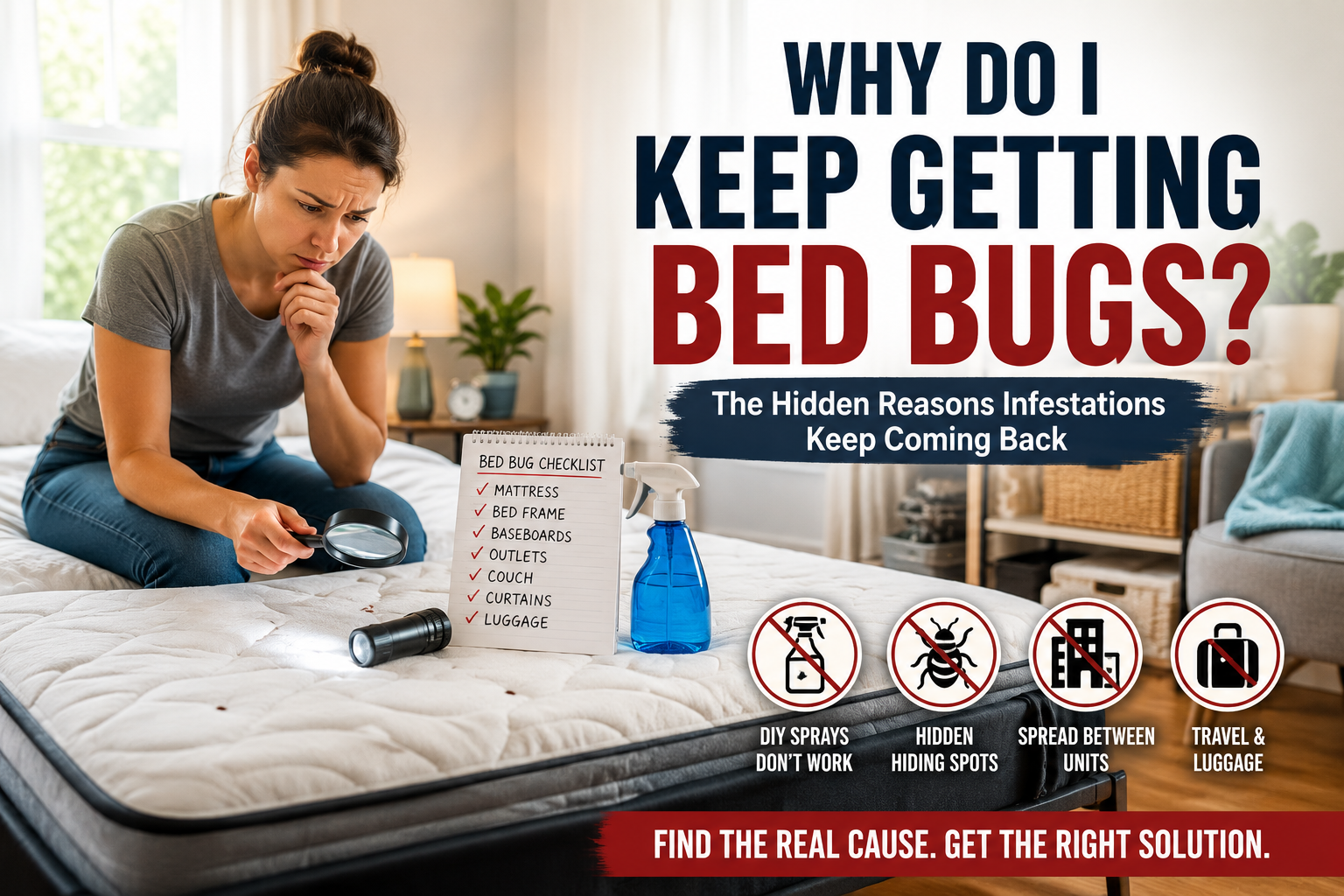
Why Do I Keep Getting Bed Bugs?

Worried homeowner inspecting mattress for recurring bed bugs in bright modern bedroom while using DIY spray products and searching for hidden bed bug infestation areas.

Bed Bug Expert Advice · Hi-Tech Pest Control · Southeast Michigan

Why Do I Keep Getting Bed Bugs After Treatment?

If you've been treated and bites came back — the infestation was never fully eliminated. Here's exactly why it happens, why it keeps happening, and what complete elimination actually requires.

40+
Years Michigan Experience
6-Mo
Michigan's Only Warranty
1
Visit — Complete Elimination
$0
Re-Inspection Fee

The Most Common Call We Receive — And What It Always Means

Over 30% of the calls Hi-Tech Pest Control receives in Southeast Michigan come from homeowners and renters who have already paid for bed bug treatment — and are still getting bitten. It is one of the most frustrating situations a person can experience, and it is also one of the most preventable.

The answer is almost always the same: the infestation was never fully eliminated. The visible bugs were reduced. Some harborages were treated. But the hidden population — deep inside furniture frames, wall voids, floor moldings, and dozens of other areas near the bed — was never located, never treated, and never stopped reproducing. The bites stopped temporarily. Then they came back.

Understanding why this happens — and why it is so much harder to get right than most people realize — is the first step toward making sure it never happens to you again.

Bites returned after treatment?

Hi-Tech Pest Control's re-inspection is free. We find what was missed — and our 6-month warranty means if bites return after our treatment, we come back at no charge. Call 248-569-8001 — same-day available.

Bed Bugs Can Survive for Months Without Feeding

This is the fact that makes throwing away furniture one of the most costly and ineffective responses to a bed bug infestation.

Bed bugs can survive 6 to 12 months without a single feeding under normal household conditions. They do not die when you remove their food source. They wait.

When you throw away a mattress, a couch, or a recliner — or when a treatment fails to eliminate the full population — the surviving bugs don't starve. They retreat into baseboards, wall voids, carpet edges, floor moldings, ceiling moldings, and structural gaps. They go dormant. And then, weeks or months later, when they detect body heat and carbon dioxide from a sleeping human, they emerge and begin feeding again.

This is why people who throw away beds and furniture are often confused when bites return 6 to 10 weeks later. The bugs were never gone. They simply had no reason to feed yet. The moment a human body is nearby and accessible, they find their way back. It is what they are built to do.

Throwing away a mattress without treating the room does not solve a bed bug infestation. It gives the bugs a reason to wait — and new furniture to repopulate when the time comes.

Why Throwing Away Furniture Makes It Worse — Not Better

This is one of the most deeply misunderstood aspects of bed bug infestations. People throw away mattresses and beds because the problem is called "bed bugs." They assume the infestation lives in the bed. It does not. The bed is simply where they feed. Everything within 5 to 8 feet of where a person sleeps is where they live.

When furniture is discarded without treating the room, the bugs that remain in the walls, carpet edges, baseboards, and structural voids — bugs that were never in the furniture at all — simply wait for new furniture to arrive. Within weeks of a new mattress or couch being brought into the home, they begin colonizing it. Bites resume. The homeowner believes they have a new infestation. In reality, the original infestation never ended.

And here is the part that rarely gets discussed: people throw away beds but almost never couches or recliners. Yet couches and recliners are just as infested — often more so — particularly when someone spends several hours a night in a recliner or on the couch. The bugs are wherever the people are. Removing one piece of furniture while leaving the others untreated accomplishes almost nothing.

What Throwing Away Furniture Does

Temporarily slows feeding — bugs still survive in walls and floors
New furniture is colonized within days to weeks of arrival
Bites return — often within a week — as bugs find new harborages
Furniture placed at curb spreads infestation to neighbors
Costs hundreds to thousands in unnecessary replacement

What Hi-Tech Treatment Does

Locates and treats every harborage — not just the visible ones
Saves furniture in virtually every home we treat
Eliminates eggs, nymphs, and adults in one visit
Bites stop the same night as treatment
Backed by Michigan's only 6-month warranty

The Real Problem in This Industry — Technician Experience

Complete bed bug elimination is the most difficult skill in pest control to learn and master. Most homeowners have no idea how high the standard actually needs to be — or how rarely it is met.

Eradicating bed bugs is the same challenge on every single job. The difficulty never changes. Whether the infestation is in a single room in a luxury hotel or a 4,000-square-foot home, the standard for complete elimination is identical: every harborage must be located, every population treated, every egg deposit reached. There are no shortcuts. There is no version of this job where doing less than the complete job produces a complete result.

And here is the uncomfortable truth: 3 to 4 months of experience treating bed bugs is one of the biggest problems in this industry. A technician who has been on the job for a few months has not seen enough infestations, enough edge cases, enough problem situations to know what to look for and how to respond when something unexpected happens. Bed bug treatment requires technicians who are intelligent, skillful, resourceful, and experienced — people who can solve problems in real time, not follow a checklist and move on.

Hi-Tech Pest Control vets every technician treating for bed bugs. The standard for who is allowed to treat is not negotiable. Some jobs take more time. Some jobs produce unforeseen complications. A seasoned technician handles those situations. An inexperienced one misses the harborages that cause the bites to return.

The proof is in the outcome — not the process. If bites returned after treatment, the job was not done correctly. It doesn't matter how many products were used or how long the technician was there. The result — bites stopping permanently — is the only measure that counts.

The Harborages Other Companies Miss — Every Time

Bed bugs are always near humans. That is not a theory — it is behavioral fact. They position themselves within feet of where a person sleeps or rests because that proximity is what allows them to feed. Just treating a bed and a chair in a bedroom is asking for trouble. The bugs in every other harborage within reach of that sleeping person are sitting there untouched, continuing to reproduce, waiting to recolonize.

These are the locations that are almost always present in every significant infestation — and the ones most commonly missed by undertrained technicians:

Box Spring Interior

The inside of a box spring is dark, warm, enclosed, and never disturbed — perfect harborage conditions. Many severe infestations are centered almost entirely inside the box spring long before spreading anywhere else. A technician who doesn't open and treat the interior is leaving the core of the infestation untouched.

Couches & Recliners

If someone is getting bitten at night and has been for months — why would the infestation only be in the bed? Couches and recliners are just as infested, often more so. The reclining mechanism alone has dozens of joints, folds, and hidden cavities. Treating the bedroom and ignoring the living room furniture is one of the most common reasons bites return.

Carpet Edges & Floor Moldings

The gap where carpet meets baseboard provides a continuous compressed channel that runs the full length of every wall in the room. Bed bugs occupy this channel throughout an established infestation. Ceiling moldings and floor moldings near sleeping areas hold populations that survive every surface treatment applied to the furniture above them.

Electrical Outlets & Wall Voids

Outlet boxes are migration pathways — particularly in apartments where wall voids connect units. Bugs pushed out of primary harborages by spray attempts or overcrowding move into outlet voids and wall cavities where no surface treatment can reach them. This population reproduces and recolonizes treated areas within weeks.

Curtains, Blinds & Window Areas

When homeowners spray alcohol or over-the-counter products near the bed, bugs scatter onto floors, curtains, blinds, and wall surfaces. These areas are rarely treated in a standard service visit — leaving a displaced population that finds its way back to furniture within days.

Headboard & Bed Frame Joints

The gap behind a wall-mounted headboard, screw holes, joint intersections, and corner mounting hardware are primary harborage points. Hollow metal tube frames harbor established populations entirely inside the tube — invisible from outside. These are present in almost every infestation and missed in almost every incomplete treatment.

Why DIY Sprays Make the Problem Significantly Worse

This is the part most people do not know until it is too late. Every repellent spray applied near a bed bug harborage creates pressure — and pressure causes bugs to scatter.

Alcohol sprays and over-the-counter insecticides kill bed bugs on direct contact. But they have no residual effect — bugs that are not directly sprayed survive. And the repellent properties of these products drive surviving bugs away from treated areas and into floors, carpets, curtains, blinds, floor moldings, ceiling moldings, and eventually wall voids.

A homeowner who has been spraying alcohol for two weeks before calling a professional has taken a contained infestation and scattered it across an entire room — or multiple rooms. What would have been a concentrated, treatable population in specific harborages has now been redistributed across dozens of hard-to-reach surfaces. The treatment scope is larger. The cost is higher. The difficulty is significantly greater.

Stop spraying before the inspection.

If you have bed bugs, do not apply any spray before Hi-Tech arrives. Every spray application makes the infestation harder to locate and treat. Call 248-569-8001 and let us assess the full scope first.

Here is something else that rarely gets discussed: if you have been getting bites for months, why would you think the infestation is only in the bed? Months of feeding means months of reproduction. A population that has been active for several months has had time to spread to every piece of upholstered furniture, every baseboard gap, and every wall void within reach. The entire affected area needs treatment — not just the mattress.

Apartment Neighbors and Visitors — The Reinfestation Source Nobody Talks About

In apartment buildings, a successfully treated unit can be reinfested within weeks if the source is a neighboring unit whose infestation remains untreated. Bed bugs travel through shared wall voids, outlet boxes mounted back-to-back in party walls, and plumbing penetrations. No amount of product applied inside your unit stops that pressure. The neighboring unit must be assessed and addressed.

But there is another reinfestation source that almost no pest control company addresses: visitors. If you have friends or family members who have bed bugs at home — and most will not tell you, or may not know themselves — every visit is a potential introduction event. Bed bugs hitchhike in clothing, bags, and purses. A guest who sits on your couch for two hours can leave behind enough bugs to start a new infestation.

If You Live in an Apartment — What to Do

If you know your neighbor has bed bugs — act immediately. Within 6 weeks of close contact, you can have a full infestation and have no idea where it came from.

Most neighbors will not tell you they have bed bugs. Watch for your own bite signs — and call for an inspection if they appear.

If you have guests — vacuum every surface they sat on when they leave. Not just the floor. The couch, the chairs, the cushions. Bed bugs on the floor are far easier to deal with than bed bugs inside furniture.

Michigan law gives renters the right to professional treatment regardless of landlord authorization. You do not need to wait for your landlord's permission to call Hi-Tech.

The uncomfortable math on visitor introduction: a neighbor or friend who sits on your couch regularly and has an active infestation can introduce enough bugs to establish a colony in your furniture within 6 weeks. You won't see them. You will start getting bitten. And you will have no idea it was the couch — because everyone always assumes it's the bed.

The Proof That Shortcuts Don't Work

The standard for complete bed bug elimination is the same whether the infestation is in a single hotel room or a five-bedroom home. The size of the space does not change the standard — it changes the time required.

Here is a simple truth about bed bug treatment that the industry rarely acknowledges: if you do a poor job on a small infestation, the survivors will reinfest the same heavily treated areas. Surviving bugs — even a handful of females with viable eggs — will repopulate an entire room. Reproduction starts over. Within weeks, bites resume. The treatment appears to have failed. In reality, it was never complete.

It does not matter if the infestation is in a one-bedroom apartment in Hazel Park or a hotel suite. The standard of thoroughness required to produce complete elimination is the same. There is no version of this job where cutting corners produces a lasting result. The bugs that survive will always find the nearest human — and they will always repopulate.

Incomplete Treatment — What Happens

Bites slow or stop temporarily. Surviving bugs retreat. 1–3 weeks later, eggs hatch. Bugs that were dormant in walls begin feeding again. Bites return — often worse than before. The homeowner calls a second company. The cycle continues.

Complete Treatment — What Happens

Every harborage is located. Every population is treated. Bites stop the same night as treatment. No survivors to repopulate. No recurring cycle. The 6-month warranty backs the result — if bites return, Hi-Tech returns at no charge.

Treated Twice and Still Getting Bitten?

Hi-Tech finds what others miss. Same-day inspections available throughout Southeast Michigan. Free re-inspection — no charge to assess what was left behind.

What a Complete Bed Bug Treatment Actually Covers

Hi-Tech Pest Control has eliminated bed bugs in Southeast Michigan since 1986. In that time, we have treated infestations in homes, apartments, hotels, nursing facilities, and commercial properties across Wayne, Oakland, and Macomb counties. The standard has never changed. Every job requires the same thoroughness. Every harborage must be found and treated before the job is done.

Here is what a complete treatment covers — the full list that most companies don't get to:

✓  Mattress seams and piping
✓  Box spring interior and frame
✓  Headboard and gap behind it
✓  Bed frame joints and screw holes
✓  Couch and sectional seams
✓  Recliner mechanism and frame
✓  Nightstands and dresser joints
✓  Carpet edges and tack strips
✓  Baseboard and floor molding gaps
✓  Ceiling molding near sleeping areas
✓  Electrical outlets and switch plates
✓  Wall voids and structural gaps
✓  Picture frames and wall décor
✓  Electronics near the bed
✓  Curtains, blinds, and window areas
✓  Apartment neighboring unit spread

The 6-month warranty is the proof. No other bed bug exterminator in Michigan offers it — because no other company is confident enough in their thoroughness to back it up. If bites return within 6 months of Hi-Tech treatment, we return at no charge.

Common Questions — Recurring Bed Bug Infestations

How quickly can bed bugs come back after treatment?

Bites can return within 7 to 14 days after an incomplete treatment as eggs in protected harborages hatch. Bugs that survived in wall voids, furniture interiors, or floor moldings begin feeding within days of hatching. In cases where furniture was discarded without room treatment, bites often return within 2 to 4 weeks as the surviving population relocates to new furniture.

Why did I stop getting bitten for 3 weeks and then start again?

This is the classic sign of incomplete treatment or discarded furniture without eradication. Surviving bugs retreat when their primary harborages are disturbed. They can wait weeks — sometimes months — before the population rebuilds enough to resume consistent feeding. The 3-week pause is not recovery. It is dormancy. The infestation never ended.

I threw away my mattress and still have bites. Why?

Because the infestation was never only in the mattress. Bed bugs live within 5 to 8 feet of where you sleep — in the box spring, bed frame, baseboards, carpet edges, and wall voids. Removing the mattress does not remove those harborages. The surviving population has now colonized new areas — or is waiting to colonize your new mattress.

Can I get bed bugs from someone who visits my home?

Yes. Visitors who have bed bugs at home can introduce them through clothing, bags, and personal items. After guests leave, vacuum every surface they sat on — couches, chairs, cushions — not just the floor. Bed bugs on the floor are far easier to deal with than bed bugs inside upholstered furniture. This is especially important if you live in an apartment building with known infestation activity nearby.

Why does Hi-Tech's treatment work when others failed?

Because we locate every harborage before we treat — not just the obvious ones. Our technicians are experienced, vetted, and held to a standard of complete elimination. We do not consider a job done until bites stop permanently. And our 6-month warranty means that if we miss anything, we come back at no charge. That accountability is what produces a different result.

Is Hi-Tech's re-inspection really free if I was treated by another company?

Yes. If you were treated by another company and are still getting bitten, Hi-Tech's inspection is free regardless. We assess what was left behind, identify the surviving harborages, and provide a full scope recommendation before any treatment cost is discussed. Call 248-569-8001 — same-day inspection available throughout Southeast Michigan.

Wayne · Oakland · Macomb County · Same-Day Service

Still Getting Bitten?
The Infestation Is Still There.

Free re-inspection. One complete visit. Michigan's only 6-month warranty.

7 days a week · 8:30 AM–10 PM · Locally owned since 1986
Should I Throw Away My Mattress If I Have Bed Bugs?

Bed Bug Expert Advice · Hi-Tech Pest Control

Should I Throw Away My Mattress If I Have Bed Bugs?

Before you drag anything to the curb — read this. Throwing away your mattress is almost always the wrong move, and it can make your infestation significantly worse.

It's one of the first things people do when they discover bed bugs — strip the mattress, drag it outside, and assume the problem is solved. It feels like the right move. The bugs are called bed bugs, after all. Get rid of the bed, get rid of the bugs.

But this is one of the most expensive mistakes a homeowner can make — and Hi-Tech Pest Control technicians see it happen every season across Southeast Michigan. Not only does throwing away your mattress almost never solve a bed bug infestation, it can actively make it worse. Here's everything you need to know before you touch a single piece of furniture.

Stop — Don't move anything yet.

Moving infested furniture through your home spreads bed bugs to rooms that weren't affected. Call Hi-Tech at 248-569-8001 for a free same-day inspection before you move, bag, or discard anything.

The Technician Needs to See the Infestation First

When a Hi-Tech technician arrives at your home, the first thing they do is a full inspection — and what they find on and around your mattress tells them everything. The mattress is evidence. It shows the stage of the infestation, how long it has been active, how severe it is, and where the colony is concentrated.

Bed bug infestations have distinct stages:

  • Early stage — small number of adults, few eggs, limited spread. Easiest and least expensive to treat.
  • Moderate stage — established colony, eggs present in seams and tufts, beginning to spread to nearby furniture.
  • Advanced stage — large colony, multiple harborage sites throughout the room, possibly spread to adjacent rooms.

If you throw away the mattress before the technician arrives, you've eliminated the primary piece of evidence. The technician can no longer accurately assess the stage, the severity, or the concentration of the infestation. That makes treatment harder, not easier — and it doesn't remove a single bed bug from your home.

The question the technician is trying to answer: Where are they? How many? How long have they been here? Throwing away the mattress before inspection removes the clearest answer to all three questions.

Are You Throwing Away the Bed to Sleep — or Because You Think the Bugs Will Leave With It?

This is the question Hi-Tech technicians ask homeowners who have already discarded their mattress. The answer is almost always the same: "I thought if I got rid of the mattress, I'd get rid of the bed bugs."

That's not how bed bugs work. Bed bugs don't live exclusively in mattresses — they live anywhere within 5 to 8 feet of where you sleep. They hide in:

The Bed Frame

Joints, screw holes, and hollow legs of bed frames are prime harborage sites — often more heavily infested than the mattress itself.

Baseboards & Outlets

Bed bugs travel along baseboards and nest behind electrical outlet covers within feet of the bed.

Wall Voids

In established infestations, bed bugs move inside walls and travel to adjacent rooms — completely unaffected by what you do to the mattress.

Nightstands & Dressers

Any furniture within reach of where you sleep is a potential harborage site — drawers, joints, and the undersides of nightstands.

Box Springs

The fabric lining and internal frame of a box spring often harbors more bed bugs than the mattress above it.

Carpet & Flooring

Bed bugs hide along carpet edges, under rugs, and beneath flooring gaps — especially near the bed and along travel routes.

Removing the mattress removes one harborage site while leaving dozens of others completely untouched. The colony continues. The bites continue. And now you've spent hundreds of dollars on a new mattress that will be infested within days — because the source was never treated.

What About the Couch? The Recliner? The Dining Room Chairs?

People call them bed bugs — so everyone focuses on the bed. But bed bugs go where the people are, not just where they sleep. If someone spends several hours a night on the couch, the recliner, or a favorite chair, those pieces of furniture become just as infested as the mattress — sometimes more so.

Hi-Tech technicians regularly find heavier bed bug activity in living room furniture than in the bedroom — particularly in homes where someone sleeps on the couch or spends significant time in a recliner. The bugs follow the host.

The Furniture That Gets Overlooked — And Shouldn't

Sofas & Sectionals

Sectional sofas are among the most difficult furniture to treat because of the number of joints, cushion seams, and hidden cavities. Each section connection point is a prime harborage area. A heavily infested sectional takes more treatment time than a mattress — but Hi-Tech treats and saves it in one visit.

Sleeper Sofas

Sleeper sofas have a folding metal frame mechanism inside — a perfect harborage structure with dozens of joints, springs, and hidden recesses. These require specific treatment attention and are one of the most commonly missed infestation sites in DIY attempts.

Recliners

The reclining mechanism, arm joints, and thick cushion seams of a recliner create dozens of harborage points. Someone who spends several hours nightly in a recliner is feeding the colony there just as much as in a bed.

Dining Room Chairs

Upholstered dining chairs with fabric undersides, padded seats, and joint connections are a frequently overlooked spread point — especially in open floor plans where the dining area is close to the living room.

If you throw away the mattress and replace it — but the couch, the recliner, and the chairs remain untreated — you will have bites again within days. The infestation was never in just one place.

Are You Throwing It Away Because of the Stains?

This is something Hi-Tech technicians hear more often than you might expect — and it's completely understandable. Bed bug infestations leave visible evidence on mattresses: small rust-colored blood spots from crushed bugs, and dark brown or black fecal stains around seams and tufts. They're unsightly, and many homeowners feel embarrassed by them.

You don't need to throw away the mattress because of the stains. Hi-Tech cleans the mattress as part of the treatment process. After treatment, a quality mattress encasement covers the entire mattress surface — and it will look completely clean and brand new. The encasement also provides ongoing protection, trapping any remaining eggs until they die and preventing re-infestation of the mattress surface.

Hi-Tech cleans the mattress. You keep it. It looks brand new.

Treatment + cleaning + encasement = a mattress that shows no evidence of infestation and is fully protected going forward. No need to spend $800–$2,000 on a replacement that will be re-infested within days if the source isn't treated.

Hi-Tech Treats Everything the Same Day — You Keep 100% of Your Furniture

This is where Hi-Tech is different from the approach that leads homeowners to throw away furniture in the first place. Some pest control companies require multiple visits over weeks or months — and during that waiting period, homeowners feel like they have to do something. They throw away the mattress. Then the couch. Then the recliner. By the time treatment is complete, they've discarded thousands of dollars of furniture that could have been saved.

Hi-Tech eliminates the infestation in a single visit — the same day you call. Every piece of furniture is treated: the mattress, the box spring, the bed frame, the couch, the sectional, the recliner, the chairs. Everything is cleaned. Everything is treated. You keep all of it.

Without Professional Help

  • Throw away mattress — $800–$2,000 to replace
  • Throw away couch — $1,000–$4,000 to replace
  • Throw away recliner — $500–$2,000 to replace
  • Bugs return — infestation was never treated
  • New furniture re-infested within days
  • Months of bites, lost sleep, and stress

With Hi-Tech Same-Day Treatment

  • Keep the mattress — cleaned and encased
  • Keep the couch — treated completely
  • Keep the recliner — treated same visit
  • Colony eliminated in one visit
  • Bites stop the same night
  • 6-month warranty — we come back free if needed

When Is Throwing Away Furniture Actually Acceptable?

There is one situation where discarding a mattress or piece of furniture makes sense: when you are attempting to treat yourself without professional help, and the furniture is so heavily infested or structurally damaged that it cannot realistically be treated effectively with consumer-grade products.

Even then — if you choose to discard infested furniture, it must be done carefully. Dragging an infested mattress through your home drops bed bugs and eggs on every surface it passes. The mattress should be bagged completely before it is moved, and clearly labeled as infested so no one else picks it up and brings the infestation into their own home.

But understand this: discarding furniture is a cost-management decision for DIY treatment — not a treatment strategy. Throwing away furniture without treating the room, the remaining furniture, and the harborage sites accomplishes nothing except an expensive replacement.

Michigan's Only 6-Month Bed Bug Warranty

Hi-Tech Pest Control is the only bed bug exterminator in Michigan offering a 6-month warranty. If bed bugs return within 6 months of treatment, we come back and retreat at absolutely no charge. No other company in Southeast Michigan offers this guarantee — because no other company is confident enough in their single-visit elimination to back it up.

That warranty covers your mattress, your furniture, your entire home. You don't need to throw anything away to be protected.

Frequently Asked Questions

Do bed bug sniffing dogs help find infestations?

Bed bug detection dogs can locate infestations by scent — including hidden colonies inside walls and furniture that aren't visually obvious. They can be useful for confirming suspected infestations in hard-to-inspect areas. However, a thorough visual inspection by an experienced technician covers the most common harborage sites effectively. Hi-Tech's 40+ years of Southeast Michigan experience means our technicians know exactly where to look — and they find infestations other companies miss every day.

Will Hi-Tech treat the same day I call?

Yes. Hi-Tech offers same-day inspections and same-day treatment throughout Southeast Michigan. We answer 7 days a week from 8:30 AM to 10:00 PM — including weekends. If you call in the morning, we can inspect and treat that afternoon. Bites stop the same night as treatment in virtually every case.

How much does bed bug treatment cost in Michigan?

Hi-Tech bed bug treatment in Southeast Michigan costs $500–$900 for early-stage infestations in 1 room, $900–$2,000 for moderate infestations across 2–3 rooms, and $2,000–$4,000 for severe whole-home infestations. Apartment units start at $275–$375. All pricing includes the free inspection, same-day treatment, furniture cleaning, and Michigan's only 6-month warranty. One professional treatment costs far less than replacing the furniture you'd throw away trying to handle it yourself.

Do I need to do anything to prepare before Hi-Tech arrives?

Do not move furniture, bag items, or throw anything away before the inspection. Leave everything in place so the technician can assess the full scope of the infestation accurately. Hi-Tech will give you specific preparation instructions after the inspection and before treatment begins.

Wayne · Oakland · Macomb County · Same-Day Service

Don't Throw Away Your Furniture.
Call Hi-Tech — We Save It.

Same-day inspection and treatment. Michigan's only 6-month warranty. Free inspection — no hidden fees.

7 days a week  ·  8:30 AM–10 PM  ·  Locally owned since 1986

Bed Bug Case Study: Bed Bugs Spread Throughout a Westland Michigan Home

Bed Bug Case Study: Bed Bugs Spread Throughout a Westland Michigan Home

Click to Call

How a Single Infested Bed Led to a Whole-Home Bed Bug Infestation

This case study from Westland, Michigan demonstrates how quickly bed bugs can spread when an infested piece of furniture enters a home.

The homeowners were a kind family who had taken in a relative who needed a place to stay. Wanting to help, they purchased a used bed for him and set up a bedroom in the attic area of the home.

Unfortunately, the used bed was already heavily infested with bed bugs.

At the time the family had no idea that the insects were present. The bed looked clean and the mattress appeared to be in good condition. However, bed bugs often hide deep in seams, joints, and cracks where they are nearly impossible to detect without a professional inspection.

Once that bed entered the home, the infestation began.

A Hidden Infestation Upstairs

The relative living in the attic had a condition known as clinomania, which is an overwhelming desire to remain in bed for extended periods of time.

Because he spent so much time in bed, the bed bugs had an ideal feeding environment and the population quickly began to grow.

At first, the insects remained mostly in the attic bedroom where the bed had been placed.

However, bed bugs rarely stay confined to one location for long.

As their population increased, they began to search for new hiding places and new hosts throughout the home.

Bed Bugs Begin Spreading Through the House

Over time, the bed bugs began moving beyond the attic.

They traveled through:

  • Wall voids
  • Floor moldings
  • Stairways
  • Furniture seams
  • Clothing and belongings

Eventually the insects were discovered downstairs in the main living areas of the home.

This is very common in severe infestations. Once a bed bug population grows large enough, they begin expanding their territory and spreading throughout the house.

At that point, the infestation was no longer limited to one bed or one room.

It had become a whole-home problem.

Fear and Silence Made the Problem Worse

The relative sleeping in the attic had realized there was a bed bug problem but was afraid to tell the family.

Unfortunately, bed bug infestations rarely improve on their own. The longer they go untreated, the larger the population becomes and the more areas of the home become affected.

By the time the family discovered how serious the infestation had become, they were understandably shocked and desperate for a solution.

The Infested Bed Was Removed

Once the homeowners realized what had happened, they removed the bed from the attic and placed it outside.

However, removing furniture alone does not eliminate a bed bug infestation.

By this point the insects had already begun spreading throughout the structure.

When I inspected the attic, it was clear that the infestation had reached a very severe stage.

Where the legs of the bed had once rested on the floor, there were multiple piles of bed bugs concentrated in those locations. These clusters form because bed bugs tend to gather near the areas where they feed most frequently.

Seeing several concentrated clusters like this is a clear sign that the infestation has surpassed the early stages and reached a large population level.

A Hard Lesson Learned During Inspection

During the inspection I focused heavily on the infestation and the amount of work that would be required to eliminate it.

Unfortunately, in that moment I made a mistake that taught me a valuable lesson.

I was standing directly over one of the infestation areas without taking the proper precautions.

When bed bugs are disturbed, they often attempt to escape quickly in search of new hiding places.

In this case, as the insects began to scatter, many of them ran directly toward my clothing.

Before I realized what was happening, several had begun running up the inside of my pant legs.

It was an unpleasant experience, and it gave me firsthand knowledge of how intensely some people can react to bed bug bites.

Within a short time I began developing a strong reaction to the bites, and the discomfort lasted for well over a week.

It was a reminder that even professionals need to stay vigilant around severe infestations.

The lesson was simple:

Never stand directly on top of an active bed bug nest without proper protective precautions.

Professional Treatment Was Required

By the time the infestation had spread throughout the home, there was no realistic way to solve the problem with partial treatments or do-it-yourself methods.

The entire home required a comprehensive bed bug treatment plan.

This included:

• Full home inspection
• Targeted treatment throughout multiple rooms
• Elimination of nesting areas
• Strategic pest control application designed to eliminate the infestation

Bed bugs reproduce rapidly, and once they spread through a structure they require professional treatment to fully eradicate them.

How Bed Bugs Spread Through Homes

This case demonstrates one of the most common ways infestations begin.

Bed bugs often enter homes through:

  • Used furniture
  • Used mattresses
  • Luggage and travel
  • Guests or visitors
  • Apartment-to-apartment spread

Once inside, they can spread quickly through:

  • Baseboards
  • Wall voids
  • Furniture joints
  • Clothing and bedding

In some cases, bed bugs can move throughout a home within a matter of weeks.

Important Lesson: Used Beds Can Introduce Bed Bugs

Used mattresses and bed frames carry one of the highest risks of introducing bed bugs into homes.

Even when furniture looks clean, bed bugs can hide in tiny cracks and seams where they remain unnoticed until the population grows.

For this reason, used bedding and mattresses should be inspected carefully before entering a home, and professional inspection is recommended when there is any doubt.

Bed Bug Treatment in Westland Michigan

Hi-Tech Pest Control provides professional bed bug inspection and treatment services throughout Westland, Livonia, Garden City, Canton, and surrounding Michigan communities.

Our goal is to identify infestations quickly and eliminate them before they spread throughout the home.

If you suspect bed bugs in your home, early intervention is critical.

Call Hi-Tech Pest Control today at 248-569-8001 for professional bed bug inspection and treatment.

Bed Bug Case Study: Used Furniture Introduced Bed Bugs Into a Beautiful Livonia Home

Bed Bugs From Used Furniture: Livonia Case Study

Click to Call

Can used Furniture Bring Bed Bugs Into Your Home

Yes. Used furniture is ine of the most common ways bed bugs are introduced into homes. Bed Bugs often hide inside furniture seams, joints, drawers, and upholstery where they are fifficult to detect. Once infested furniture enters a home, bed bugs can behin feeding immediately and may spread to other rooms within days. Professional inspection and treatment are usually required to eliminate the infestation completely.
used furniture infested with bed bugs

When Beautiful Furniture Brings an Ugly Problem

This case study comes from a beautiful home in Livonia, Michigan where the homeowners had invested heavily in high-end furnishings and maintained their home meticulously. Every room reflected care and attention to detail — polished hardwood floors, well-placed decor, and expensive bedroom furniture.

Unfortunately, one purchase introduced a hidden problem.

The homeowners had purchased large, heavy, used bedroom furniture online. It was elegant, expensive, and appeared to be in excellent condition. What they could not see was what had been hiding inside it.

Bed bugs.

Used furniture can sometimes carry bed bug eggs, nymphs, or adult insects deep inside seams, joints, and cavities where they are nearly impossible to detect without a professional inspection.

Within days, the homeowners began experiencing bites and signs of bed bug activity in the master bedroom.

The First Challenge: Acceptance

One of the most common obstacles in bed bug cases is not the insects themselves — it is acceptance of the problem.

The homeowners believed the issue was limited strictly to the bedroom furniture and master bedroom area. Because the furniture had been recently brought into the home, they assumed the insects were confined to that single location.

However, bed bugs do not remain confined once they begin feeding.

They move.

They travel through:

  • Floor moldings
  • Electrical outlets
  • Furniture seams
  • Baseboards
  • Nightstands
  • Upholstered furniture
  • Adjacent rooms

    In many homes, bed bugs can begin spreading within days, particularly when a new infestation is introduced and the insects immediately begin feeding and reproducing.

    Explaining this to homeowners requires experience, patience, and clarity.

    This was one of those cases where the conversation became very direct.

    We made it clear that we could not leave the home untreated if bed bugs were present.

    Treating only part of a home while leaving the rest untreated often results in the insects relocating and spreading, sometimes appearing weeks or months later in places like couches or recliners.

    No one wants to be sitting on their couch months later watching television — or enjoying a drink — only to discover bed bugs have simply moved to another room.

    Concerns About Pest Control Products

    The homeowners had understandable concerns about pest control treatments and insecticides. Many homeowners worry about chemical exposure and the safety of their family, pets, and belongings.

    This is extremely common in upscale homes where owners carefully manage what enters their environment.

    We explained several important points:

    • Modern pest control treatments are precisely applied and targeted
    • Treatments are designed to eliminate pests while remaining safe for humans and pets when applied properly
    • The goal is one treatment to solve the problem completely

    We also explained something many people overlook.

    Homeowners are exposed to many chemicals every day through common household products such as:

    • Hair spray
    • Tile cleaner
    • Oven cleaner
    • Air fresheners
    • Cleaning agents

    Professional pest control treatments are applied strategically and only where necessary to eliminate the infestation.

    Our commitment was simple:

    One properly executed treatment.
    No damage to the home.
    No broken windows.
    No ruined plants.
    No repeat infestations.

The Real Source of the Infestation

After inspection, it became clear that the used bedroom furniture had introduced the infestation.

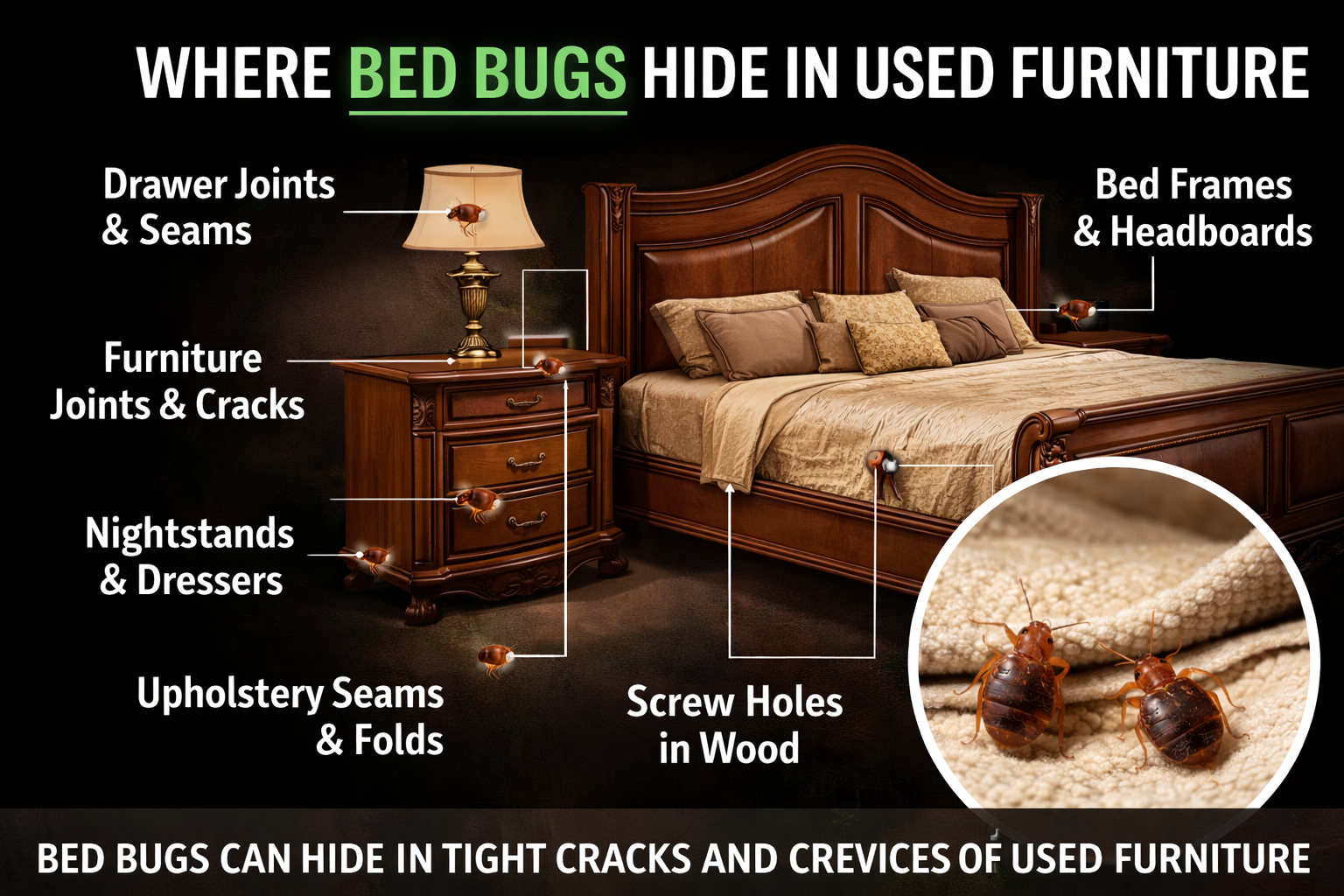
Bed bugs often hide in:

  • Drawer joints
  • Upholstery seams
  • Bed frames
  • Headboards
  • Screw holes
  • Internal wood joints

Once inside the home, they quickly begin feeding and reproducing.

When bed bugs enter a home through furniture, they are often already in a reproduction stage, meaning eggs and young insects are already present.

This can accelerate the spread of the infestation if not addressed quickly.

The Treatment Plan

Once the homeowners understood the risk of partial treatment, they agreed to proceed with a full-home treatment approach.

The plan included:

• Inspection of all sleeping and resting areas
• Targeted treatment throughout the home
• Removal of unnecessary dust products
• Preparation guidance for the homeowners
• Strategic application of professional treatment materials

The goal was clear:

Eliminate the infestation in one visit.

Results

The treatment was completed successfully.

The infestation was eliminated and the homeowners were relieved to return to enjoying their home without the stress and discomfort bed bugs bring.

What started as a difficult conversation ended with a very satisfied customer.

Important Lesson: Used Furniture Carries Risk

Purchasing used furniture can sometimes introduce pests into a home.

While many second-hand items are perfectly safe, there is always a percentage risk that furniture may carry bed bugs, especially upholstered or wooden bedroom pieces.

If used furniture enters the home already containing bed bugs, reproduction can begin immediately.

This is why professional inspection and quick action are so important.

Why Experience Matters in Bed Bug Treatment

Treating bed bugs in upscale homes requires:

• Experience
• Discretion
• Precision
• Respect for the homeowner’s property

Hi-Tech Pest Control has decades of experience solving difficult bed bug infestations in homes throughout Livonia and the surrounding Michigan communities.

Our goal is simple:

Solve the problem completely so our customers can return to enjoying their homes.

Need Bed Bug Help in Livonia?

If you suspect bed bugs in your home, acting quickly is critical.

Hi-Tech Pest Control provides professional bed bug inspections and treatments throughout Livonia and nearby communities.

Call 248-569-8001 today to schedule an inspection.

CALL NOW – 248-569-8001