
Bed Bug Expert Advice · Hi-Tech Pest Control · Southeast Michigan
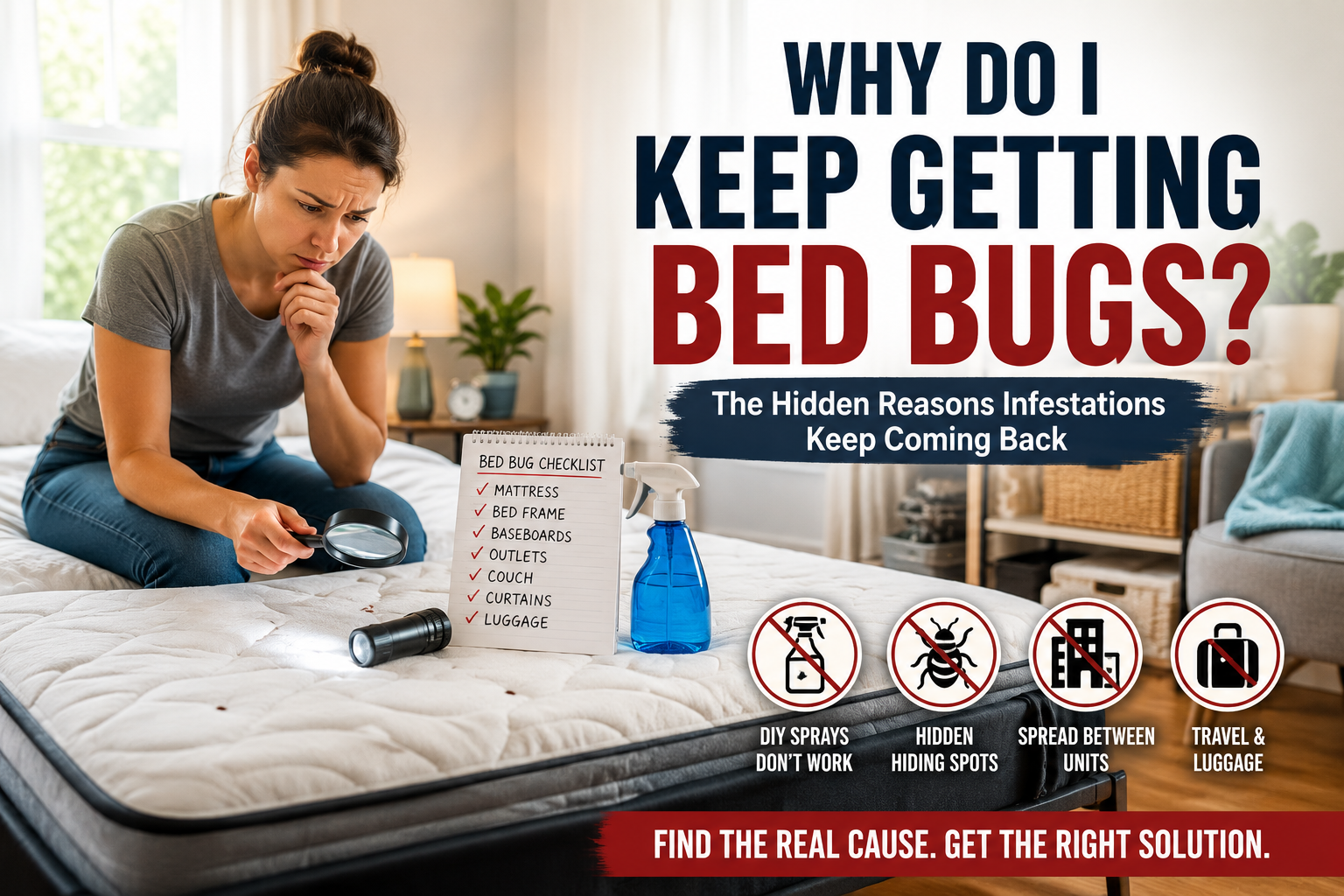
Why Do I Keep Getting Bed Bugs After Treatment?
If you've been treated and bites came back — the infestation was never fully eliminated. Here's exactly why it happens, why it keeps happening, and what complete elimination actually requires.
The Most Common Call We Receive — And What It Always Means
Over 30% of the calls Hi-Tech Pest Control receives in Southeast Michigan come from homeowners and renters who have already paid for bed bug treatment — and are still getting bitten. It is one of the most frustrating situations a person can experience, and it is also one of the most preventable.
The answer is almost always the same: the infestation was never fully eliminated. The visible bugs were reduced. Some harborages were treated. But the hidden population — deep inside furniture frames, wall voids, floor moldings, and dozens of other areas near the bed — was never located, never treated, and never stopped reproducing. The bites stopped temporarily. Then they came back.
Understanding why this happens — and why it is so much harder to get right than most people realize — is the first step toward making sure it never happens to you again.
Hi-Tech Pest Control's re-inspection is free. We find what was missed — and our 6-month warranty means if bites return after our treatment, we come back at no charge. Call 248-569-8001 — same-day available.
Bed Bugs Can Survive for Months Without Feeding
This is the fact that makes throwing away furniture one of the most costly and ineffective responses to a bed bug infestation.
Bed bugs can survive 6 to 12 months without a single feeding under normal household conditions. They do not die when you remove their food source. They wait.
When you throw away a mattress, a couch, or a recliner — or when a treatment fails to eliminate the full population — the surviving bugs don't starve. They retreat into baseboards, wall voids, carpet edges, floor moldings, ceiling moldings, and structural gaps. They go dormant. And then, weeks or months later, when they detect body heat and carbon dioxide from a sleeping human, they emerge and begin feeding again.
This is why people who throw away beds and furniture are often confused when bites return 6 to 10 weeks later. The bugs were never gone. They simply had no reason to feed yet. The moment a human body is nearby and accessible, they find their way back. It is what they are built to do.
Throwing away a mattress without treating the room does not solve a bed bug infestation. It gives the bugs a reason to wait — and new furniture to repopulate when the time comes.
Why Throwing Away Furniture Makes It Worse — Not Better
This is one of the most deeply misunderstood aspects of bed bug infestations. People throw away mattresses and beds because the problem is called "bed bugs." They assume the infestation lives in the bed. It does not. The bed is simply where they feed. Everything within 5 to 8 feet of where a person sleeps is where they live.
When furniture is discarded without treating the room, the bugs that remain in the walls, carpet edges, baseboards, and structural voids — bugs that were never in the furniture at all — simply wait for new furniture to arrive. Within weeks of a new mattress or couch being brought into the home, they begin colonizing it. Bites resume. The homeowner believes they have a new infestation. In reality, the original infestation never ended.
And here is the part that rarely gets discussed: people throw away beds but almost never couches or recliners. Yet couches and recliners are just as infested — often more so — particularly when someone spends several hours a night in a recliner or on the couch. The bugs are wherever the people are. Removing one piece of furniture while leaving the others untreated accomplishes almost nothing.
What Throwing Away Furniture Does
What Hi-Tech Treatment Does
The Real Problem in This Industry — Technician Experience
Complete bed bug elimination is the most difficult skill in pest control to learn and master. Most homeowners have no idea how high the standard actually needs to be — or how rarely it is met.
Eradicating bed bugs is the same challenge on every single job. The difficulty never changes. Whether the infestation is in a single room in a luxury hotel or a 4,000-square-foot home, the standard for complete elimination is identical: every harborage must be located, every population treated, every egg deposit reached. There are no shortcuts. There is no version of this job where doing less than the complete job produces a complete result.
And here is the uncomfortable truth: 3 to 4 months of experience treating bed bugs is one of the biggest problems in this industry. A technician who has been on the job for a few months has not seen enough infestations, enough edge cases, enough problem situations to know what to look for and how to respond when something unexpected happens. Bed bug treatment requires technicians who are intelligent, skillful, resourceful, and experienced — people who can solve problems in real time, not follow a checklist and move on.
Hi-Tech Pest Control vets every technician treating for bed bugs. The standard for who is allowed to treat is not negotiable. Some jobs take more time. Some jobs produce unforeseen complications. A seasoned technician handles those situations. An inexperienced one misses the harborages that cause the bites to return.
The proof is in the outcome — not the process. If bites returned after treatment, the job was not done correctly. It doesn't matter how many products were used or how long the technician was there. The result — bites stopping permanently — is the only measure that counts.
The Harborages Other Companies Miss — Every Time
Bed bugs are always near humans. That is not a theory — it is behavioral fact. They position themselves within feet of where a person sleeps or rests because that proximity is what allows them to feed. Just treating a bed and a chair in a bedroom is asking for trouble. The bugs in every other harborage within reach of that sleeping person are sitting there untouched, continuing to reproduce, waiting to recolonize.
These are the locations that are almost always present in every significant infestation — and the ones most commonly missed by undertrained technicians:
Box Spring Interior
The inside of a box spring is dark, warm, enclosed, and never disturbed — perfect harborage conditions. Many severe infestations are centered almost entirely inside the box spring long before spreading anywhere else. A technician who doesn't open and treat the interior is leaving the core of the infestation untouched.
Couches & Recliners
If someone is getting bitten at night and has been for months — why would the infestation only be in the bed? Couches and recliners are just as infested, often more so. The reclining mechanism alone has dozens of joints, folds, and hidden cavities. Treating the bedroom and ignoring the living room furniture is one of the most common reasons bites return.
Carpet Edges & Floor Moldings
The gap where carpet meets baseboard provides a continuous compressed channel that runs the full length of every wall in the room. Bed bugs occupy this channel throughout an established infestation. Ceiling moldings and floor moldings near sleeping areas hold populations that survive every surface treatment applied to the furniture above them.
Electrical Outlets & Wall Voids
Outlet boxes are migration pathways — particularly in apartments where wall voids connect units. Bugs pushed out of primary harborages by spray attempts or overcrowding move into outlet voids and wall cavities where no surface treatment can reach them. This population reproduces and recolonizes treated areas within weeks.
Curtains, Blinds & Window Areas
When homeowners spray alcohol or over-the-counter products near the bed, bugs scatter onto floors, curtains, blinds, and wall surfaces. These areas are rarely treated in a standard service visit — leaving a displaced population that finds its way back to furniture within days.
Headboard & Bed Frame Joints
The gap behind a wall-mounted headboard, screw holes, joint intersections, and corner mounting hardware are primary harborage points. Hollow metal tube frames harbor established populations entirely inside the tube — invisible from outside. These are present in almost every infestation and missed in almost every incomplete treatment.
Why DIY Sprays Make the Problem Significantly Worse
This is the part most people do not know until it is too late. Every repellent spray applied near a bed bug harborage creates pressure — and pressure causes bugs to scatter.
Alcohol sprays and over-the-counter insecticides kill bed bugs on direct contact. But they have no residual effect — bugs that are not directly sprayed survive. And the repellent properties of these products drive surviving bugs away from treated areas and into floors, carpets, curtains, blinds, floor moldings, ceiling moldings, and eventually wall voids.
A homeowner who has been spraying alcohol for two weeks before calling a professional has taken a contained infestation and scattered it across an entire room — or multiple rooms. What would have been a concentrated, treatable population in specific harborages has now been redistributed across dozens of hard-to-reach surfaces. The treatment scope is larger. The cost is higher. The difficulty is significantly greater.
If you have bed bugs, do not apply any spray before Hi-Tech arrives. Every spray application makes the infestation harder to locate and treat. Call 248-569-8001 and let us assess the full scope first.
Here is something else that rarely gets discussed: if you have been getting bites for months, why would you think the infestation is only in the bed? Months of feeding means months of reproduction. A population that has been active for several months has had time to spread to every piece of upholstered furniture, every baseboard gap, and every wall void within reach. The entire affected area needs treatment — not just the mattress.
Apartment Neighbors and Visitors — The Reinfestation Source Nobody Talks About
In apartment buildings, a successfully treated unit can be reinfested within weeks if the source is a neighboring unit whose infestation remains untreated. Bed bugs travel through shared wall voids, outlet boxes mounted back-to-back in party walls, and plumbing penetrations. No amount of product applied inside your unit stops that pressure. The neighboring unit must be assessed and addressed.
But there is another reinfestation source that almost no pest control company addresses: visitors. If you have friends or family members who have bed bugs at home — and most will not tell you, or may not know themselves — every visit is a potential introduction event. Bed bugs hitchhike in clothing, bags, and purses. A guest who sits on your couch for two hours can leave behind enough bugs to start a new infestation.
If You Live in an Apartment — What to Do
If you know your neighbor has bed bugs — act immediately. Within 6 weeks of close contact, you can have a full infestation and have no idea where it came from.
Most neighbors will not tell you they have bed bugs. Watch for your own bite signs — and call for an inspection if they appear.
If you have guests — vacuum every surface they sat on when they leave. Not just the floor. The couch, the chairs, the cushions. Bed bugs on the floor are far easier to deal with than bed bugs inside furniture.
Michigan law gives renters the right to professional treatment regardless of landlord authorization. You do not need to wait for your landlord's permission to call Hi-Tech.
The uncomfortable math on visitor introduction: a neighbor or friend who sits on your couch regularly and has an active infestation can introduce enough bugs to establish a colony in your furniture within 6 weeks. You won't see them. You will start getting bitten. And you will have no idea it was the couch — because everyone always assumes it's the bed.
The Proof That Shortcuts Don't Work
The standard for complete bed bug elimination is the same whether the infestation is in a single hotel room or a five-bedroom home. The size of the space does not change the standard — it changes the time required.
Here is a simple truth about bed bug treatment that the industry rarely acknowledges: if you do a poor job on a small infestation, the survivors will reinfest the same heavily treated areas. Surviving bugs — even a handful of females with viable eggs — will repopulate an entire room. Reproduction starts over. Within weeks, bites resume. The treatment appears to have failed. In reality, it was never complete.
It does not matter if the infestation is in a one-bedroom apartment in Hazel Park or a hotel suite. The standard of thoroughness required to produce complete elimination is the same. There is no version of this job where cutting corners produces a lasting result. The bugs that survive will always find the nearest human — and they will always repopulate.
Incomplete Treatment — What Happens
Bites slow or stop temporarily. Surviving bugs retreat. 1–3 weeks later, eggs hatch. Bugs that were dormant in walls begin feeding again. Bites return — often worse than before. The homeowner calls a second company. The cycle continues.
Complete Treatment — What Happens
Every harborage is located. Every population is treated. Bites stop the same night as treatment. No survivors to repopulate. No recurring cycle. The 6-month warranty backs the result — if bites return, Hi-Tech returns at no charge.
Treated Twice and Still Getting Bitten?
Hi-Tech finds what others miss. Same-day inspections available throughout Southeast Michigan. Free re-inspection — no charge to assess what was left behind.
What a Complete Bed Bug Treatment Actually Covers
Hi-Tech Pest Control has eliminated bed bugs in Southeast Michigan since 1986. In that time, we have treated infestations in homes, apartments, hotels, nursing facilities, and commercial properties across Wayne, Oakland, and Macomb counties. The standard has never changed. Every job requires the same thoroughness. Every harborage must be found and treated before the job is done.
Here is what a complete treatment covers — the full list that most companies don't get to:
The 6-month warranty is the proof. No other bed bug exterminator in Michigan offers it — because no other company is confident enough in their thoroughness to back it up. If bites return within 6 months of Hi-Tech treatment, we return at no charge.
Common Questions — Recurring Bed Bug Infestations
How quickly can bed bugs come back after treatment?
Bites can return within 7 to 14 days after an incomplete treatment as eggs in protected harborages hatch. Bugs that survived in wall voids, furniture interiors, or floor moldings begin feeding within days of hatching. In cases where furniture was discarded without room treatment, bites often return within 2 to 4 weeks as the surviving population relocates to new furniture.
Why did I stop getting bitten for 3 weeks and then start again?
This is the classic sign of incomplete treatment or discarded furniture without eradication. Surviving bugs retreat when their primary harborages are disturbed. They can wait weeks — sometimes months — before the population rebuilds enough to resume consistent feeding. The 3-week pause is not recovery. It is dormancy. The infestation never ended.
I threw away my mattress and still have bites. Why?
Because the infestation was never only in the mattress. Bed bugs live within 5 to 8 feet of where you sleep — in the box spring, bed frame, baseboards, carpet edges, and wall voids. Removing the mattress does not remove those harborages. The surviving population has now colonized new areas — or is waiting to colonize your new mattress.
Can I get bed bugs from someone who visits my home?
Yes. Visitors who have bed bugs at home can introduce them through clothing, bags, and personal items. After guests leave, vacuum every surface they sat on — couches, chairs, cushions — not just the floor. Bed bugs on the floor are far easier to deal with than bed bugs inside upholstered furniture. This is especially important if you live in an apartment building with known infestation activity nearby.
Why does Hi-Tech's treatment work when others failed?
Because we locate every harborage before we treat — not just the obvious ones. Our technicians are experienced, vetted, and held to a standard of complete elimination. We do not consider a job done until bites stop permanently. And our 6-month warranty means that if we miss anything, we come back at no charge. That accountability is what produces a different result.
Is Hi-Tech's re-inspection really free if I was treated by another company?
Yes. If you were treated by another company and are still getting bitten, Hi-Tech's inspection is free regardless. We assess what was left behind, identify the surviving harborages, and provide a full scope recommendation before any treatment cost is discussed. Call 248-569-8001 — same-day inspection available throughout Southeast Michigan.
Related Bed Bug Resources
Wayne · Oakland · Macomb County · Same-Day Service
Still Getting Bitten?
The Infestation Is Still There.
Free re-inspection. One complete visit. Michigan's only 6-month warranty.
7 days a week · 8:30 AM–10 PM · Locally owned since 1986