Hi-Tech Pest Control Bald-Faced Hornet Nest Removal in Michigan

Hi-Tech Pest Control's Professional Bald-Faced Hornet Nest Removal Services in Michigan

Hi-Tech Pest Control has over 40 years of experience safely removing aggressive bald-faced hornet nests from homes and businesses across Southeast Michigan. We eliminate dangerous nests quickly so you can safely enjoy your property again.
Call Now!
⚠️ Stinging Insect Hazard Alert: Farmington Hills, MI

Bald-Faced Hornets vs. Yellow Jackets: Why DIY Wasp Removal Is a Dangerous Game in Farmington Hills

If you see heavy pest traffic darting in and out of a bush, tree, or ground cover, pause immediately. There is no other pest in Michigan that exhibits that specific, aggressive, in-and-out highway pattern. You are likely staring at a nest of Bald-Faced Hornets or Yellow Jackets—two of the most territorial, smart, and attack-prone insects in North America.

Need Immediate Wasp or Hornet Removal?

Don't risk severe stings. Our trained technicians handle aggressive stinging insects safely.

📞 Call Emergency Pest Control Now

Real Customer Story: Essex Dr in Farmington Hills, MI

We recently received a call from a homeowner on Essex Dr in Farmington Hills. They knew they had a Bald-Faced Hornet nest and initially did what many homeowners do—they shopped around for the cheapest price. However, after calling other local services, they quickly called us back due to technician availability and expertise.

The reality is that most pest technicians are simply not trained or experienced enough to handle active Bald-Faced Hornet nests. Many operators are genuinely afraid of these insects—and for good reason. They know that without the right gear, strategy, and nerve, an attack is almost guaranteed.

In this case, the nest was built unusually low to the ground inside a dense bush, rather than high up in the tree canopy where Bald-Faced Hornets typically nest. A lawn care crew found it the hard way while trimming, positively identified the hazard, and immediately alerted the homeowner. We dispatched an experienced technician, completely dismantled the medium-sized nest, and safely removed the entire colony—including the workers, nest structure, and reproductive queens.

Smart, Territorial, and Armed with a Painful Blow

Honestly, we are lucky these two wasp species don't get any bigger. Both Bald-Faced Hornets and Yellow Jackets are highly intelligent, extremely protective of their domain, and organized in their defense.

They don't attack at random—they attack on trigger. Simply vibrating the ground or crossing directly in front of their flight path as they leave or enter the nest will provoke an immediate swarm. They hit like a trained unit, launching targeted strikes designed specifically to drive you far away from their home.

💥 Speaking From Experience: The Pain Factor

While insect sting guides often rank Yellow Jackets and Bald-Faced Hornets equally in pain, speaking from firsthand experience: the Bald-Faced Hornet is by far the winner.

Getting hit by a Bald-Faced Hornet feels less like an insect sting and more like someone throwing rocks at you at full speed. Both stings are agonizingly painful, and the throbbing, swollen ache can easily linger for up to one full week non-stop.

How to Spot the Mouth of the Nest (Safely)

If you suspect a nest nearby, do not go hacking through bushes or sticking tools into holes. Stand back at a safe distance (at least 15 to 20 feet clear of flight paths) and remain completely still for just 2 minutes. By watching the incoming and outgoing traffic, the wasps will map out the exact entrance for you.

Medical Warning: Respect the Sting

Even if you have never had an allergic reaction to insect stings in the past, venom load changes with multiple stings. Anyone who receives stings from the neck up should exercise extreme caution. Swelling near the face, throat, or neck can cause sudden airway constriction and breathing difficulty.

If stung near the head or neck:

  • Take an antihistamine immediately if safe for you to do so.
  • Monitor breathing closely.
  • Do not hesitate to seek emergency medical care if swelling or shortness of breath begins.

Spotted Hornet Traffic in Your Yard?

Keep your family and lawn crews safe. Contact our Farmington Hills stinging insect specialists today.

Schedule Professional Nest Removal

Serving Farmington Hills & Surrounding Oakland County Areas

We provide specialized, high-risk stinging insect removal across Oakland County. Click your local area below to request service:

Southeast Michigan Yellow Jacket Exterminator | Hi-Tech Pest Control

Yellow jackets entering house siding near a wall opening, indicating a possible hidden nest inside the wall. Hi-Tech Pest Control yellow jacket extermination in Southeast Michigan.
🚨 WARNING: High volume of wall-nest emergencies reported in Metro Detroit. Book immediate dispatch below.

Yellow Jackets in Siding & Drywall: The Hidden Danger in Livonia Homes

If you have noticed yellow jackets constantly buzzing around a tiny gap in your home's exterior vinyl, aluminum, or brick veneer siding here in **Livonia** or the surrounding Metro Detroit area, you aren't looking at a simple outdoor bug problem. You are looking at the entry point to a dangerous, hidden structural infestation.

Homeowners often assume the insects are nesting right behind the hole. Unfortunately, yellow jacket queens navigate deep into wall cavities to build their colonies. The actual nest could be several feet away from the entrance—hidden far up an interior wall or ceiling joist where consumer bug sprays can't possibly reach.

They Mold Their Paper Nests to Fit Your Southeast Michigan Home

Just like the large, grey paper nests yellow jackets build in local bushes or trees, a colony inside a structure builds a paper shelter out of chewed wood pulp. Instead of a round ball, **the nest dynamically expands to conform to the exact shape of your interior wall void.** As the reproductives generate thousands of new workers through the hot summer months, the colony rapidly runs out of space.

⚠️ Do You Hear a "Crumbling Paper" Sound?

When the colony fills the wall cavity, the workers must make room to expand. To do this, they begin actively **chewing away your home's plasterboard and interior drywall**. If you sit quietly in the room, it will sound exactly like someone is rhythmically wrinkling, scratching, or crumbling paper right inside the wall.

The Dangerous "Dark Spot" Illusion

If left untreated, the wasps will chew completely through the structural plasterboard, leaving only the thin layer of interior latex paint untouched. From your living room, this looks like a small, mysterious damp or dark spot on the wall.

Never touch, poke, or press on this dark spot.

Because the physical drywall is entirely gone, the slightest pressure will rupture the paint. If broken, hundreds to thousands of highly aggressive yellow jackets will instantly spill into your room, attacking anyone and anything nearby.

Severe Health and Medical Risks

Yellow jackets are fiercely protective of their queens and will sting aggressively. Unlike honeybees, they do not lose their stingers and can strike a victim multiple times, pumping painful venom with every contact.

Critical Medical Notice for Southeast Michigan Residents: Stings localized from the neck up—including the face, throat, and scalp—carry a drastically elevated medical risk. Neck-up stings can cause rapid localized swelling that threatens respiratory airways, causing severe breathing difficulties or life-threatening anaphylactic shock, even in individuals with no history of bee allergies.

Why Professional Elimination is Required

Attempting to DIY this issue by sealing or caulking the outside siding hole is a critical mistake. If you trap them, their only escape route is forward—forcing them to rapidly chew through your drywall and enter your living space all at once.

Our licensed technicians utilize specialized thermal imaging to map the exact boundaries of the nest inside your walls, applying targeted, professional-grade treatments that completely eradicate the colony safely without damaging your home.

📍 Providing Rapid Response Throughout a 30-Mile Radius of Livonia:
  • Livonia & Plymouth
  • Canton & Northville
  • Novi & Farmington Hills
  • Birmingham & Bloomfield
  • Royal Oak & Troy
  • Ann Arbor & Ypsilanti

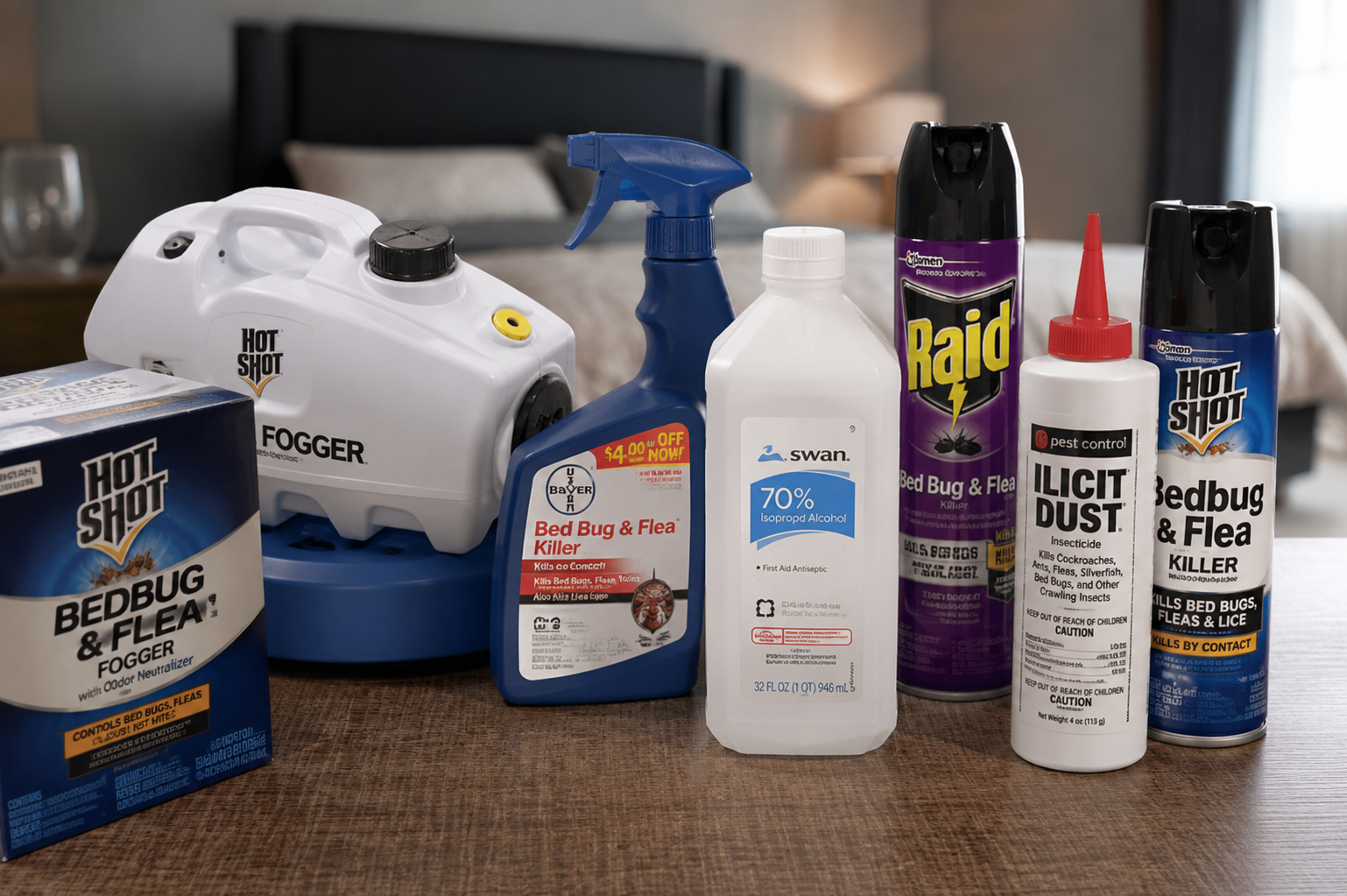
Do Bed Bug Foggers Work? Why Foggers & DIY Sprays Fail

Common DIY bed bug products including foggers, rubbing alcohol, insecticide dusts, aerosol sprays, and over-the-counter treatments often used before professional bed bug extermination.
Same-Day Bed Bug Service Free Inspection One-Visit Elimination Michigan's Only 6-Month Bed Bug Warranty Serving Wayne, Oakland & Macomb Since 1986 5.0 Star Rated

Do Bed Bug Foggers Work? Why Foggers & DIY Sprays Fail

The short version from 40 years in the field: a fogger will kill a fly buzzing around the room. It will not kill the bed bugs living inside your mattress seams, box spring, and wall voids.

The Direct Answer

No — bed bug foggers do not work. There is a reason you will never see a professional exterminator rely on fogging to eliminate an infestation. Foggers release insecticide into the open air, where it drifts, settles, and dissipates. Bed bugs don't live in open air. They live pressed deep inside cracks, seams, screw holes, and fabric folds — exactly where the fog never reaches.

Why Foggers & Bug Bombs Don't Kill Bed Bugs

Nearly every bed bug fogger on the shelf is built the same way, using the same class of active ingredients — pyrethrins, piperonyl butoxide, cyano-based compounds, or cypermethrin. Cypermethrin is one of the longer-lasting active ingredients of the group, and even it falls short when it's delivered as a fog.

The failure isn't really about the chemical. It's about the delivery method. When you set off a fogger, the insecticide becomes airborne and drifts through the open room. It will knock down an exposed insect — a fly in flight, an earwig crossing the floor. But it does not travel underneath, inside, and into the tight cracks and fabric folds where bed bugs actually nest. The bugs simply stay put in their harborage while the fog passes overhead.

Then comes the second problem: once the fog dissipates, there is virtually no residual left behind. A real treatment leaves protection working in the cracks and voids for weeks. A fogger leaves almost nothing. And there's a hidden cost — the disturbance can actually scatter surviving bugs deeper into walls and adjacent rooms, spreading a contained problem into a larger one.

Field note: A fogger's chemical settles on flat, open surfaces facing the ceiling. Bed bugs harbor on the undersides and insides of things — the underside of a slat, the inside of a seam, the back of a headboard against the wall. Gravity and geometry are both working against the fog.

The Other DIY Methods — And Why They Fail Too

Foggers aren't the only thing homeowners reach for before calling a professional. Here's what we see most often, and the honest field verdict on each.

1

Diatomaceous Earth

Doesn't Eliminate

Diatomaceous earth almost always gets applied to surfaces — dusted across furniture and floors — and homeowners routinely use far too much of it. The problem is twofold. First, that excess becomes airborne, and residents end up inhaling it every day, which is the last thing you want in the room where you sleep. Second, a surface dusting does not reach the bed bugs. The desiccant effect only works on direct, sustained contact, and it never reaches all the tucked-away nesting areas where the infestation actually lives.

2

Rubbing Alcohol

Doesn't Eliminate

Alcohol was never engineered to be an insecticide, and it doesn't behave like one. What it mostly does is scare bed bugs and scatter them — you'll drive them out of one harborage and send them running onto walls, curtains, and into new hiding spots. You may kill a few on direct contact, but you spread the rest. It's also a genuine fire hazard to spray around a bedroom. Net effect: the infestation relocates instead of ending.

3

Essential Oils

Doesn't Eliminate

Essential oils are genuinely disturbing to bed bugs — but "disturbing" is not "eliminating." Like alcohol, they mostly chase the bugs around. They can do a decent job of temporarily keeping bed bugs off of you and slowing the feeding, which is why people think they're working. But slowing the bite is not stopping the infestation. The colony keeps reproducing in the walls and the bed frame, and essential oils will not eradicate it.

4

Foggers / Bug Bombs

Doesn't Eliminate

Covered in full above — the delivery method can't reach the harborage, there's no residual once it clears, and the disturbance can push survivors deeper into walls and neighboring rooms. Of all the DIY options, this is the one most likely to make the problem bigger.

DIY vs. Professional Treatment: The Honest Comparison

Factor DIY Foggers & Sprays Professional Treatment
Reaches cracks, seams & voids No — treats open air only Yes — targeted to harborage
Residual protection after Virtually none Weeks of active protection
Effect on surviving bugs Scatters them deeper / wider Eliminates at the source
Reaches eggs & all life stages No Yes
Warranty / guarantee None 6-month warranty (bed bugs)
Time to results Weeks of trial & error, often worse One-visit elimination
The pattern to notice: every DIY method fails for the same underlying reason. Bed bugs don't live out in the open where sprays and fogs land. They live in the tightest, most protected spaces in the room. Any method that only treats surfaces is treating the wrong 5% of your bedroom.
1986Serving SE Michigan Since
1Visit Elimination
6Month Warranty
5Star Rated

Stop Wasting Money on Products That Don't Work

Every week you spend fogging and spraying is a week the infestation keeps growing. Get a free inspection and one-visit elimination from the team that's handled Southeast Michigan bed bugs since 1986.

Call 248-569-8001
Same-day service • 7 days a week, 8:30 AM–10 PM • Free inspection

Frequently Asked Questions

Will a bug bomb or fogger kill bed bugs at all?
It may kill a small number of bed bugs that happen to be fully exposed on an open surface when it goes off. But it does not reach the ones inside mattress seams, box springs, cracks, and wall voids — which is where the vast majority live. Because the fog leaves virtually no residual and can scatter survivors deeper into the structure, foggers routinely leave the core infestation intact.
Why do professional exterminators never use foggers?
Because the delivery method is wrong for the pest. Professionals target the actual harborage — the cracks, seams, and voids where bed bugs nest — with treatments that leave lasting residual protection. Fogging just puts chemical into open air that bed bugs aren't occupying. You won't find a reputable pro relying on a fogger to eliminate an infestation.
Does diatomaceous earth work on bed bugs?
Not as a standalone fix. It only kills on direct, prolonged contact, and homeowners typically apply it to open surfaces — where the bugs aren't — while using so much of it that it becomes airborne and gets inhaled daily. It never reaches all the hidden nesting areas, so the infestation continues.
Can rubbing alcohol or essential oils get rid of bed bugs?
No. Both mostly disturb and scatter bed bugs rather than eliminate them. Alcohol drives them onto walls and curtains (and is a fire risk indoors); essential oils can temporarily keep bugs off you and slow feeding, which fools people into thinking they're working. Neither stops the colony from reproducing, so neither eradicates the infestation.
What actually gets rid of bed bugs?
A professional treatment that targets the harborage directly, reaches all life stages including eggs, and leaves residual protection behind. At Hi-Tech Pest Control we offer same-day service, a free inspection, one-visit elimination, and Michigan's only 6-month bed bug warranty. Call 248-569-8001.

First Signs of Bed Bugs: Bites, Not Stains | Hi-Tech Pest Control

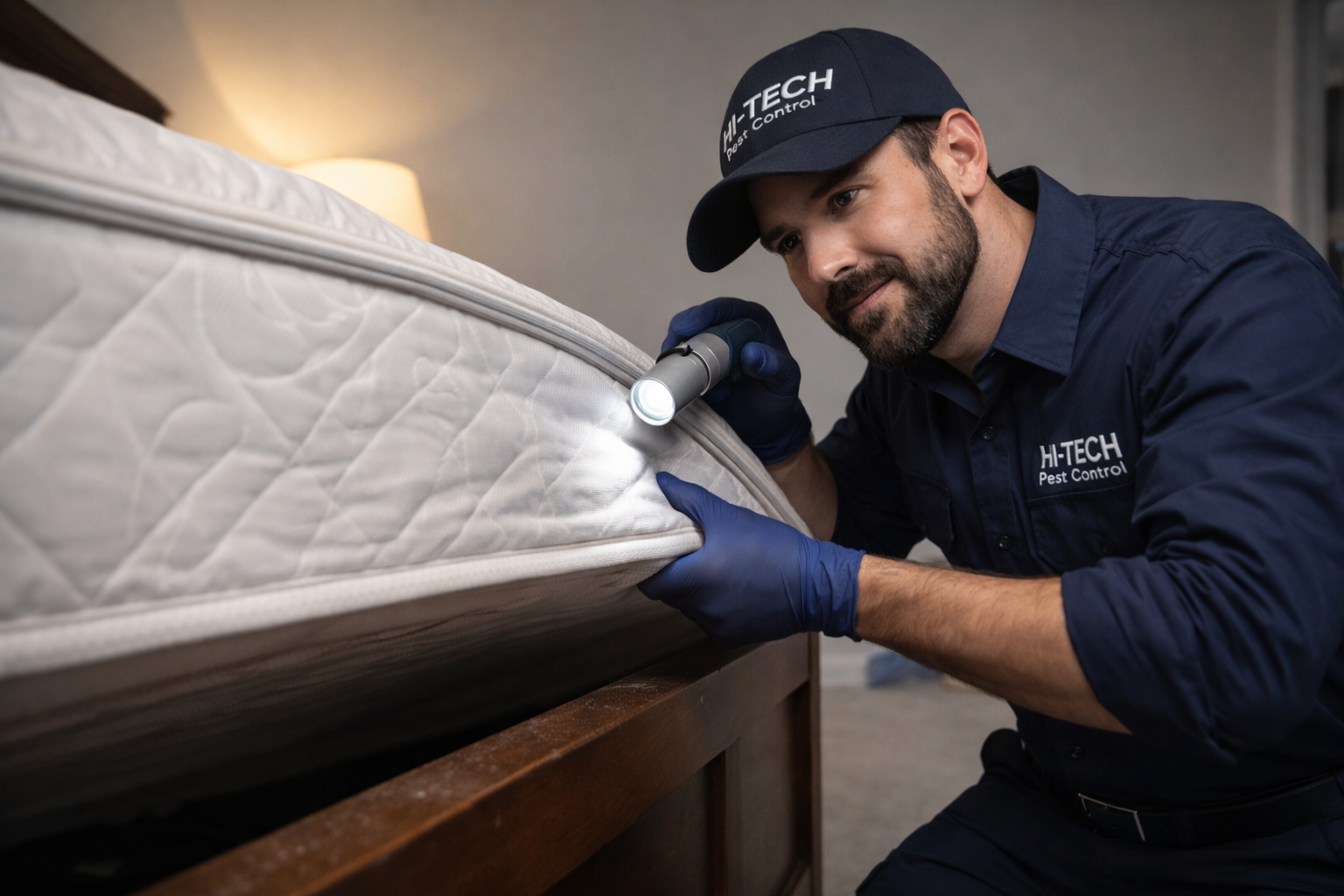
Bed bug exterminator inspection and treatment
Bed Bug Evidence Guide

The first physical evidence of bed bugs isn't a stain, a shed skin, or a black spot near an outlet. It's a bite — and it's the one piece of evidence almost everyone ignores.

After 40 years of bed bug inspections across Metro Detroit, we see the same pattern in home after home. By the time most families call us, they've spent months chasing the wrong evidence — the fecal spots, stains, and blood smears the internet tells them to hunt for. Here's the problem: those are late-stage signs. The real first sign showed up on their skin months earlier, and it was dismissed as a mosquito, a spider, or "just a rash."

This guide walks you through the actual evidence timeline — what shows up first, what shows up last, and what each stage means for your home.

The Real Bed Bug Evidence Timeline

Physical evidence doesn't appear all at once. It arrives in a predictable order, and understanding that order tells you how far along an infestation really is.

  • 1
    Months 1–2 — The Bites Everyone Ignores

    Bites are the first physical evidence — and the most ignored. Unlike other insect bites, bed bug bites carry a disturbing, persistent itch that sets them apart from a mosquito or flea bite. They typically start on the upper body and exposed skin — arms, shoulders, neck, face — the areas closest to a feeding bug while you sleep. Most people blame the dog, the yard, or laundry detergent and move on.

  • 2
    Months 2–3 — The Doctor Visit That Settles Nothing

    When the bites keep coming, many people see a doctor or dermatologist — and here's what most don't realize: bed bug bites can't be positively identified by looking at them. Bite reactions vary too much from person to person. If the bites don't get identified in 2 to 3 months, the evidence that finally settles it usually isn't medical at all. It's a sighting.

  • 3
    Months 3–4 — The First Sighting

    Around the 3-to-4-month mark, most homeowners see their first bed bug — and in most cases they immediately know exactly what it is. It happens at night: an oval-shaped, reddish-brown bug, caught while it was feeding or escaping across your pillow or bedclothes, where it's highly visible against the fabric. That single sighting is your first positive identification — not a stain, not a spot, not a trap.

  • 4
    Month 4 and Beyond — Spots, Stains & Smears (Late Stage)

    The fecal spots, stains, and blood smears everyone treats as "first signs" are actually the final stage of evidence — they appear after the population has been feeding and reproducing for months. If you're finding evidence around electrical outlets or floor moldings, the infestation has spread well beyond the bed, it's past the reproduction stage, and you're likely carrying bed bugs to other locations — work, cars, family members' homes.

If you're seeing spots and stains, you're not catching it early — you're catching it late. At that stage, every day matters. Same-day service is available.

What the Internet Gets Backwards

Search "signs of bed bugs" and nearly every article leads with fecal spotting, shed skins, and eggs. That advice isn't wrong about what the evidence is — it's wrong about when it appears.

Don't start your search here

  • Fecal spots & stains — final-stage evidence, months into an infestation
  • Blood smears on sheets — a sign of an established, feeding population
  • Shed skins & eggs — proof of reproduction cycles already completed
  • Outlets & floor moldings — if they're there, they've spread far from the bed

Start your search here

  • Bites with a disturbing itch, unlike any other insect bite
  • Upper body and exposed skin — arms, shoulders, neck, face
  • The obvious places near you — mattress seams, pillow area, headboard, box spring, the couch or recliner where someone sleeps
  • Night checks of pillows and bedclothes, where a feeding bug is highly visible

Bed bugs stay close to their food source: you. When you're trying to identify them, look in the obvious places nearby where they can feed on humans — not in the carpet, and not across the room. Curious where they go once established? Read our full guide on where bed bugs hide.

Why Most Bed Bug Traps Fail (And the $2 Fix That Works Better)

Trapping bed bugs is difficult when you don't know where they are — and the honest truth from four decades in the field is that trapping usually doesn't work. Most consumer traps simply aren't engineered around how bed bugs actually behave.

Trap Type Verdict Why
CO₂ (carbon dioxide) traps ✖ Ineffective In real-world use, they fail to outcompete the biggest CO₂ source in the room — the sleeping human a few feet away.
Moats / bed leg interceptors ✖ Ineffective They're built on a false premise. Bed bugs don't live in the carpet like fleas, and they don't roam the floors. The bugs are already on or near the bed — they aren't crossing the room to climb a bed leg.
Two-sided tape (the kind from the school-supply aisle) ✔ Your best bet Cheap, simple, and placed where the bugs actually travel — directly between them and their host.

How to place two-sided tape correctly

1

Identify the host. Place tape near the person who gets the most bites and gives off the most body heat — that's who the bugs are traveling to.

2

Cut off the routes. Apply strips between you and the bed bugs — along the mattress edge, headboard paths, and bedding routes they'd cross to feed.

3

Check it nightly. A bug on the tape is a positive identification — the confirmation traps, doctors, and stain-hunting couldn't give you.

One important note: tape confirms bed bugs — it doesn't eliminate them. If you catch one, you have a breeding population nearby, and DIY treatment at that point almost always spreads them further into walls and furniture. That's the moment to call 248-569-8001 for a free inspection.

0
Years Fighting Bed Bugs
0
Visit to Eliminate
0
Month Warranty — Michigan's Only
0
Star Rating

Bed Bug Evidence: Quick Answers

Bites. They're the first physical evidence and the most commonly ignored. Bed bug bites have a disturbing itch unlike other insect bites and usually start on the upper body and exposed skin. Fecal spots, stains, and blood smears come months later — they're final-stage evidence, not first signs.

Usually not with certainty — bite reactions look too similar to other insect bites and skin conditions to be diagnostic on their own. In most homes, the first positive identification is a sighting, which typically happens 2 to 4 months after the bites begin.

Oval-shaped and reddish-brown, most often spotted at night while it's feeding or escaping across your pillow or bedclothes, where it's highly visible. Most homeowners recognize it instantly.

In our field experience, no. CO₂ traps can't compete with the sleeping human nearby, and interceptors assume bed bugs live on the floor and climb bed legs — they don't. Bed bugs don't live in carpet like fleas. Inexpensive two-sided tape, placed between the bugs and the person getting bitten most, is more likely to confirm them.

That's late-stage evidence. It means the population is past the reproduction stage, has spread beyond the bed, and you may be carrying bed bugs to other locations. At this point, professional one-visit treatment is the fastest way to stop it. Same-day service is available — call 248-569-8001.

Stop Guessing. Get a Positive Identification Today.

Whether you're at the "mystery bites" stage or finding stains at the outlets, Hi-Tech Pest Control eliminates bed bugs in one visit — backed by Michigan's only 6-month bed bug warranty. Free inspection. Same-day service across Metro Detroit.

📞 248-569-8001
5.0★ Rated • Serving Wayne, Oakland & Macomb Counties Since 1986

Bed Bug Extermination Near You

Hi-Tech Pest Control provides one-visit bed bug elimination throughout Southeast Michigan:

Bed Bugs in Berkley Michigan — Older Homes at Risk | Hi-Tech Pest Control

Berkley bed bugs in older homes header image featuring a Hi-Tech Pest Control technician inspecting a bedroom in a historic Berkley home, highlighting hidden bed bug risks in older houses and expert local treatment services with the phone number 248-569-8001.
Bed Bugs in Berkley Michigan — What Homeowners Need to Know About Older Homes | Hi-Tech Pest Control

Bed Bug Education · Berkley Michigan

Bed Bugs in Berkley Michigan — What Homeowners Need to Know About Older Homes

Hi-Tech Pest Control · Oakland County Bed Bug Specialists Since 1986

If you own or rent a home in Berkley, Michigan, and you're dealing with bed bugs, there's something important your pest control company may not be telling you — and it has everything to do with the house you live in.

Berkley is one of the most densely built cities in Oakland County. Nearly every home in the city was constructed before 1960. Bungalows. Cape Cods. Brick colonials. Homes built with plaster and lath walls, original hardwood floors, and decades of accumulated structural gaps that standard bed bug treatments are not designed to reach.

This matters enormously when it comes to bed bug elimination — and it's the reason so many Berkley homeowners call Hi-Tech Pest Control after a treatment from another company has already failed.

The Detroit metro area ranked #3 in the nation for bed bug activity in 2025. Berkley — sitting squarely within Oakland County and bordered by Royal Oak, Ferndale, and Huntington Woods — is an active bed bug market year-round. If you're seeing bites or signs of activity, call 248-569-8001 for a free same-day inspection.

Why Berkley's Older Homes Are a Bed Bug's Best Friend

Bed bugs are extraordinarily good at hiding. In a newer home built with standard drywall construction, the hiding places are predictable — mattress seams, box springs, bed frames, baseboards. A well-trained technician following a standard protocol has a reasonable chance of finding and eliminating them.

In a Berkley bungalow or Cape Cod built in 1942, the situation is completely different.

Original plaster and lath construction creates wall cavities that are substantially larger and more interconnected than the stud bays found in modern drywall homes. The lath strips themselves — thin horizontal boards nailed across the studs before plaster was applied — create a hidden layer behind the plaster surface where bed bugs can live entirely undisturbed for months. A surface spray treatment hits the plaster. It never reaches what's behind it.

Original hardwood subfloors add another layer of complexity. The tongue-and-groove joints that give these floors their beauty and durability also create gaps at every seam — gaps that widen slightly as the wood expands and contracts over decades. Bed bugs exploit these gaps readily, moving between the floor surface and the subfloor void below.

Add decades of settling, original baseboards with accumulated gaps at the floor line, vintage built-in cabinetry, and original window casings with paint-filled crevices, and you have a home that offers bed bugs an almost unlimited number of harborage areas that a standard pest control visit will never fully address.

Where Bed Bugs Hide in Berkley's Older Homes

  • Inside plaster and lath wall cavities — behind the plaster surface
  • Hardwood subfloor gaps and tongue-and-groove seams
  • Original baseboard gaps at the floor line
  • Vintage built-in cabinetry and original shelving voids
  • Window casing crevices and original door trim gaps
  • Mattress seams, box springs, and bed frames (standard hiding spots)
  • Upholstered furniture seams and cushion voids
  • Electrical outlet boxes in older plaster walls

The Three Most Common Reasons Bed Bug Treatments Fail in Berkley

1. Surface-Only Spray Treatments

The most common treatment approach used by national chains and many local companies is a surface spray — a product applied to visible surfaces including mattress seams, baseboards, and furniture. In a newer home this approach catches a significant portion of the infestation. In a Berkley home with plaster walls and original hardwood floors, it misses the majority of the bugs hiding inside the structure itself.

Bed bugs treated with surface sprays that don't penetrate their harborage areas simply retreat deeper into wall voids and floor gaps. The resident notices fewer bites for a week or two — and then the population rebounds from the untreated eggs and hidden adults that survived the treatment.

2. Heat Treatments That Damage Original Materials

Heat treatment is heavily marketed as the premium bed bug solution. The concept is straightforward — raise the entire home's temperature to 120–140°F and kill every bed bug and egg in the structure. In a typical newer home, heat treatment has a reasonable track record.

In a Berkley home with original plaster walls and hardwood floors, heat treatment carries serious risks that most companies don't discuss upfront.

Heat treatment risks in Berkley's older homes: Temperatures of 120–140°F can crack original plaster walls, warp original hardwood floors, damage vintage trim and built-in woodwork, delaminate original cabinetry joints, destroy antique furniture adhesives, and cause permanent structural damage in homes that were built to last 100 years — and largely have. Many Berkley homeowners who choose heat treatment face repair costs that exceed the cost of the treatment itself.

3. Single-Unit Treatment in Upper/Lower Flat Conversions

A significant number of Berkley's older single-family homes were converted to upper/lower flat configurations at some point in their history — a housing type that is extremely common throughout Southeast Michigan's pre-war residential cities.

In these converted flats, original plaster walls create interconnected cavities between the upper and lower units. Bed bugs move freely through these shared wall voids — meaning a treatment of only one unit almost always fails within weeks as the untreated population in the adjacent unit repopulates the treated space.

Any bed bug treatment in a Berkley upper/lower flat should include a professional assessment of both units, regardless of which unit the complaint originates from.

Getting Bites in Your Berkley Home?

Same-day free inspections throughout Berkley zip code 48072 — 7 days a week, 8:30 AM to 10 PM. We specialize in older Oakland County residential construction.

📞 Call 248-569-8001 Schedule Free Inspection

How Bed Bugs Get Into Berkley Homes

Understanding how bed bugs enter your home is just as important as understanding how to eliminate them — because re-introduction after treatment is one of the most common reasons infestations return.

Hotel Travel

Hotel travel is the leading cause of new bed bug infestations in Berkley homes. Bed bugs are expert hitchhikers — they travel in luggage, on clothing, and in personal items from hotel rooms. This happens at every hotel price point. Five-star resorts, budget motels, extended-stay properties, and Airbnb rentals all have documented bed bug incidents. If you've traveled recently and are now experiencing bites, hotel-origin introduction is the most likely explanation.

Secondhand and Vintage Furniture

Berkley's proximity to Royal Oak's active antique and vintage market, combined with the widespread availability of secondhand furniture through Facebook Marketplace and Craigslist, makes furniture purchase one of the top three introduction sources for new bed bug cases in the city. Upholstered sofas, vintage bed frames, antique dressers, and secondhand mattresses are all high-risk items — even when they appear clean and come from a reputable-seeming seller.

Neighbors and Adjacent Units

Berkley's tight lot spacing and the prevalence of upper/lower flat conversions mean that neighbor-to-neighbor bed bug spread is a consistent introduction pathway in the city. If a neighbor — or the tenant above or below you — has an untreated infestation, bed bugs can migrate through shared wall voids into your unit without any action on your part.

Guests and Visitors

Overnight guests traveling from cities with high bed bug activity — Detroit, Chicago, New York, or any major destination city — can introduce an infestation through infested luggage or personal items. This is true even when your guest is staying in your home's cleanest and most well-maintained guest room.

What Actually Works for Bed Bug Elimination in Berkley's Older Homes

Effective bed bug treatment in Berkley's pre-1960 housing stock requires a specialist who understands the specific structural challenges these homes present — not a technician following a standard route designed for newer construction.

The approach needs to go beyond surface treatment to address the harborage areas inside plaster walls, hardwood floor voids, and structural gaps that are unique to older residential construction. It needs to eliminate all life stages — not just the visible adults and nymphs, but the eggs hidden deep inside wall cavities where no surface spray will ever reach.

And it needs to do this without damaging the original materials that make Berkley's housing stock worth living in — the hardwood floors, the plaster walls, the vintage trim and built-in cabinetry that newer construction simply doesn't replicate.

Hi-Tech Pest Control has treated Oakland County's older residential homes for over 40 years. Our professional-grade chemical approach is specifically suited to Berkley's construction — penetrating the structural harborage areas that standard treatments miss, eliminating every life stage, and protecting the original materials and finishes in your home.

Why Berkley Homeowners Choose Hi-Tech

  • 40+ years treating older Oakland County residential construction
  • One-visit elimination — bites stop the same night of treatment
  • No heat — original hardwood floors and plaster walls fully protected
  • Treatment reaches inside plaster walls and hardwood floor voids
  • Michigan's only 6-month bed bug warranty on every job
  • Free same-day inspections — no charge ever
  • Upper/lower flat assessment available — stops adjacent-unit spread

Signs of Bed Bugs in Your Berkley Home

Early detection significantly reduces the cost and complexity of elimination. In Berkley's older homes — where bed bugs can establish themselves inside wall voids quickly — catching an infestation early is especially valuable.

Common signs to watch for:

  • Bites in clusters or straight lines — typically on arms, shoulders, and legs. Bed bug bites are often mistaken for mosquito bites or allergic reactions.
  • Small blood spots on sheets or pillowcases — from bugs being crushed during sleep.
  • Dark rusty staining along mattress seams — bed bug excrement that leaves permanent dark spots on fabric surfaces.
  • Shed skins near baseboards and furniture — bed bugs shed their exoskeleton five times before reaching adulthood.
  • Live bugs in furniture seams or behind outlet covers — in older plaster-wall homes, electrical outlet boxes are a common hiding spot.
  • A faint sweet or musty odor — heavy infestations can produce a distinctive scent from the bugs' scent glands.

If you notice any of these signs — even one — call for a professional inspection immediately. In Berkley's older homes, infestations that are caught in one room are dramatically easier and less costly to eliminate than infestations that have had weeks to spread into wall voids throughout the structure.

Don't wait. Bed bugs reproduce quickly — a female lays 5–7 eggs per day. In Berkley's older homes with abundant wall void harborage space, a small infestation can become a whole-home problem within weeks. Free same-day inspections are available throughout Berkley 48072. Call 248-569-8001.

Berkley Renters — What You Need to Know

If you're renting in Berkley and you've found bed bugs, you have rights — and you have options even if your landlord is slow to respond.

Under Michigan law, landlords are generally responsible for maintaining rental properties free of pest infestations. If you report a bed bug infestation to your landlord and they fail to act promptly, you may have legal remedies available including rent withholding and repair-and-deduct options depending on your specific circumstances.

Hi-Tech Pest Control provides free inspections for Berkley renters regardless of landlord authorization. We provide written documentation of our findings — a professional inspection report that you can present to your landlord or property management company as formal notice of the infestation. This documentation creates a paper trail that is important if the situation escalates.

If you're in an upper or lower flat and you believe the infestation is coming from an adjacent unit, mention this when you call — we'll assess both units and provide documentation covering the full building situation.

Frequently Asked Questions — Bed Bugs in Berkley Michigan

How much does bed bug treatment cost in Berkley?

Bed bug treatment in Berkley ranges from $500–$900 for early-stage single-room infestations to $2,000–$4,000 for severe whole-home cases. Hi-Tech provides free same-day inspections with written quotes before any work begins. Every treatment includes Michigan's only 6-month warranty at no additional charge. Call 248-569-8001 for a free inspection.

Can I treat bed bugs myself in my Berkley home?

DIY treatments are particularly ineffective in Berkley's older homes. Store-bought sprays and foggers cannot penetrate plaster wall voids, hardwood floor gaps, or the structural harborage areas where bed bugs establish themselves in older construction. DIY approaches almost always scatter bugs deeper into the structure rather than eliminating them — and make professional treatment more difficult afterward. Professional treatment from a specialist in older construction is the only reliable approach for Berkley homes.

How fast do bed bugs spread in a Berkley bungalow?

In Berkley's older homes with extensive wall void harborage space, bed bugs can spread from the primary bedroom to adjacent rooms within one to two weeks of initial introduction. The interconnected plaster wall cavities in these homes allow bugs to move through the structure faster than in newer drywall construction. Early treatment — before bugs establish themselves inside walls throughout the home — is critical to keeping elimination costs manageable.

Will bed bugs go away on their own?

No. Bed bugs do not go away on their own. They will continue to reproduce and spread as long as a feeding host — you — is present. Every week without treatment is another week of population growth and structural spread. In Berkley's older homes where wall void harborage is abundant, waiting makes the elimination significantly more complex and costly.

Is Hi-Tech Pest Control local to Berkley?

Yes. Hi-Tech Pest Control is based in Livonia, Michigan — approximately 20 minutes from Berkley via I-696. We have served Oakland County communities including Berkley since 1986. Same-day service is available throughout Berkley zip code 48072.

Free Same-Day Bed Bug Inspection in Berkley Michigan

Hi-Tech Pest Control serves Berkley zip code 48072 — 7 days a week, 8:30 AM to 10 PM. One-visit elimination. Michigan's only 6-month warranty. Older home specialist.

📞 Call 248-569-8001 Schedule Free Inspection

How Do I Know If I Have Bed Bugs? Signs & Symptoms | Hi-Tech Pest Control

Concerned woman inspecting her mattress in a clean modern bedroom, unsure if she may have bed bugs, checking the bed closely for signs of infestation in a realistic home setting.

You woke up with red, itchy marks on your arms. Maybe you found them on your legs too. You've checked the internet, you've inspected your mattress, and now you're reading this — trying to figure out if these bites are what you think they are. The uncertainty is one of the worst parts. This guide will tell you exactly how to know whether you have bed bugs — and what to do the moment you're certain.

Bed bug identification is more complicated than most people realize. The bites themselves look similar to other insect bites. The bugs themselves are small, fast, and expert at hiding. And the early stages of an infestation can be subtle enough that even experienced homeowners miss them for weeks. By the time most people are certain they have bed bugs, the infestation has already grown beyond what they imagined.

Here is the complete, honest guide to knowing whether you have bed bugs — from the very first suspicious bite to the point where you need to call a professional.

The Bite Pattern: What Bed Bug Bites Actually Feel and Look Like

The single most reliable early indicator of a bed bug infestation is not the bugs themselves — it's the bite pattern. Bed bug bites have specific characteristics that distinguish them from other common insect bites, and understanding those differences is the first step toward a confident identification.

Bed Bug Bites Are Persistent — They Don't Go Away in a Day

This is the detail most people miss. A mosquito bite typically fades within 24 to 72 hours. A spider bite may last a few days but is almost always a single mark, in a single location, from a single incident. Bed bug bites are different. The itching is constant, the red areas or spots persist for a week or longer, and they are deeply disturbing in a way that a random insect bite is not. The inflammation from bed bug saliva — which contains anticoagulant compounds that prevent your blood from clotting while the bug feeds — produces a reaction that your body continues fighting for days after the feeding event.

If you have red, itchy marks that are still clearly visible and actively itching after 5 to 7 days, you are not dealing with a mosquito. Mosquito bites simply do not persist that long. If the marks are lasting more than a week and the itching keeps returning, bed bugs belong at the top of your list of suspects.

Multiple Bites — Not Just One

Bed bugs feed in clusters or lines. A single bed bug will typically bite multiple times during one feeding session, and multiple bugs may feed on the same person in the same night. The result is a pattern of bites — three or four in a cluster, or a line of bites across a stretch of exposed skin — rather than a single isolated mark. Spider bites are almost always solitary. Mosquito bites, while multiple, are random and scattered. A repeated pattern of clustered or linear bites on the same body areas night after night is one of the strongest indicators of bed bug activity.

Bed Bug Bites vs. Other Common Insect Bites

Use this comparison to understand how bed bug bites differ from the other common culprits that homeowners confuse them with:

Bite Type Duration Pattern Timing Key Indicator
Bed Bugs 7–14 days or longer Clusters or lines, same areas repeatedly While sleeping, consistently Persistent, recurring, progressively more bites
Mosquitoes 24–72 hours Random, scattered Outdoors, warm months Fades quickly, outdoor exposure
Spiders 2–5 days typically Single isolated bite, often two puncture marks Random, not while sleeping Almost always just one bite, not recurring
Carpet Beetle Larvae 3–7 days Scattered, often on skin that touched carpet or fabric Any time, not bite-specific Reaction to larvae hairs, not an actual bite
Fleas 2–4 days Around ankles and lower legs primarily Any time, associated with pets Pet presence, concentrated at ankle level

The Carpet Beetle Confusion — Why People Get This Wrong

Carpet beetle larvae are one of the most common misdiagnoses when homeowners think they have bed bugs. The marks left on skin by carpet beetle larvae look remarkably similar to bed bug bites — red, raised, itchy welts that can persist for several days. But understanding the difference is important because the treatment approach is completely different.

Carpet beetle reactions are not bites. Carpet beetle larvae are covered in tiny bristle-like hairs called setae. When these larvae crawl across your skin during sleep — or when you come into contact with fabric, carpet, or upholstery where they're active — those hairs cause a dermatological reaction that closely resembles an insect bite. Your skin is reacting to the larvae's hairs, not to venom or feeding behavior.

⚠️ The Critical Distinction: Carpet Beetles vs. Bed Bugs

It is genuinely rare for carpet beetle larvae to populate beds and couches in the way bed bugs do. Carpet beetle larvae primarily live in carpets, natural fiber clothing stored in drawers, wool rugs, and pantry items — not in mattresses and upholstered sleeping areas. If you are waking up with bites consistently after sleeping in your bed, you should consider bed bugs first, not carpet beetles. The consistent sleeping location, the pattern of marks on exposed skin, and the persistence of the reaction all point away from carpet beetles and toward bed bugs in the vast majority of cases where this confusion occurs.

Carpet beetle presence is confirmed by finding the larvae themselves — small, oval, bristly creatures about 1/4 inch long — or finding shed skins, damaged natural fibers, or fecal pellets in areas where natural fabrics are stored.

The Bed Bug Bite Timeline: How Long Before You're Certain?

One of the most important things to understand about bed bug infestations is how the timeline of bites maps to the growth of the infestation. This timeline is not just about your discomfort — it's a direct indicator of how established the infestation has become and how urgently you need professional help.

W1

Week 1 — First Bites: Suspicion Stage

You notice a few marks. They're itchy and persist longer than you'd expect. You're not sure — it could be mosquitoes, it could be dry skin, it could be anything. Most people dismiss the first bites entirely. The infestation is very small at this point — possibly a single pregnant female or a small cluster of bugs from a recent introduction.

W2

Week 2 — Recurring Pattern: Growing Concern

The bites are happening again. The same areas of your body. The same timing — after sleeping. You start checking your mattress. You may not find anything yet because the population is still small and the bugs are expert at hiding. At this stage, a thorough inspection by someone who knows where to look will often find evidence.

W3

Weeks 3–4 — No Question: Bed Bug Stage

The bites are consistent, persistent, and deeply uncomfortable. The pattern is clear. If you've been getting consistent bites for a month, you know with certainty that you have bed bugs in the home. At this point the infestation has grown beyond the initial introduction — eggs have hatched, nymphs have developed, and the population is expanding. You are approaching or past the infestation threshold where bugs become reliably findable on inspection.

W4+

One Month and Beyond — Find the Nest

If you have been getting bites for more than a month, the infestation is established. You should now be approaching the threshold where the bugs or their signs are locatable — either by a careful self-inspection or by a professional bed bug technician who knows exactly where to look. Do not wait longer. Every week of delay means more eggs, more spread, and a more expensive treatment.

Been Waking Up With Bites for More Than a Week?

Don't wait another night. Hi-Tech Pest Control provides free same-day inspections throughout Southeast Michigan. One call — we come to you, find every hiding spot, and give you a firm quote before we start. Michigan's only 6-month warranty on every treatment.

📞 248-569-8001

Free inspection · Same-day response · Open 7 days · 8:30 AM – 10:00 PM

Should You See a Doctor or Dermatologist?

In the early stages of a suspected infestation — particularly when you have only a few bites and aren't yet certain of the source — your doctor or dermatologist can provide a meaningful professional opinion. A doctor or dermatologist should be able to positively identify the marks as insect bites based on their appearance, distribution, and inflammatory characteristics. This is particularly useful for ruling out other skin conditions like eczema, hives, or contact dermatitis that can sometimes be mistaken for insect bites.

What a dermatologist cannot do is tell you which insect caused the bites. No physician can look at a bite mark and definitively say "that's a bed bug bite versus a mosquito bite" — the skin's reaction to various insect salivas is too similar for that level of specificity. What they can do is confirm that you are dealing with insect bites rather than a non-insect skin condition, which is genuinely useful information when you're trying to rule in or rule out a bed bug infestation.

📋 What to Tell Your Doctor

  • When the bites first appeared and how long they have been occurring
  • The pattern and location of the bites on your body
  • Whether they consistently appear after sleeping in the same location
  • Whether other household members are also experiencing bites
  • Any recent travel, hotel stays, used furniture purchases, or visiting households that may have introduced bed bugs

This information helps your doctor contextualize the marks and gives you a stronger foundation for the pest control conversation that follows.

Physical Evidence: What to Look for Beyond the Bites

Bites are the first signal. Physical evidence is the confirmation. Here is what bed bugs leave behind — and where to look for it:

Fecal Staining

Bed bugs digest blood and excrete dark, rust-colored spots that look like tiny ink dots. These stains appear on mattress seams, box spring fabric, bed frame joints, behind headboards, and along baseboards. They are one of the most reliable indicators of an active infestation. Run your finger across a suspicious dark spot — if it smears, it is likely fecal matter. If it doesn't, it's more likely a different type of stain.

Shed Skins

Bed bugs shed their exoskeleton five times as they develop from egg to adult. These shed skins — called cast skins or molts — are translucent, pale yellow, and shaped exactly like a bed bug. Finding shed skins in your mattress seams, under your box spring, or in the joints of your bed frame is definitive evidence of an active or recent infestation.

Eggs and Egg Shells

Bed bug eggs are tiny — approximately 1mm long, white, and oblong. They are almost impossible to see without looking carefully and are typically glued to surfaces in concealed locations. Empty egg shells are slightly easier to spot because of their translucent appearance. Finding eggs or egg shells means the infestation is actively reproducing.

Live Bugs

Adult bed bugs are apple-seed sized, flat when unfed and balloon-shaped after feeding, and reddish-brown in color. Nymphs are smaller and lighter in color. They are fast movers and will scatter when exposed to light. Check mattress seams, the box spring, behind the headboard, inside bed frame crevices, behind electrical outlet covers on walls adjacent to the bed, and inside any furniture upholstery seams near the sleeping area.

The Musty Sweet Odor

A well-established bed bug infestation has a distinctive odor — often described as sweet, musty, or faintly similar to coriander or almonds. This pheromone smell is most noticeable when you disturb the harborage area. If you pull back your mattress and notice an unusual sweet-musty smell you can't account for, that is a significant indicator of an active infestation.

The One-Month Rule — When You Know for Certain

There is a point in every bed bug infestation where uncertainty ends. If you have been experiencing consistent bites for more than a month, you have bed bugs. This is not maybe, this is not possibly, this is a certainty. Here is why the one-month mark is the definitive threshold:

  • No other common biting insect in Southeast Michigan will produce consistent, recurring bites in the same location every night for a month — mosquitoes are seasonal and outdoor, spiders are non-recurring, fleas concentrate at ankles
  • By the one-month mark, a bed bug infestation has gone through at least one complete hatch cycle — meaning eggs have hatched and new nymphs are feeding, significantly increasing the number of bugs present
  • At this stage the population has grown large enough that a professional bed bug technician should be able to locate the primary harborage in a thorough inspection
  • The longer you wait past the one-month mark, the more rooms the infestation spreads to and the more expensive the treatment becomes

What to Do the Moment You're Certain

Do not throw out furniture — this spreads bed bugs through hallways to neighbors without solving anything. Do not spray store-bought treatments — these kill visible adults and trigger bugs to scatter deeper into walls, making the infestation harder to treat. Do not wait for another month to pass. Call a professional bed bug exterminator with the experience and method to eliminate the infestation completely in one visit.

Why Acting Before One Month Is Always Better

The one-month mark is the certainty threshold — but the ideal time to call is earlier. A bed bug population grows exponentially. A single pregnant female introduced into your home can produce a small but confirmed infestation within 4 to 6 weeks. By the 3-month mark, that infestation can number in the hundreds. By 6 months, potentially thousands of bugs across multiple rooms.

The practical consequence of this growth curve is that early-stage infestations are simpler and less expensive to treat than established ones. If you are at week 2 with a strong suspicion — bites persisting longer than expected, a pattern forming, marks that won't go away — do not wait for absolute certainty. Schedule a free inspection now. If the technician finds nothing, you've lost nothing but an hour. If they find a small early infestation, you've caught it at the cheapest and easiest stage to eliminate.

How Did Bed Bugs Get Into Your Home?

Understanding where bed bugs come from helps contextualize your situation and prevents re-introduction after treatment. The most common sources in Southeast Michigan are:

Hotel Stays

The single most common source nationally. Bed bugs hide in hotel mattress seams, headboards, and upholstered furniture. They transfer to luggage during a single overnight stay with no visible sign. Residents near Detroit Metro Airport in Canton Township, Romulus, and western Wayne County face elevated risk from the heavy hotel traffic along the I-275 and I-94 corridors.

Used Furniture

The second most common source — and the most preventable. A used mattress, upholstered couch, or antique dresser purchased from Facebook Marketplace, an estate sale, or a secondhand store can introduce an active infestation into a previously clean home. Bed bugs can survive dormant in furniture for up to 6 months without a human host.

Neighboring Units in Apartments

In Southeast Michigan's dense apartment markets — Warren, Sterling Heights, Detroit, Westland, and Eastpointe — bed bugs spread between neighboring units through shared wall voids, electrical outlets in party walls, and plumbing penetrations. A neighbor's untreated infestation becomes your problem within weeks.

Guests and Travel Items

Out-of-town guests who stayed in infested accommodations before visiting can bring bed bugs in their luggage or clothing. Buying clothing at secondhand stores and not washing it before wearing it is a documented introduction vector.

What to Do If You Think You Have Bed Bugs — Step by Step

✅ The Right Actions in Order

  • Do not panic — bed bugs are a solvable problem with the right treatment
  • Do not throw out furniture — it spreads the infestation and costs money without helping
  • Do not spray store-bought aerosols — they scatter bugs and make professional treatment harder
  • Strip your bed and inspect mattress seams, box spring corners, and bed frame joints for fecal spots, shed skins, or live bugs
  • Check behind the headboard and along the baseboard directly behind your bed
  • Document what you find — photos help the technician assess the infestation severity
  • Read the Bed Bug Treatment Preparation Guide so you know what to expect
  • Call Hi-Tech Pest Control at 248-569-8001 for a free same-day inspection

Stop Wondering. Get a Free Same-Day Inspection.

If you've been waking up with bites for more than a week — don't wait another night. Hi-Tech Pest Control has been eliminating bed bugs in Southeast Michigan since 1986. Free inspection. One visit. Michigan's only 6-month warranty.

248-569-8001

Open 7 days · 8:30 AM – 10:00 PM · Same-day response · Free inspection · No hidden fees

CALL NOW – 248-569-8001