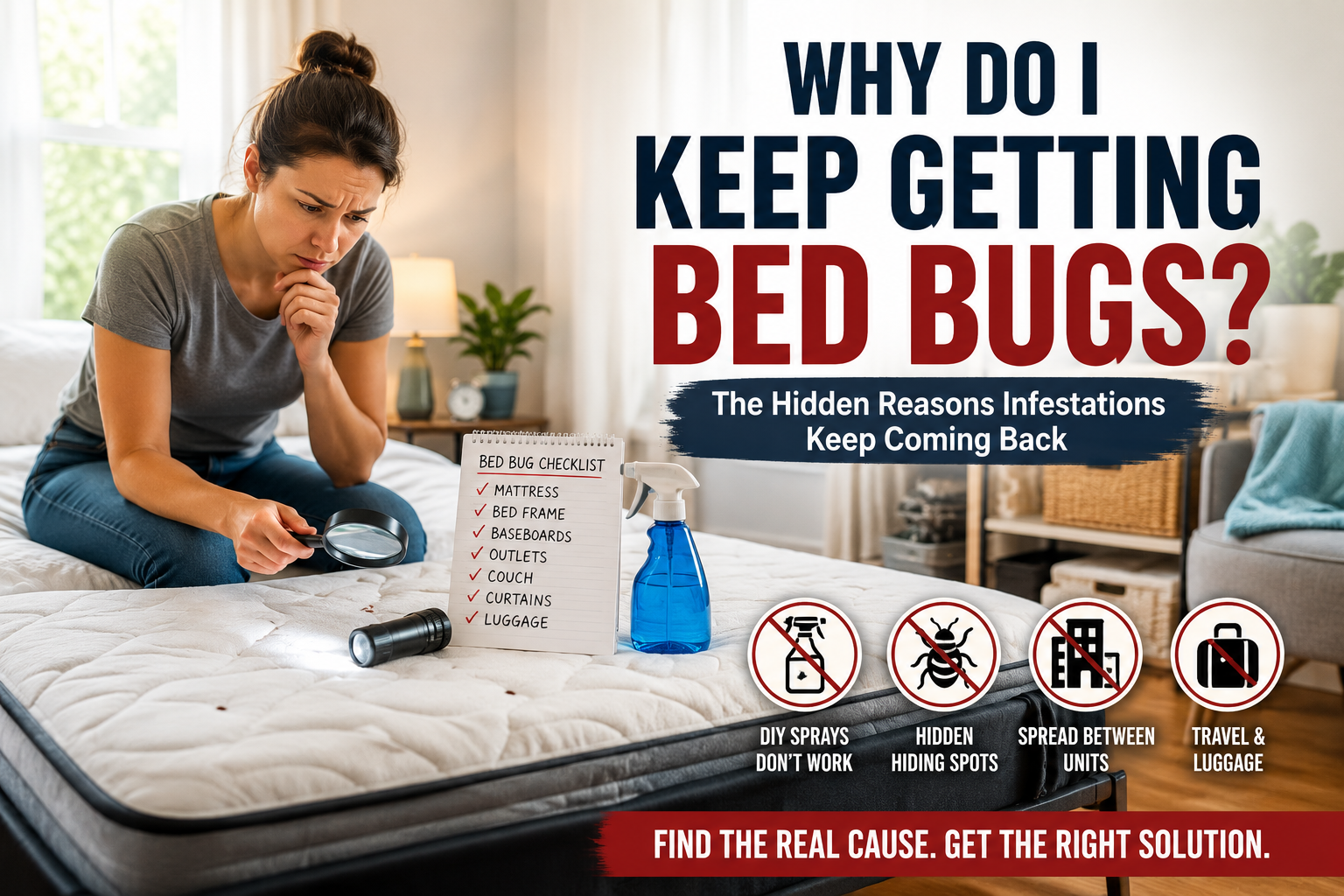
Why Do I Keep Getting Bed Bugs?

Worried homeowner inspecting mattress for recurring bed bugs in bright modern bedroom while using DIY spray products and searching for hidden bed bug infestation areas.

Bed Bug Expert Advice · Hi-Tech Pest Control · Southeast Michigan

Why Do I Keep Getting Bed Bugs After Treatment?

If you've been treated and bites came back — the infestation was never fully eliminated. Here's exactly why it happens, why it keeps happening, and what complete elimination actually requires.

40+
Years Michigan Experience
6-Mo
Michigan's Only Warranty
1
Visit — Complete Elimination
$0
Re-Inspection Fee

The Most Common Call We Receive — And What It Always Means

Over 30% of the calls Hi-Tech Pest Control receives in Southeast Michigan come from homeowners and renters who have already paid for bed bug treatment — and are still getting bitten. It is one of the most frustrating situations a person can experience, and it is also one of the most preventable.

The answer is almost always the same: the infestation was never fully eliminated. The visible bugs were reduced. Some harborages were treated. But the hidden population — deep inside furniture frames, wall voids, floor moldings, and dozens of other areas near the bed — was never located, never treated, and never stopped reproducing. The bites stopped temporarily. Then they came back.

Understanding why this happens — and why it is so much harder to get right than most people realize — is the first step toward making sure it never happens to you again.

Bites returned after treatment?

Hi-Tech Pest Control's re-inspection is free. We find what was missed — and our 6-month warranty means if bites return after our treatment, we come back at no charge. Call 248-569-8001 — same-day available.

Bed Bugs Can Survive for Months Without Feeding

This is the fact that makes throwing away furniture one of the most costly and ineffective responses to a bed bug infestation.

Bed bugs can survive 6 to 12 months without a single feeding under normal household conditions. They do not die when you remove their food source. They wait.

When you throw away a mattress, a couch, or a recliner — or when a treatment fails to eliminate the full population — the surviving bugs don't starve. They retreat into baseboards, wall voids, carpet edges, floor moldings, ceiling moldings, and structural gaps. They go dormant. And then, weeks or months later, when they detect body heat and carbon dioxide from a sleeping human, they emerge and begin feeding again.

This is why people who throw away beds and furniture are often confused when bites return 6 to 10 weeks later. The bugs were never gone. They simply had no reason to feed yet. The moment a human body is nearby and accessible, they find their way back. It is what they are built to do.

Throwing away a mattress without treating the room does not solve a bed bug infestation. It gives the bugs a reason to wait — and new furniture to repopulate when the time comes.

Why Throwing Away Furniture Makes It Worse — Not Better

This is one of the most deeply misunderstood aspects of bed bug infestations. People throw away mattresses and beds because the problem is called "bed bugs." They assume the infestation lives in the bed. It does not. The bed is simply where they feed. Everything within 5 to 8 feet of where a person sleeps is where they live.

When furniture is discarded without treating the room, the bugs that remain in the walls, carpet edges, baseboards, and structural voids — bugs that were never in the furniture at all — simply wait for new furniture to arrive. Within weeks of a new mattress or couch being brought into the home, they begin colonizing it. Bites resume. The homeowner believes they have a new infestation. In reality, the original infestation never ended.

And here is the part that rarely gets discussed: people throw away beds but almost never couches or recliners. Yet couches and recliners are just as infested — often more so — particularly when someone spends several hours a night in a recliner or on the couch. The bugs are wherever the people are. Removing one piece of furniture while leaving the others untreated accomplishes almost nothing.

What Throwing Away Furniture Does

Temporarily slows feeding — bugs still survive in walls and floors
New furniture is colonized within days to weeks of arrival
Bites return — often within a week — as bugs find new harborages
Furniture placed at curb spreads infestation to neighbors
Costs hundreds to thousands in unnecessary replacement

What Hi-Tech Treatment Does

Locates and treats every harborage — not just the visible ones
Saves furniture in virtually every home we treat
Eliminates eggs, nymphs, and adults in one visit
Bites stop the same night as treatment
Backed by Michigan's only 6-month warranty

The Real Problem in This Industry — Technician Experience

Complete bed bug elimination is the most difficult skill in pest control to learn and master. Most homeowners have no idea how high the standard actually needs to be — or how rarely it is met.

Eradicating bed bugs is the same challenge on every single job. The difficulty never changes. Whether the infestation is in a single room in a luxury hotel or a 4,000-square-foot home, the standard for complete elimination is identical: every harborage must be located, every population treated, every egg deposit reached. There are no shortcuts. There is no version of this job where doing less than the complete job produces a complete result.

And here is the uncomfortable truth: 3 to 4 months of experience treating bed bugs is one of the biggest problems in this industry. A technician who has been on the job for a few months has not seen enough infestations, enough edge cases, enough problem situations to know what to look for and how to respond when something unexpected happens. Bed bug treatment requires technicians who are intelligent, skillful, resourceful, and experienced — people who can solve problems in real time, not follow a checklist and move on.

Hi-Tech Pest Control vets every technician treating for bed bugs. The standard for who is allowed to treat is not negotiable. Some jobs take more time. Some jobs produce unforeseen complications. A seasoned technician handles those situations. An inexperienced one misses the harborages that cause the bites to return.

The proof is in the outcome — not the process. If bites returned after treatment, the job was not done correctly. It doesn't matter how many products were used or how long the technician was there. The result — bites stopping permanently — is the only measure that counts.

The Harborages Other Companies Miss — Every Time

Bed bugs are always near humans. That is not a theory — it is behavioral fact. They position themselves within feet of where a person sleeps or rests because that proximity is what allows them to feed. Just treating a bed and a chair in a bedroom is asking for trouble. The bugs in every other harborage within reach of that sleeping person are sitting there untouched, continuing to reproduce, waiting to recolonize.

These are the locations that are almost always present in every significant infestation — and the ones most commonly missed by undertrained technicians:

Box Spring Interior

The inside of a box spring is dark, warm, enclosed, and never disturbed — perfect harborage conditions. Many severe infestations are centered almost entirely inside the box spring long before spreading anywhere else. A technician who doesn't open and treat the interior is leaving the core of the infestation untouched.

Couches & Recliners

If someone is getting bitten at night and has been for months — why would the infestation only be in the bed? Couches and recliners are just as infested, often more so. The reclining mechanism alone has dozens of joints, folds, and hidden cavities. Treating the bedroom and ignoring the living room furniture is one of the most common reasons bites return.

Carpet Edges & Floor Moldings

The gap where carpet meets baseboard provides a continuous compressed channel that runs the full length of every wall in the room. Bed bugs occupy this channel throughout an established infestation. Ceiling moldings and floor moldings near sleeping areas hold populations that survive every surface treatment applied to the furniture above them.

Electrical Outlets & Wall Voids

Outlet boxes are migration pathways — particularly in apartments where wall voids connect units. Bugs pushed out of primary harborages by spray attempts or overcrowding move into outlet voids and wall cavities where no surface treatment can reach them. This population reproduces and recolonizes treated areas within weeks.

Curtains, Blinds & Window Areas

When homeowners spray alcohol or over-the-counter products near the bed, bugs scatter onto floors, curtains, blinds, and wall surfaces. These areas are rarely treated in a standard service visit — leaving a displaced population that finds its way back to furniture within days.

Headboard & Bed Frame Joints

The gap behind a wall-mounted headboard, screw holes, joint intersections, and corner mounting hardware are primary harborage points. Hollow metal tube frames harbor established populations entirely inside the tube — invisible from outside. These are present in almost every infestation and missed in almost every incomplete treatment.

Why DIY Sprays Make the Problem Significantly Worse

This is the part most people do not know until it is too late. Every repellent spray applied near a bed bug harborage creates pressure — and pressure causes bugs to scatter.

Alcohol sprays and over-the-counter insecticides kill bed bugs on direct contact. But they have no residual effect — bugs that are not directly sprayed survive. And the repellent properties of these products drive surviving bugs away from treated areas and into floors, carpets, curtains, blinds, floor moldings, ceiling moldings, and eventually wall voids.

A homeowner who has been spraying alcohol for two weeks before calling a professional has taken a contained infestation and scattered it across an entire room — or multiple rooms. What would have been a concentrated, treatable population in specific harborages has now been redistributed across dozens of hard-to-reach surfaces. The treatment scope is larger. The cost is higher. The difficulty is significantly greater.

Stop spraying before the inspection.

If you have bed bugs, do not apply any spray before Hi-Tech arrives. Every spray application makes the infestation harder to locate and treat. Call 248-569-8001 and let us assess the full scope first.

Here is something else that rarely gets discussed: if you have been getting bites for months, why would you think the infestation is only in the bed? Months of feeding means months of reproduction. A population that has been active for several months has had time to spread to every piece of upholstered furniture, every baseboard gap, and every wall void within reach. The entire affected area needs treatment — not just the mattress.

Apartment Neighbors and Visitors — The Reinfestation Source Nobody Talks About

In apartment buildings, a successfully treated unit can be reinfested within weeks if the source is a neighboring unit whose infestation remains untreated. Bed bugs travel through shared wall voids, outlet boxes mounted back-to-back in party walls, and plumbing penetrations. No amount of product applied inside your unit stops that pressure. The neighboring unit must be assessed and addressed.

But there is another reinfestation source that almost no pest control company addresses: visitors. If you have friends or family members who have bed bugs at home — and most will not tell you, or may not know themselves — every visit is a potential introduction event. Bed bugs hitchhike in clothing, bags, and purses. A guest who sits on your couch for two hours can leave behind enough bugs to start a new infestation.

If You Live in an Apartment — What to Do

If you know your neighbor has bed bugs — act immediately. Within 6 weeks of close contact, you can have a full infestation and have no idea where it came from.

Most neighbors will not tell you they have bed bugs. Watch for your own bite signs — and call for an inspection if they appear.

If you have guests — vacuum every surface they sat on when they leave. Not just the floor. The couch, the chairs, the cushions. Bed bugs on the floor are far easier to deal with than bed bugs inside furniture.

Michigan law gives renters the right to professional treatment regardless of landlord authorization. You do not need to wait for your landlord's permission to call Hi-Tech.

The uncomfortable math on visitor introduction: a neighbor or friend who sits on your couch regularly and has an active infestation can introduce enough bugs to establish a colony in your furniture within 6 weeks. You won't see them. You will start getting bitten. And you will have no idea it was the couch — because everyone always assumes it's the bed.

The Proof That Shortcuts Don't Work

The standard for complete bed bug elimination is the same whether the infestation is in a single hotel room or a five-bedroom home. The size of the space does not change the standard — it changes the time required.

Here is a simple truth about bed bug treatment that the industry rarely acknowledges: if you do a poor job on a small infestation, the survivors will reinfest the same heavily treated areas. Surviving bugs — even a handful of females with viable eggs — will repopulate an entire room. Reproduction starts over. Within weeks, bites resume. The treatment appears to have failed. In reality, it was never complete.

It does not matter if the infestation is in a one-bedroom apartment in Hazel Park or a hotel suite. The standard of thoroughness required to produce complete elimination is the same. There is no version of this job where cutting corners produces a lasting result. The bugs that survive will always find the nearest human — and they will always repopulate.

Incomplete Treatment — What Happens

Bites slow or stop temporarily. Surviving bugs retreat. 1–3 weeks later, eggs hatch. Bugs that were dormant in walls begin feeding again. Bites return — often worse than before. The homeowner calls a second company. The cycle continues.

Complete Treatment — What Happens

Every harborage is located. Every population is treated. Bites stop the same night as treatment. No survivors to repopulate. No recurring cycle. The 6-month warranty backs the result — if bites return, Hi-Tech returns at no charge.

Treated Twice and Still Getting Bitten?

Hi-Tech finds what others miss. Same-day inspections available throughout Southeast Michigan. Free re-inspection — no charge to assess what was left behind.

What a Complete Bed Bug Treatment Actually Covers

Hi-Tech Pest Control has eliminated bed bugs in Southeast Michigan since 1986. In that time, we have treated infestations in homes, apartments, hotels, nursing facilities, and commercial properties across Wayne, Oakland, and Macomb counties. The standard has never changed. Every job requires the same thoroughness. Every harborage must be found and treated before the job is done.

Here is what a complete treatment covers — the full list that most companies don't get to:

✓  Mattress seams and piping
✓  Box spring interior and frame
✓  Headboard and gap behind it
✓  Bed frame joints and screw holes
✓  Couch and sectional seams
✓  Recliner mechanism and frame
✓  Nightstands and dresser joints
✓  Carpet edges and tack strips
✓  Baseboard and floor molding gaps
✓  Ceiling molding near sleeping areas
✓  Electrical outlets and switch plates
✓  Wall voids and structural gaps
✓  Picture frames and wall décor
✓  Electronics near the bed
✓  Curtains, blinds, and window areas
✓  Apartment neighboring unit spread

The 6-month warranty is the proof. No other bed bug exterminator in Michigan offers it — because no other company is confident enough in their thoroughness to back it up. If bites return within 6 months of Hi-Tech treatment, we return at no charge.

Common Questions — Recurring Bed Bug Infestations

How quickly can bed bugs come back after treatment?

Bites can return within 7 to 14 days after an incomplete treatment as eggs in protected harborages hatch. Bugs that survived in wall voids, furniture interiors, or floor moldings begin feeding within days of hatching. In cases where furniture was discarded without room treatment, bites often return within 2 to 4 weeks as the surviving population relocates to new furniture.

Why did I stop getting bitten for 3 weeks and then start again?

This is the classic sign of incomplete treatment or discarded furniture without eradication. Surviving bugs retreat when their primary harborages are disturbed. They can wait weeks — sometimes months — before the population rebuilds enough to resume consistent feeding. The 3-week pause is not recovery. It is dormancy. The infestation never ended.

I threw away my mattress and still have bites. Why?

Because the infestation was never only in the mattress. Bed bugs live within 5 to 8 feet of where you sleep — in the box spring, bed frame, baseboards, carpet edges, and wall voids. Removing the mattress does not remove those harborages. The surviving population has now colonized new areas — or is waiting to colonize your new mattress.

Can I get bed bugs from someone who visits my home?

Yes. Visitors who have bed bugs at home can introduce them through clothing, bags, and personal items. After guests leave, vacuum every surface they sat on — couches, chairs, cushions — not just the floor. Bed bugs on the floor are far easier to deal with than bed bugs inside upholstered furniture. This is especially important if you live in an apartment building with known infestation activity nearby.

Why does Hi-Tech's treatment work when others failed?

Because we locate every harborage before we treat — not just the obvious ones. Our technicians are experienced, vetted, and held to a standard of complete elimination. We do not consider a job done until bites stop permanently. And our 6-month warranty means that if we miss anything, we come back at no charge. That accountability is what produces a different result.

Is Hi-Tech's re-inspection really free if I was treated by another company?

Yes. If you were treated by another company and are still getting bitten, Hi-Tech's inspection is free regardless. We assess what was left behind, identify the surviving harborages, and provide a full scope recommendation before any treatment cost is discussed. Call 248-569-8001 — same-day inspection available throughout Southeast Michigan.

Wayne · Oakland · Macomb County · Same-Day Service

Still Getting Bitten?
The Infestation Is Still There.

Free re-inspection. One complete visit. Michigan's only 6-month warranty.

7 days a week · 8:30 AM–10 PM · Locally owned since 1986

Should I Throw Away My Mattress If I Have Bed Bugs?

Bed Bug Expert Advice · Hi-Tech Pest Control

Should I Throw Away My Mattress If I Have Bed Bugs?

Before you drag anything to the curb — read this. Throwing away your mattress is almost always the wrong move, and it can make your infestation significantly worse.

It's one of the first things people do when they discover bed bugs — strip the mattress, drag it outside, and assume the problem is solved. It feels like the right move. The bugs are called bed bugs, after all. Get rid of the bed, get rid of the bugs.

But this is one of the most expensive mistakes a homeowner can make — and Hi-Tech Pest Control technicians see it happen every season across Southeast Michigan. Not only does throwing away your mattress almost never solve a bed bug infestation, it can actively make it worse. Here's everything you need to know before you touch a single piece of furniture.

Stop — Don't move anything yet.

Moving infested furniture through your home spreads bed bugs to rooms that weren't affected. Call Hi-Tech at 248-569-8001 for a free same-day inspection before you move, bag, or discard anything.

The Technician Needs to See the Infestation First

When a Hi-Tech technician arrives at your home, the first thing they do is a full inspection — and what they find on and around your mattress tells them everything. The mattress is evidence. It shows the stage of the infestation, how long it has been active, how severe it is, and where the colony is concentrated.

Bed bug infestations have distinct stages:

  • Early stage — small number of adults, few eggs, limited spread. Easiest and least expensive to treat.
  • Moderate stage — established colony, eggs present in seams and tufts, beginning to spread to nearby furniture.
  • Advanced stage — large colony, multiple harborage sites throughout the room, possibly spread to adjacent rooms.

If you throw away the mattress before the technician arrives, you've eliminated the primary piece of evidence. The technician can no longer accurately assess the stage, the severity, or the concentration of the infestation. That makes treatment harder, not easier — and it doesn't remove a single bed bug from your home.

The question the technician is trying to answer: Where are they? How many? How long have they been here? Throwing away the mattress before inspection removes the clearest answer to all three questions.

Are You Throwing Away the Bed to Sleep — or Because You Think the Bugs Will Leave With It?

This is the question Hi-Tech technicians ask homeowners who have already discarded their mattress. The answer is almost always the same: "I thought if I got rid of the mattress, I'd get rid of the bed bugs."

That's not how bed bugs work. Bed bugs don't live exclusively in mattresses — they live anywhere within 5 to 8 feet of where you sleep. They hide in:

The Bed Frame

Joints, screw holes, and hollow legs of bed frames are prime harborage sites — often more heavily infested than the mattress itself.

Baseboards & Outlets

Bed bugs travel along baseboards and nest behind electrical outlet covers within feet of the bed.

Wall Voids

In established infestations, bed bugs move inside walls and travel to adjacent rooms — completely unaffected by what you do to the mattress.

Nightstands & Dressers

Any furniture within reach of where you sleep is a potential harborage site — drawers, joints, and the undersides of nightstands.

Box Springs

The fabric lining and internal frame of a box spring often harbors more bed bugs than the mattress above it.

Carpet & Flooring

Bed bugs hide along carpet edges, under rugs, and beneath flooring gaps — especially near the bed and along travel routes.

Removing the mattress removes one harborage site while leaving dozens of others completely untouched. The colony continues. The bites continue. And now you've spent hundreds of dollars on a new mattress that will be infested within days — because the source was never treated.

What About the Couch? The Recliner? The Dining Room Chairs?

People call them bed bugs — so everyone focuses on the bed. But bed bugs go where the people are, not just where they sleep. If someone spends several hours a night on the couch, the recliner, or a favorite chair, those pieces of furniture become just as infested as the mattress — sometimes more so.

Hi-Tech technicians regularly find heavier bed bug activity in living room furniture than in the bedroom — particularly in homes where someone sleeps on the couch or spends significant time in a recliner. The bugs follow the host.

The Furniture That Gets Overlooked — And Shouldn't

Sofas & Sectionals

Sectional sofas are among the most difficult furniture to treat because of the number of joints, cushion seams, and hidden cavities. Each section connection point is a prime harborage area. A heavily infested sectional takes more treatment time than a mattress — but Hi-Tech treats and saves it in one visit.

Sleeper Sofas

Sleeper sofas have a folding metal frame mechanism inside — a perfect harborage structure with dozens of joints, springs, and hidden recesses. These require specific treatment attention and are one of the most commonly missed infestation sites in DIY attempts.

Recliners

The reclining mechanism, arm joints, and thick cushion seams of a recliner create dozens of harborage points. Someone who spends several hours nightly in a recliner is feeding the colony there just as much as in a bed.

Dining Room Chairs

Upholstered dining chairs with fabric undersides, padded seats, and joint connections are a frequently overlooked spread point — especially in open floor plans where the dining area is close to the living room.

If you throw away the mattress and replace it — but the couch, the recliner, and the chairs remain untreated — you will have bites again within days. The infestation was never in just one place.

Are You Throwing It Away Because of the Stains?

This is something Hi-Tech technicians hear more often than you might expect — and it's completely understandable. Bed bug infestations leave visible evidence on mattresses: small rust-colored blood spots from crushed bugs, and dark brown or black fecal stains around seams and tufts. They're unsightly, and many homeowners feel embarrassed by them.

You don't need to throw away the mattress because of the stains. Hi-Tech cleans the mattress as part of the treatment process. After treatment, a quality mattress encasement covers the entire mattress surface — and it will look completely clean and brand new. The encasement also provides ongoing protection, trapping any remaining eggs until they die and preventing re-infestation of the mattress surface.

Hi-Tech cleans the mattress. You keep it. It looks brand new.

Treatment + cleaning + encasement = a mattress that shows no evidence of infestation and is fully protected going forward. No need to spend $800–$2,000 on a replacement that will be re-infested within days if the source isn't treated.

Hi-Tech Treats Everything the Same Day — You Keep 100% of Your Furniture

This is where Hi-Tech is different from the approach that leads homeowners to throw away furniture in the first place. Some pest control companies require multiple visits over weeks or months — and during that waiting period, homeowners feel like they have to do something. They throw away the mattress. Then the couch. Then the recliner. By the time treatment is complete, they've discarded thousands of dollars of furniture that could have been saved.

Hi-Tech eliminates the infestation in a single visit — the same day you call. Every piece of furniture is treated: the mattress, the box spring, the bed frame, the couch, the sectional, the recliner, the chairs. Everything is cleaned. Everything is treated. You keep all of it.

Without Professional Help

  • Throw away mattress — $800–$2,000 to replace
  • Throw away couch — $1,000–$4,000 to replace
  • Throw away recliner — $500–$2,000 to replace
  • Bugs return — infestation was never treated
  • New furniture re-infested within days
  • Months of bites, lost sleep, and stress

With Hi-Tech Same-Day Treatment

  • Keep the mattress — cleaned and encased
  • Keep the couch — treated completely
  • Keep the recliner — treated same visit
  • Colony eliminated in one visit
  • Bites stop the same night
  • 6-month warranty — we come back free if needed

When Is Throwing Away Furniture Actually Acceptable?

There is one situation where discarding a mattress or piece of furniture makes sense: when you are attempting to treat yourself without professional help, and the furniture is so heavily infested or structurally damaged that it cannot realistically be treated effectively with consumer-grade products.

Even then — if you choose to discard infested furniture, it must be done carefully. Dragging an infested mattress through your home drops bed bugs and eggs on every surface it passes. The mattress should be bagged completely before it is moved, and clearly labeled as infested so no one else picks it up and brings the infestation into their own home.

But understand this: discarding furniture is a cost-management decision for DIY treatment — not a treatment strategy. Throwing away furniture without treating the room, the remaining furniture, and the harborage sites accomplishes nothing except an expensive replacement.

Michigan's Only 6-Month Bed Bug Warranty

Hi-Tech Pest Control is the only bed bug exterminator in Michigan offering a 6-month warranty. If bed bugs return within 6 months of treatment, we come back and retreat at absolutely no charge. No other company in Southeast Michigan offers this guarantee — because no other company is confident enough in their single-visit elimination to back it up.

That warranty covers your mattress, your furniture, your entire home. You don't need to throw anything away to be protected.

Frequently Asked Questions

Do bed bug sniffing dogs help find infestations?

Bed bug detection dogs can locate infestations by scent — including hidden colonies inside walls and furniture that aren't visually obvious. They can be useful for confirming suspected infestations in hard-to-inspect areas. However, a thorough visual inspection by an experienced technician covers the most common harborage sites effectively. Hi-Tech's 40+ years of Southeast Michigan experience means our technicians know exactly where to look — and they find infestations other companies miss every day.

Will Hi-Tech treat the same day I call?

Yes. Hi-Tech offers same-day inspections and same-day treatment throughout Southeast Michigan. We answer 7 days a week from 8:30 AM to 10:00 PM — including weekends. If you call in the morning, we can inspect and treat that afternoon. Bites stop the same night as treatment in virtually every case.

How much does bed bug treatment cost in Michigan?

Hi-Tech bed bug treatment in Southeast Michigan costs $500–$900 for early-stage infestations in 1 room, $900–$2,000 for moderate infestations across 2–3 rooms, and $2,000–$4,000 for severe whole-home infestations. Apartment units start at $275–$375. All pricing includes the free inspection, same-day treatment, furniture cleaning, and Michigan's only 6-month warranty. One professional treatment costs far less than replacing the furniture you'd throw away trying to handle it yourself.

Do I need to do anything to prepare before Hi-Tech arrives?

Do not move furniture, bag items, or throw anything away before the inspection. Leave everything in place so the technician can assess the full scope of the infestation accurately. Hi-Tech will give you specific preparation instructions after the inspection and before treatment begins.

Wayne · Oakland · Macomb County · Same-Day Service

Don't Throw Away Your Furniture.
Call Hi-Tech — We Save It.

Same-day inspection and treatment. Michigan's only 6-month warranty. Free inspection — no hidden fees.

7 days a week  ·  8:30 AM–10 PM  ·  Locally owned since 1986

Southfield Bed Bug Signs

Signs of a Bed Bug Infestation in Southfield Michigan | Hi-Tech Pest Control
🐛 Bed Bugs in Southfield?   Call 248-569-8001 — Free Same-Day Inspection
Bed Bug Signs · Southfield, Michigan

7 Signs of a Bed Bug Infestation
in Your Southfield Michigan Home

Most Southfield homeowners miss the early warning signs until the infestation is already large and expensive to treat. Here's exactly what to look for — right now.

📍 Southfield, Michigan ✍️ Hi-Tech Pest Control 📅 May 2026 ⏱ 6 min read
📞 Call 248-569-8001 — Same Day Free Inspection Request

Bed bugs are expert hiders. They feed at night, retreat before dawn, and spend 90% of their lives hidden in cracks and seams you'd never think to check. By the time most Southfield Michigan homeowners are sure they have bed bugs, the infestation has been active for weeks — sometimes months.

The key to keeping treatment costs low is catching it early. Here are the 7 signs to look for — starting with the ones most commonly missed.

⚠️ Southfield-specific risk: Southfield's high concentration of apartment complexes, hotels, and multi-family housing along the M-10 and I-696 corridors means bed bugs travel frequently between units. Early detection is critical — especially if you've had overnight guests or recently traveled.

#1 Dark Fecal Spots on Mattress Seams

Bed bug fecal spots on mattress seam — dark brown dots indicating active bed bug infestation Southfield Michigan
Dark fecal spots along a mattress seam — one of the earliest and most reliable signs of bed bugs. Replace the image src with your uploaded photo URL.

This is the #1 sign that Southfield homeowners find first — and most don't know what it means. Tiny dark brown or black dots along your mattress seams, on your sheets, behind your headboard, or along your baseboards.

Each dot is about the size of a period at the end of a sentence. They are bed bug fecal matter — digested blood — and they smear when wet. A cluster of these spots in one location means bed bugs are actively feeding nearby. The more spots you find, the larger and more established the infestation.

💡 Check these spots first: All four mattress seams, the tags on each corner, the box spring underside, and the headboard backside facing the wall.

#2 Shed Skins in Hiding Spots

Shed bed bug skins exuviae found in mattress seam — sign of growing bed bug colony Southfield Michigan
Translucent shed bed bug skins (exuviae) found in a mattress fold. Each skin represents a nymph that has grown and molted. Multiple skins mean an established, growing colony.

Bed bugs shed their skin five times as they grow from egg to adult. Each shed skin is left behind in the same hiding spot — a translucent, hollow shell in the exact shape of a bed bug.

Finding shed skins is serious. It means the infestation has been active long enough for bugs to complete multiple growth cycles. One or two skins means a recent infestation. Dozens of skins means the colony has been established for weeks or months and has grown significantly.

⚠️ Where to look: In mattress seams, inside box spring folds, along bed frame joints, inside nightstand drawers, and behind electrical outlet covers.
Finding These Signs? Call 248-569-8001 — Free Same-Day Inspection in Southfield

#3 Rust-Colored Blood Stains on Sheets

Rust colored blood stains on bed sheets from bed bug feeding — sign of bed bug infestation Southfield Michigan
Small rust-colored smear marks on sheets or pillowcases — caused by rolling onto a feeding bed bug or blood smearing after a bite. Almost certain confirmation of bed bugs.

Small rust-colored or reddish-brown smear marks on your sheets, pillowcases, or mattress cover. These appear when you roll over onto a feeding bed bug and crush it — or when blood smears from a bite site during sleep.

This sign is one of the most definitive confirmations of an active infestation. Unlike fecal spots, which could theoretically be mistaken for something else, blood smears on bedding combined with other signs leave little doubt.

#4 Live Bugs in Seams and Cracks

Seeing a live bed bug is the most obvious confirmation — but most Southfield homeowners never actually see one because bed bugs are nocturnal and move quickly to hiding spots at the first sign of light or disturbance.

If you do spot a live bug, it will be flat and oval — about the size of an apple seed — reddish-brown if unfed, dark red and swollen if recently fed. It moves slowly and deliberately. It will be near the mattress, bed frame, or furniture close to where you sleep.

⚠️ Don't crush it — capture it. Place it in a sealed plastic bag or container and photograph it. Call Hi-Tech at 248-569-8001 — we confirm identification before any treatment begins.
4–8 Weeks
How long most Southfield homeowners have bed bugs before noticing any signs. By then the colony is already well established.

#5 Tiny White Eggs in Fabric Folds

Bed bug eggs are about 1mm long — roughly the size of a grain of sand — pearl-white and oval. They are glued to surfaces in clusters with a sticky secretion, making them nearly impossible to remove or spot without looking very carefully.

Most Southfield homeowners never find eggs because they require very close inspection of mattress seams, box spring folds, and furniture joints with a flashlight. An eye-spot is visible on eggs more than 5 days old. Finding egg clusters means active breeding is underway and the population is growing rapidly.

💡 Use a flashlight and magnifying glass to inspect mattress seams and box spring folds. Eggs are almost always in the deepest, darkest fold you can find.

#6 Unexplained Bite Marks on Skin

Bed bug bite marks on arm in line pattern — red raised welts from bed bug feeding Southfield Michigan
Bed bug bites appearing in a line or cluster pattern on the arm. Bites are small, red, raised welts that are intensely itchy — but 30% of people show no visible reaction at all.

Waking up with small, red, itchy welts on your arms, shoulders, neck, or face that weren't there when you went to bed. Bed bug bites often appear in a line or cluster — called the "breakfast, lunch, and dinner" pattern — because a single bug feeds multiple times along exposed skin.

However, bites alone are not a reliable confirmation. About 30% of people show no visible reaction. Mosquito bites, flea bites, and allergic reactions can all look identical. Always combine bite observations with a physical inspection for fecal spots, shed skins, and blood stains.

#7 Musty Sweet Odor in the Bedroom

Large bed bug infestations emit a distinctive sweet, musty odor — often described as overripe raspberries, almonds, or coriander. This smell comes from pheromones released by aggregating colonies.

This sign only becomes detectable when the infestation is significant — hundreds or thousands of bugs present. If your bedroom has an unexplained sweet musty smell that gets stronger near the mattress or furniture, treat it as a serious warning sign and call Hi-Tech immediately.

⚠️ If you can smell it, the infestation is large. A detectable odor means hundreds of bugs are present. Do not delay — call 248-569-8001 for same-day elimination.

Where to Inspect Your Southfield Home Right Now

🛏️ Bedroom — Check First

  • All four mattress seams and tags
  • Box spring underside fabric
  • All bed frame joints and screw holes
  • Headboard — front and back
  • Nightstand drawers and undersides
  • Electrical outlets near the bed
  • Baseboards along bedroom walls

🛋️ Living Areas — Check Second

  • All couch and recliner seams
  • Under sofa cushions and in folds
  • Curtain folds near sleeping areas
  • Inside dresser drawers and joints
  • Closet shelving and clothing
  • Behind wall art near the bed
  • Inside alarm clocks and electronics near bed
📞 Found Any of These Signs? Call 248-569-8001 — Same-Day Elimination in Southfield
🏢

Hi-Tech Pest Control — Serving Southfield, Michigan Since 1986

Oakland County's most experienced bed bug specialists. 40+ years eliminating bed bug infestations in one visit. Free same-day inspections, no hidden fees, BBB Accredited. Open 7 days a week 8:30 AM to 10 PM. Learn about Hi-Tech →

Frequently Asked Questions

Bed bug sign questions from Southfield Michigan homeowners

What are the first signs of bed bugs in a Southfield Michigan home?

The earliest signs are tiny dark fecal spots on mattress seams and unexplained itchy welts on exposed skin when you wake up. A faint musty sweet odor in the bedroom may also appear before you ever see a live bug.

What do bed bug fecal spots look like?

Tiny dark brown or black dots — about the size of a period — appearing in clusters along mattress seams, on sheets, behind headboards, and along baseboards. They smear when wet. Multiple spots in one area confirms active infestation.

Can you have bed bugs without seeing them?

Yes — absolutely. Bed bugs are nocturnal and expert hiders. Most Southfield homeowners never see a live bug even with an established infestation. Look for fecal spots, shed skins, blood stains, and eggs instead.

What do shed bed bug skins look like?

Translucent, hollow shells — the exact shape of a bed bug but empty and pale tan. Found in mattress seams, box spring folds, and furniture crevices. Multiple skins mean an active, growing colony.

Do bed bug bites always itch?

No — about 30% of people show no visible reaction at all. Others experience intense itching beginning 24–72 hours after the bite. Never rely on bites alone to confirm or rule out bed bugs.

What does a bed bug smell like?

Large infestations emit a musty sweet odor — often described as overripe raspberries or almonds. This only becomes detectable when hundreds of bugs are present. If you can smell it, call immediately.

How long does it take to notice a bed bug infestation?

Most Southfield homeowners don't notice for 4–8 weeks after the infestation begins. Bed bugs are nocturnal and secretive. By the time visible signs appear, the colony is already well established.

Who is the best bed bug exterminator in Southfield Michigan?

Hi-Tech Pest Control — serving Oakland County and Southeast Michigan since 1986. Free same-day inspections, complete colony elimination in one visit. Call 248-569-8001.

Found a Sign? Don't Wait — The Colony Is Growing Right Now

Every day you wait, more eggs hatch and the infestation spreads further. Hi-Tech Pest Control eliminates the entire colony in one visit — free inspection, same day, in Southfield and all of Southeast Michigan.

📞 248-569-8001 Call Now — Same-Day Service Request Free Inspection Online

Open 7 days a week · 8:30 AM – 10:00 PM · Free inspection · No hidden fees · BBB Accredited · Since 1986

Hi-Tech Pest Control · 39111 6 Mile Rd., Livonia, MI 48152 · Serving Oakland County since 1986

Farmington Hills Mice Prevention

How to Prevent Mice in Your Farmington Hills Michigan Home | Hi-Tech Pest Control
🐭 Mice in Farmington Hills?   Call 248-569-8001 — Free Same-Day Inspection
Mice Prevention · Farmington Hills, Michigan

How to Prevent Mice
in Your Farmington Hills Michigan Home

A mouse can squeeze through a gap the size of a dime. Every fall, Farmington Hills homes have dozens of these gaps. Here are the 5 steps that actually keep mice out.

📍 Farmington Hills, Michigan ✍️ Hi-Tech Pest Control 📅 May 2026 ⏱ 6 min read
📞 Call 248-569-8001 — Same Day Free Inspection Request

Every fall, Farmington Hills homeowners face the same problem — mice looking for warmth as Michigan temperatures drop. And every fall, thousands of mice find their way inside because the gaps they use to enter are so small most homeowners never notice them.

A mouse can fit through a hole the size of a dime. A gap around a utility pipe, a crack in the foundation from last winter's freeze-thaw cycle, the space under a garage door that doesn't quite seal — these are the entry points that put mice inside warm Farmington Hills homes every October.

⚠️ Act before October. Prevention steps completed in September — before the cold weather migration begins — are 10x more effective than trying to deal with an established infestation in December. Two mice become 1,500 in a year inside a heated Michigan home.

#1 Seal Every Entry Point Before October

Mouse entry point gap in foundation being sealed with steel wool and caulk — mice prevention Farmington Hills Michigan
Gaps around utility pipes and foundation cracks are the most common mouse entry points in Farmington Hills homes. Steel wool combined with caulk is the most effective seal — mice cannot chew through steel wool.

This is the single most important step — and the one most homeowners skip because entry points are hard to find. Walk the complete perimeter of your home at ground level and check every one of these locations.

🏗️ Foundation Cracks

Farmington Hills' freeze-thaw cycles create new foundation cracks every winter. Any crack wider than 6mm is a mouse entry point. Seal with concrete patch or expanding foam.

🔧 Utility Pipe Gaps

Gaps around gas lines, water pipes, electrical conduit, and HVAC lines where they enter the foundation. Often left unsealed by builders. Pack with steel wool then seal with caulk.

🚪 Door Weatherstripping

Worn or missing weatherstripping on exterior doors — especially garage entry doors — leaves gaps mice use nightly. Replace any stripping that doesn't form a complete seal.

🏠 Siding Gaps

Where siding meets the foundation, window frames, or corners of the home. Common in Farmington Hills homes built in the 1970s-90s. Seal with exterior-grade caulk.

🌬️ Dryer & HVAC Vents

Exterior dryer vents and HVAC exhaust openings without proper screens. Install fine-mesh screens on all exterior vents — mice will use any unscreened opening.

🌳 Where Deck Meets House

The gap between deck framing and the home's exterior wall is a common and overlooked entry point. Check and seal where deck ledger boards attach to the house foundation.

💡 Best sealing material: Steel wool packed into the gap first, then covered with exterior caulk or expanding foam. Mice cannot chew through steel wool. Foam alone is ineffective — mice chew right through it.
Already Have Mice? Call 248-569-8001 — Eliminate First, Then Seal

#2 Eliminate All Food Sources and Attractants

Properly sealed food storage containers preventing mice in kitchen pantry — mice prevention Farmington Hills Michigan
Sealed hard-sided food containers eliminate one of the primary reasons mice establish permanent colonies inside Farmington Hills homes. Cardboard and thin plastic bags offer no protection against mice.

Mice enter Farmington Hills homes primarily for warmth — but they stay because of food. Once a mouse finds reliable food sources inside your home, it establishes a permanent colony and brings others. Eliminating food access makes your home significantly less hospitable.

  • Store all pantry items in hard-sided sealed containers — cardboard boxes and thin plastic bags offer no protection
  • Don't leave pet food out overnight — store in sealed metal or hard plastic containers
  • Clean under appliances monthly — crumbs under the stove and refrigerator are a primary food source
  • Empty kitchen trash cans every night — or use trash cans with tight-fitting lids
  • Keep garage trash cans sealed — outdoor food waste near the home draws mice to your property first
  • Clean up fallen fruit, bird seed, and compost near the home — outdoor food sources attract mice to your yard before they find their way inside
  • Don't store grass seed, birdseed, or fertilizer in open bags in the garage
6mm
The size of gap a mouse needs to enter your Farmington Hills home — the width of a pencil. Most homes have dozens of gaps this size or larger.

#3 Protect Your Garage — The #1 Entry Point in Farmington Hills

Garage door bottom seal gap — common mouse entry point in Farmington Hills Michigan homes
The gap under a garage door is one of the most common mouse entry points in Farmington Hills homes. A worn or improperly fitted door seal leaves a gap large enough for mice to enter nightly.

In Farmington Hills attached-garage homes, the garage is where the vast majority of mice enter first — then migrate into the living areas through the interior wall. Most homeowners never connect the garage to the kitchen mouse problem because the path isn't obvious.

  • Replace worn garage door bottom seals — the rubber sweep should form a complete contact with the floor with no gaps
  • Install a door sweep on the interior door between garage and living area
  • Seal all gaps around the interior garage wall where pipes, wires, and HVAC ducts pass through
  • Don't store dog food, bird seed, or grass seed in open bags in the garage
  • Keep the garage clean and clutter-free — piles of boxes, stored furniture, and debris create ideal nesting conditions
  • Check the gap where the garage door track meets the wall at the top corners — mice use this regularly
⚠️ Farmington Hills homeowners: If you have an attached garage and mice in the kitchen, the mice are almost certainly entering through the garage first — not directly through the home exterior. Treat the garage as the primary entry zone.

#4 Fix Landscaping That Invites Mice In

Most Farmington Hills homeowners don't think of landscaping as a mice problem — but the area immediately surrounding your home is where mice live before they come inside. Certain landscaping choices make it dramatically easier for mice to reach your home's entry points undetected.

  • Keep mulch beds at least 12 inches away from the foundation — mulch is warm and provides ideal mouse nesting conditions directly against your home
  • Trim tree branches that overhang or touch the roofline — mice use branches as highways onto your roof and into attic vents
  • Keep firewood stacked at least 20 feet from the home and elevated off the ground — wood piles are prime mouse nesting sites
  • Cut back dense shrubs planted directly against the foundation — they conceal entry points and provide shelter for mice approaching the home
  • Keep grass trimmed short within 3 feet of the foundation — tall grass provides cover for mice moving toward the home
  • Remove yard debris, leaf piles, and abandoned equipment near the home — all provide outdoor nesting and harborage

#5 When Prevention Isn't Enough — Call Hi-Tech

Prevention steps work best before mice are already inside. If you complete these steps in September — before Michigan temperatures drop — you dramatically reduce the chance of mice entering this fall.

But if mice are already inside your Farmington Hills home, prevention steps alone will not solve the problem. You must eliminate the existing population first — then seal. Sealing entry points while mice are already inside traps them — and trapped mice chew new holes through drywall, insulation, and wiring to escape.

⚠️ The most important rule: Eliminate first. Seal second. Never the other way around. Hi-Tech Pest Control eliminates the entire mouse population, then inspects and seals every entry point — in the correct order, every time.

Hi-Tech has been eliminating mouse infestations in Farmington Hills and throughout Oakland County since 1986. Same-day service. Complete population elimination. Entry point sealing included. Free inspection with honest quote before any work begins.

📞 Mice Already Inside? Call 248-569-8001 — Same-Day Elimination in Farmington Hills
🏢

Hi-Tech Pest Control — Serving Farmington Hills, Michigan Since 1986

Oakland County's most experienced rodent control specialists. 40+ years eliminating mice in Farmington Hills homes. Complete population elimination, entry point sealing, same-day service. Free inspections, no hidden fees. Open 7 days a week 8:30 AM to 10 PM. Learn about Hi-Tech →

Frequently Asked Questions

Mice prevention questions from Farmington Hills Michigan homeowners

How do mice get into Farmington Hills Michigan homes?

Through gaps as small as 6mm — foundation cracks, utility pipe gaps, garage door seals, weatherstripping, siding gaps, and unscreened vents. Michigan's freeze-thaw cycles create new entry points every winter. Most Farmington Hills homes have dozens of these gaps.

When do mice start entering homes in Michigan?

When temperatures drop below 50°F — typically October through December. Prevention steps completed in September are most effective. Mice already inside heated homes stay active and breed year-round.

What smells keep mice away from Michigan homes?

Peppermint oil and ultrasonic devices have little proven effectiveness against established infestations. The most effective deterrents are physical — sealing entry points, eliminating food sources, and professional exclusion. Scent repellents do not replace professional treatment.

Does a clean house prevent mice?

Cleanliness reduces attractants but doesn't prevent mice entirely. Mice enter primarily for warmth. Even the cleanest Farmington Hills home can have mice if entry points are unsealed. Eliminating food sources reduces how quickly mice establish permanent colonies once they enter.

What is the best mouse repellent for Michigan homes?

Physical exclusion — sealing every entry point with steel wool and caulk. No spray or scent-based product substitutes for proper sealing. Professional exclusion by Hi-Tech identifies every entry point in your specific home. Call 248-569-8001.

Can mice come back after extermination?

Yes — if entry points aren't sealed after elimination. Hi-Tech always eliminates the population first, then seals all entry points. This two-step process is the only way to achieve lasting results.

How do I know if I have mice in my Farmington Hills home?

Scratching in walls at night, small dark droppings in cabinets or along baseboards, gnaw marks on food packaging, grease marks along walls, and an ammonia odor in enclosed spaces. Call 248-569-8001 for a free same-day inspection.

Who is the best mice exterminator in Farmington Hills Michigan?

Hi-Tech Pest Control — serving Oakland County since 1986. Complete population elimination, entry point sealing, same-day service. Call 248-569-8001 for a free inspection.

Mice Don't Leave on Their Own — and Every Week the Population Grows

Hi-Tech Pest Control eliminates the entire mouse population, seals every entry point, and protects your Farmington Hills home. 40+ years experience. Same-day service. Done right the first time.

📞 248-569-8001 Call Now — Same-Day Service Request Free Inspection Online

Open 7 days a week · 8:30 AM – 10:00 PM · Free inspection · No hidden fees · BBB Accredited · Since 1986

Hi-Tech Pest Control · 39111 6 Mile Rd., Livonia, MI 48152 · Serving Oakland County since 1986

Westland Stinging Insect Season

Stinging Insect Season Guide for Westland Michigan | Wasps, Hornets & Yellow Jackets | Hi-Tech Pest Control
🐝 Wasps or Yellow Jackets in Westland?   Call 248-569-8001 — Same-Day Removal Available
Stinging Insect Season · Westland, Michigan

Stinging Insect Season Guide
for Westland Michigan

Yellow jackets, hornets, and wasps don't stay dangerous year-round — but when they peak in August, a single Westland yard can have a colony of 5,000+ workers. Here's what to expect every month.

📍 Westland, Michigan ✍️ Hi-Tech Pest Control 📅 May 2026 ⏱ 7 min read
🐝 Call 248-569-8001 — Same Day Free Inspection Request

Most Westland Michigan homeowners think of stinging insects as a summer problem — and they're right, but not in the way they expect. The most dangerous period isn't when you first start seeing wasps in June. It's August and September, when colonies that have been quietly growing all summer reach their maximum size and become aggressive scavengers.

Understanding the seasonal cycle of stinging insects in Westland is the difference between catching a problem early — when treatment is easy and inexpensive — and dealing with a 5,000-worker yellow jacket colony under your deck stairs in August.

⚠️ The rule every Westland homeowner needs to know: The smaller the nest, the safer and cheaper to treat. A spring nest with 50 workers costs a fraction of what an August nest with 5,000 workers costs to eliminate. Act early.

🌱 Spring (April–May) Risk: Low

Small early spring wasp nest being built under eave — low risk stage Westland Michigan
A new queen wasp beginning nest construction in early spring. At this stage the nest contains fewer than 50 workers — the safest and least expensive time to treat. Replace src with your uploaded photo URL.

In April, overwintered queen wasps and yellow jackets emerge from hibernation — typically when temperatures consistently reach 50°F. Each queen immediately begins building a new nest and laying eggs. At this stage, nests are tiny — golf ball to tennis ball sized — and colonies contain fewer than 50 workers.

This is the best time to treat. A small spring nest can be eliminated quickly, safely, and inexpensively. The queens that establish nests on your Westland property in April will become the massive colonies that create emergencies in August. Early treatment eliminates that risk entirely.

  • Walk your property perimeter in April looking for small papery nests under eaves, on fence posts, and in shrubs
  • Check under deck boards and railings — common early nesting sites
  • Look for single queen wasps flying repeatedly around the same spot — she's building a nest nearby
  • Treat any nest you find immediately — don't wait to see if it grows

☀️ Early Summer (June–July) Risk: Moderate

Growing yellow jacket or hornet nest on eave in early summer Westland Michigan — moderate risk
A growing wasp or hornet nest in early summer — colonies are expanding rapidly at this stage. Treatment is still manageable but becomes more complex as colony size increases through July.

By June, spring nests have grown significantly. Yellow jacket colonies can reach 500–1,000 workers by mid-July. Aerial hornet nests are becoming visible on eaves and tree branches. Paper wasp nests under deck railings are active with workers coming and going constantly.

Activity around your Westland yard increases noticeably. Workers are foraging aggressively for protein to feed growing larvae. This is when most Westland homeowners first notice stinging insects on their property — and when many make the mistake of trying to spray the nest themselves.

💡 Still the right time to treat. June and July nests are manageable with professional treatment — significantly easier than August. If you see a nest forming anywhere near a door, patio, or play area, call Hi-Tech immediately at 248-569-8001.
See a Nest Forming? Call Now — 248-569-8001 — Before It Reaches Peak Season

🔥 Late Summer (August–September) ⚠ Peak Danger

Large bald faced hornet nest or yellow jacket nest at peak season August Westland Michigan — maximum danger
A fully developed late-summer nest at peak size. Yellow jacket colonies can contain 5,000+ workers by August. Any disturbance at this stage can trigger an immediate swarm of hundreds of insects. Do NOT approach — call 248-569-8001.

This is when stinging insects become genuinely dangerous in Westland Michigan. Yellow jacket colonies are at their maximum size — 5,000 or more workers in a single colony. Bald-faced hornet nests have reached full development. And critically — the colony's behavior changes dramatically.

Natural food sources that sustained the colony all summer — caterpillars, insects, and plant matter — begin to decline in late August. Yellow jackets become aggressive scavengers, drawn to outdoor food, beverages, garbage, and anything sweet. They are more easily triggered, sting without provocation, and pursue perceived threats much further from the nest than earlier in the season.

⚠️ August is when most sting emergencies happen in Westland. A homeowner runs a lawnmower over a ground nest. A child plays near a nest under deck stairs. Someone reaches into a recycling bin where yellow jackets have been foraging. The result is multiple stings from hundreds of workers in seconds. Do NOT approach any nest from June onward without professional equipment.

Why August Ground Nests Are the Most Dangerous

Yellow jacket ground nests are invisible — you can walk past one hundreds of times without knowing it's there. The only sign is a small hole in the ground with insect traffic. By August, that hole leads to an underground colony the size of a basketball containing thousands of workers. A lawnmower vibration is enough to trigger a full defensive swarm.

Hi-Tech Pest Control eliminates late-season ground nests safely using professional protective equipment and methods that reach the deep nest center where the colony lives. Do not attempt to treat a late-summer ground nest yourself.

5,000+
Workers in a Westland yellow jacket colony by August — all capable of stinging multiple times. A spring nest treated at 50 workers costs a fraction of eliminating this.

🍂 Fall (October–November) Risk: Declining

As Michigan temperatures drop in October, stinging insect colonies begin to decline. Worker wasps and yellow jackets die off as the season ends. New queens mate and find protected overwintering spots — in soil, wood piles, under bark — to survive the winter and start new colonies in spring.

The existing nest will not reactivate next year. However, new queens from your property will build new nests in the same or nearby locations the following spring. Treating in fall and identifying what attracted the colony to your property prevents next year's problem before it starts.

  • Have Hi-Tech inspect and treat any remaining nests in October
  • Seal gaps in siding, eaves, and fascia where queens might overwinter
  • Remove old nest structures — paper nests don't reactivate but new queens may build on the same structure
  • Address wood rot, exposed fascia, and landscaping that attracted colonies this season

The 3 Most Dangerous Stinging Insects in Westland Michigan

🐝 Yellow Jackets

Peak: August–September
Ground nests and wall void nests. 5,000+ workers. Sting multiple times. Most sting incidents in Westland involve yellow jackets. Ground nests are invisible until disturbed.

🐝 Bald-Faced Hornets

Peak: July–September
Large gray aerial nests on eaves and trees. Extremely aggressive — attack zone extends 3+ feet from nest. Can sting multiple times and spray venom at eyes.

🐝 Paper Wasps

Active: May–October
Open umbrella nests under eaves and railings. Less aggressive than yellow jackets but will sting when nest is approached. Multiple nests common on one property.

Call Hi-Tech Immediately If Any of These Apply

🚨 Someone Has Been Stung

Multiple stings, allergic reaction, or difficulty breathing — call 911 first, then call Hi-Tech for immediate nest elimination.

🚨 Nest Near Entry Door

Any nest within 10 feet of a door, window, or area children or pets use is an immediate safety hazard requiring same-day removal.

🚨 Ground Nest in Lawn

Do not mow, do not approach, do not spray. Mark the area and keep everyone away. Call 248-569-8001 for same-day ground nest elimination.

🚨 Buzzing Inside Walls

Yellow jackets in a wall void will continue expanding and may emerge inside the home. This requires immediate professional treatment.

🚨 Known Allergy Present

If anyone in the household has a bee or wasp allergy, any active nest on the property is a life-threatening risk requiring immediate elimination.

🚨 Kids or Pets Play Nearby

A nest within range of a backyard play area, sandbox, or dog run cannot wait. Same-day professional removal protects your family immediately.

🚨 Emergency? Call 248-569-8001 — We Answer 7 Days a Week Until 10 PM
🏢

Hi-Tech Pest Control — Serving Westland, Michigan Since 1986

Wayne County's most experienced stinging insect specialists. 40+ years eliminating yellow jackets, hornets, and wasps in Westland homes. Same-day service, complete colony elimination, free inspections. Open 7 days a week 8:30 AM to 10 PM. Learn about Hi-Tech →

Frequently Asked Questions

Stinging insect season questions from Westland Michigan homeowners

When is yellow jacket season in Westland Michigan?

Yellow jacket season peaks from late July through September. Colonies reach maximum size of 5,000+ workers in August — when they become highly aggressive scavengers as natural food sources decline.

When should I call a professional for stinging insect removal in Westland?

Immediately if a nest is near an entry door or children's area, someone has been stung, you hear buzzing inside a wall, you've found a ground nest, or anyone has a known sting allergy. Call 248-569-8001 for same-day service.

What is the most dangerous stinging insect in Westland Michigan?

Yellow jackets — they nest in the ground where they're easily disturbed, sting multiple times without provocation, and colonies exceed 5,000 workers by late summer. Ground nests are invisible until someone steps too close.

How do I know if I have a yellow jacket nest in my Westland yard?

Repeated flying traffic going in and out of one specific ground area or siding gap. Yellow jackets flying low over your lawn in a consistent pattern. Do not approach — call 248-569-8001 immediately.

Can I spray a wasp nest myself in Westland Michigan?

Store sprays don't reach the deep nest center. Partially treated nests become extremely aggressive. Wall void nests are inaccessible. Professional treatment eliminates the colony without triggering a dangerous swarm. Never treat a ground nest yourself.

Do wasp and hornet nests go away in winter in Michigan?

The colony dies off in fall but new queens overwinter nearby and build new nests in the same locations the following spring. The old nest won't reactivate, but new ones will form nearby without intervention.

What month are wasps worst in Michigan?

August and early September — colonies are at maximum size and declining food sources make them highly aggressive scavengers. This is when most sting incidents occur in Westland Michigan.

Who is the best stinging insect exterminator in Westland Michigan?

Hi-Tech Pest Control — serving Wayne County since 1986. Same-day nest removal, complete colony elimination, 40+ years local expertise. Call 248-569-8001 for immediate service.

Don't Wait Until August — Treat the Nest Before It Reaches 5,000 Workers

Hi-Tech Pest Control eliminates stinging insect nests completely — same day, at the source, safe for your Westland family. The sooner you call, the smaller the nest and the lower the cost.

📞 248-569-8001 Call Now — Same-Day Service Request Free Inspection Online

Open 7 days a week · 8:30 AM – 10:00 PM · Free inspection · No hidden fees · BBB Accredited · Since 1986

Hi-Tech Pest Control · 39111 6 Mile Rd., Livonia, MI 48152 · Serving Wayne County since 1986

CALL NOW – 248-569-8001