
Bed Bug Education · Hi-Tech Pest Control · Southeast Michigan
How Fast Do Bed Bugs Reproduce?
The Numbers That Make Waiting a Costly Mistake
One female bed bug introduced into your home today can produce a colony of hundreds within two to three months — all without a single visible bug ever being seen. Understanding the reproductive math changes everything about when to act.
The Reproductive Math That Makes Every Day Count
Most homeowners who call Hi-Tech Pest Control ask the same question after we complete our inspection: "How did this get so bad so fast?"
The answer is almost always the same. The infestation didn't get bad fast — it was growing quietly for weeks or months before the first bite was noticed. Bed bugs are extraordinarily good at remaining hidden during the early stages of an infestation. But they are not good at staying small. Their reproductive capacity is one of the most misunderstood aspects of bed bug biology — and it is the single most important reason why waiting to treat is one of the most expensive decisions a homeowner can make.
Understanding how bed bugs reproduce — and what that math means for a real infestation in a real home — changes everything about how urgently treatment needs to happen.
Hi-Tech Pest Control offers same-day inspections throughout Southeast Michigan — free of charge. Every day without treatment is another day the population grows. Call 248-569-8001 now.
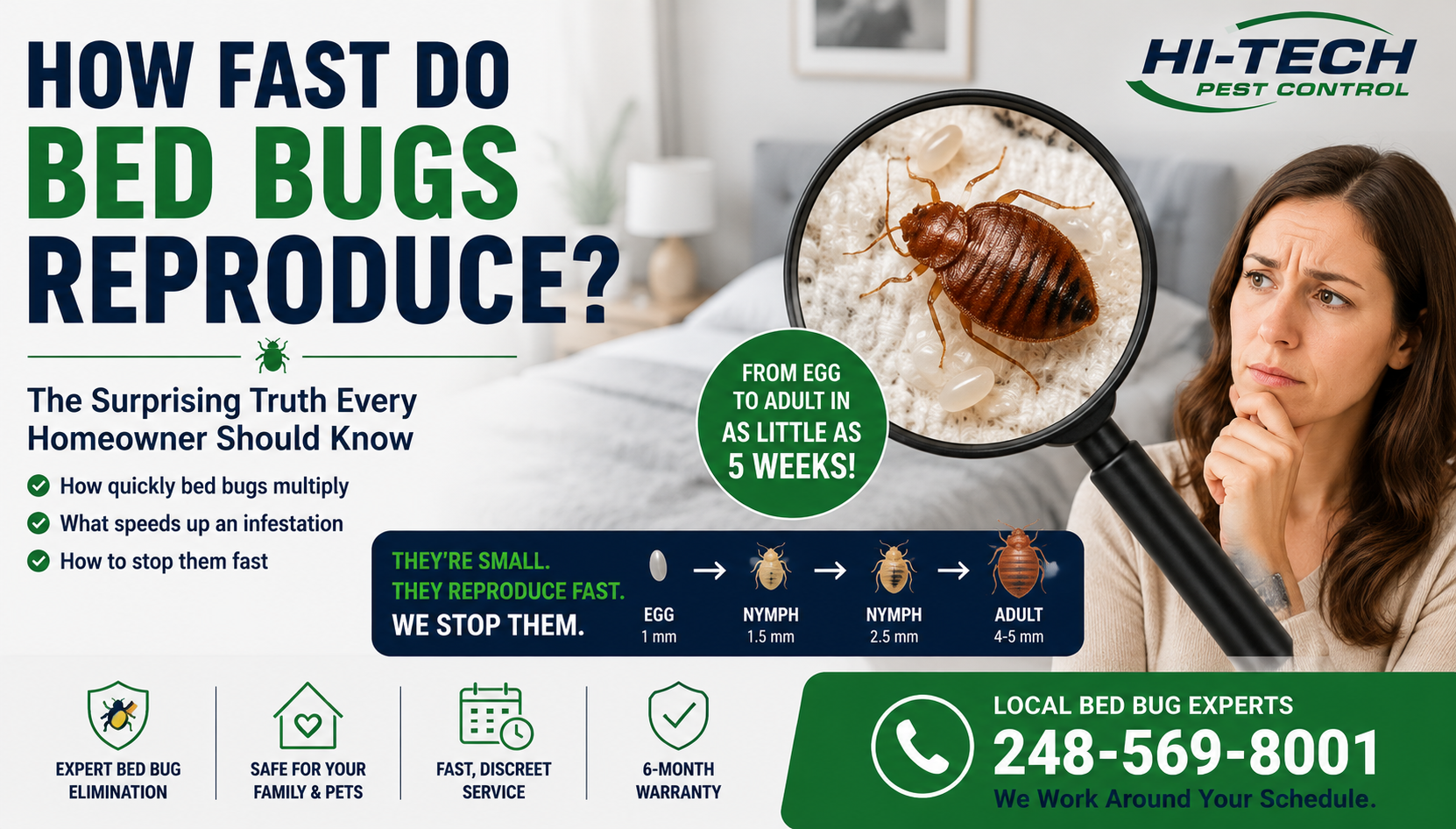
The Bed Bug Reproductive Cycle — Step by Step
Every number in this cycle is documented biology — not an estimate. This is what happens inside a mattress seam, a box spring, or a couch cushion while a homeowner waits to call.
What Waiting Actually Costs — In Dollars and in Daily Life
The reproductive math above translates directly into real costs — financial costs that grow with every week of delay, and personal costs that affect daily life in ways most people never anticipate when they first discover bites.
The Cost of Waiting
A one-room treatment at $500–$900 becomes a whole-home treatment at $2,000–$4,000 as the population spreads to every sleeping and resting area in the home.
As primary harborages become overcrowded, bugs migrate into wall voids — areas that require significantly more complex and time-consuming treatment to reach completely.
In apartment buildings, a growing population that reaches wall voids can migrate to neighboring units — creating a building-wide situation from what began as a single introduction.
Many homeowners who delay calling attempt DIY treatments first. Every spray application that doesn't eliminate the full population scatters it — making professional treatment more complex and more expensive.
The Cost of Acting Now
Early treatment eliminates the infestation before it spreads to additional rooms, additional furniture, and neighboring units. The treatment scope — and cost — stays at its smallest possible level.
Hi-Tech's same-day treatment eliminates the infestation in one visit. Bites stop the same night. Sleep returns to normal immediately — not after weeks of continued exposure.
Early-stage infestations are eliminated in the furniture — no disposal needed, no replacement cost, no new furniture becoming infested within days of purchase.
Michigan's only 6-month bed bug warranty backs every Hi-Tech treatment. If bugs return within 6 months, we come back at no charge. Zero financial risk.
The Personal Cost Nobody Talks About
The financial cost of a growing infestation is significant. But the personal cost — the effect on daily life while an infestation goes untreated — is something most pest control companies never address honestly.
Visible Bite Marks in Public
Bed bug bites appear on exposed skin — face, neck, arms, hands. They are visible to everyone in your daily environment. Teachers, office workers, healthcare providers, and students deal with bite marks that colleagues, administrators, and supervisors notice and ask about. The embarrassment and discomfort of explaining visible welts in professional settings is a real and immediate consequence of every day the infestation continues untreated.
Sleep Deprivation & Exhaustion
Bed bugs feed primarily at night — between 2 and 5 AM when sleep is deepest. The biting itself often wakes people up. The anxiety of knowing an infestation exists makes falling back asleep nearly impossible. Over days and weeks, the accumulated sleep deprivation affects concentration, mood, work performance, and physical health. This is not a minor inconvenience — it is a health impact that compounds with every night the infestation continues.
Anxiety & Psychological Stress
The psychological effect of a bed bug infestation is well documented — persistent anxiety, hypervigilance, difficulty concentrating, and a feeling of being unable to relax anywhere in your own home. Many people describe checking their sheets before bed every night, feeling something crawling when nothing is there, and being unable to invite friends or family over. This stress is not irrational — it is a direct response to a real and ongoing threat that ends completely the night of successful treatment.
Stained Bedding & Mattresses
Active infestations leave visible evidence — blood spots on sheets and pillowcases from crushed bugs, and dark fecal staining on mattress seams and fabric. These stains are unsightly and embarrassing, and they accumulate with every night the infestation continues. Hi-Tech cleans the mattress as part of treatment — and a quality encasement installed after treatment covers all staining completely, leaving the mattress looking new. There is no reason to discard a stained mattress or sleep on stained bedding a single additional night.
Every one of these personal costs ends the same night as Hi-Tech's treatment. Bites stop. Sleep returns. The anxiety of an active infestation — the checking, the hypervigilance, the visible marks — disappears with the infestation itself. Same-day service available throughout Southeast Michigan.
The Real-World Timeline — From Introduction to Advanced Infestation
This is what actually happens in a Southeast Michigan home when a single mated female is introduced — and treatment is delayed.
Why Eggs Are the Reason Most Treatments Fail
Understanding the reproductive cycle also explains why so many bed bug treatments — particularly DIY attempts — produce the same frustrating result: bites stop briefly, then return.
Every DIY spray product, every alcohol application, and every over-the-counter fogger has one thing in common: they cannot reach eggs in protected harborages. Bed bug eggs are deposited deep inside mattress seams, box spring frames, furniture joints, and baseboard cracks — precisely the locations that surface sprays cannot penetrate. The spray kills the adults and nymphs it contacts directly. The eggs survive, completely unaffected.
Six to ten days after that spray application, those eggs hatch. The nymphs that emerge feed immediately — and the bites return. The homeowner believes they have a new infestation. In reality, the original infestation was never eliminated. The eggs that were already laid before the spray simply waited out the treatment and continued the reproductive cycle.
This is one of the most common calls Hi-Tech receives: a homeowner who sprayed, had the bites stop for a week, and is now getting bitten again — often more severely than before, because the DIY spray also scattered surviving adults into harder-to-reach harborages like wall voids and ceiling moldings.
Hi-Tech's professional-grade treatment reaches the harborages where eggs are deposited — not just the visible surface population. Eliminating eggs is what stops the reproductive cycle completely. It is the difference between bites stopping temporarily and bites stopping permanently.
The Population Is Growing Right Now.
Same-Day Treatment Stops It Tonight.
Hi-Tech Pest Control serves all of Southeast Michigan — Wayne, Oakland, and Macomb Counties. Same-day inspections. Free of charge. No commitment required to inspect.
Bed Bug Reproduction — Common Questions
How fast do bed bugs reproduce?
A single female bed bug lays 1 to 5 eggs per day — up to 500 eggs in her lifetime. Eggs hatch in 6 to 10 days. Nymphs reach reproductive maturity in 5 to 6 weeks. A single introduced female can produce a colony of 200 to 500 individuals within 2 to 3 months. At warmer household temperatures — 70°F and above — the cycle accelerates significantly.
How long does it take to notice a bed bug infestation?
Most people do not notice a bed bug infestation until 4 to 8 weeks after introduction — often longer. Early-stage bugs remain hidden in harborages and bite infrequently enough that the bites are attributed to mosquitoes, rashes, or allergies. By the time bites become undeniable and nightly, the infestation is typically already in the moderate stage with dozens to hundreds of individuals established throughout primary harborages.
Why did bites stop after I sprayed and then come back?
Because the spray killed adults and nymphs on contact, but left eggs in protected harborages completely unaffected. Bed bug eggs are immune to contact insecticides and are hidden in locations that surface sprays cannot penetrate. 6 to 10 days after the spray application, those eggs hatched — and the new nymphs began feeding immediately. The original reproductive cycle was never interrupted. Professional treatment reaches the harborages where eggs are deposited.
Does temperature affect how fast bed bugs reproduce?
Yes significantly. Bed bugs reproduce most rapidly at temperatures between 70°F and 80°F — the typical range of a heated Michigan home in fall and winter. At these temperatures, eggs hatch in 6 to 7 days and nymphs reach maturity in 5 weeks. At lower temperatures, the cycle slows — but does not stop. A Michigan home in winter is still warm enough to sustain active reproduction throughout the infestation.
Can bed bugs spread to other rooms while I wait to treat?
Yes. As primary harborages become overcrowded — typically around months 2 and 3 — bed bugs begin migrating to secondary harborages throughout the home. They follow the host: wherever a person sleeps or rests regularly, bed bugs will establish. Moving to another room to escape bites does not provide relief. It introduces the infestation to every new resting area the host uses and expands the affected zone that must be treated.
How does Hi-Tech stop the reproductive cycle completely?
By locating and treating every harborage where adults, nymphs, and eggs are present — not just the visible surface population. Professional-grade products are applied directly into harborages in a way that reaches egg deposits that no surface spray can penetrate. Adults, nymphs, and eggs are all eliminated in the same treatment visit. Bites stop the same night. Michigan's only 6-month warranty backs every treatment — if bugs return within 6 months, we come back at no charge.
Wayne · Oakland · Macomb County · Same-Day Service
Every Day You Wait, the Population Grows.
Call Hi-Tech Today.
Free inspection. One complete visit. Michigan's only 6-month warranty.
7 days a week · 8:30 AM–10 PM · Locally owned since 1986