Bed Bug Exterminator in Pontiac Michigan — One-Visit Elimination

Bed Bug Exterminator in Pontiac Michigan — One-Visit Elimination
If you are waking up with bites in your Pontiac home or apartment, you need a bed bug exterminator with the experience to eliminate the problem completely — the first time. Pontiac is one of Oakland County’s most active bed bug markets, and Hi-Tech Pest Control has been the region’s most trusted bed bug specialist since 1986.
We serve Pontiac homeowners, apartment renters, landlords, property managers, hotels, group homes, and commercial properties with one proven approach: one-visit elimination backed by Michigan’s only 6-month warranty. Free bed bug inspection.
WHY PONTIAC MICHIGAN HAS A SERIOUS BED BUG PROBLEM
Pontiac sits in the heart of Oakland County — part of the Detroit metro area that ranked #3 in the entire nation for bed bug activity in 2025. Several factors make Pontiac one of the most challenging bed bug markets in Southeast Michigan.
Dense multi-unit housing. Pontiac’s apartment complexes, rental homes, group homes, and multi-family properties create ideal conditions for bed bug spread. When one unit has an active infestation, bed bugs travel through shared walls, electrical conduits, and hallways to neighboring units — often before any resident realizes there is a problem.
Older housing stock. Much of Pontiac’s residential housing was built before modern pest control standards. Older homes have more cracks, gaps, and wall voids where bed bugs hide and travel — making thorough professional treatment even more critical than in newer construction.
High-traffic transitional housing. Pontiac’s concentration of group homes, halfway houses, recovery facilities, and transitional housing creates constant movement of residents — and with that movement comes a significantly elevated risk of bed bug introduction and spread.
Secondhand furniture. Pontiac’s active marketplace for used furniture, mattresses, and household goods creates frequent opportunities for infested items to enter new homes and apartments.
Low competition from quality exterminators. Most national pest control chains focus their Pontiac operations on surface-level treatments — which is exactly why Hi-Tech Pest Control receives so many calls from Pontiac residents who have already paid another company and still have bed bugs.
WHY BED BUG TREATMENTS FAIL IN PONTIAC
Hi-Tech Pest Control receives calls every week from Pontiac homeowners and renters who paid another pest control company two, three, or more times — and still have bed bugs. In Pontiac’s older housing stock where bed bugs have often spread through walls to multiple units, surface treatments barely address the real infestation.
The root cause is always the same. Most pest control companies treat what they can see — visible surfaces on the mattress, the floor around the bed, the edges of the box spring. In Pontiac’s older apartment buildings where infestations have often spread through walls to multiple units, surface treatments barely scratch the surface of the infestation.
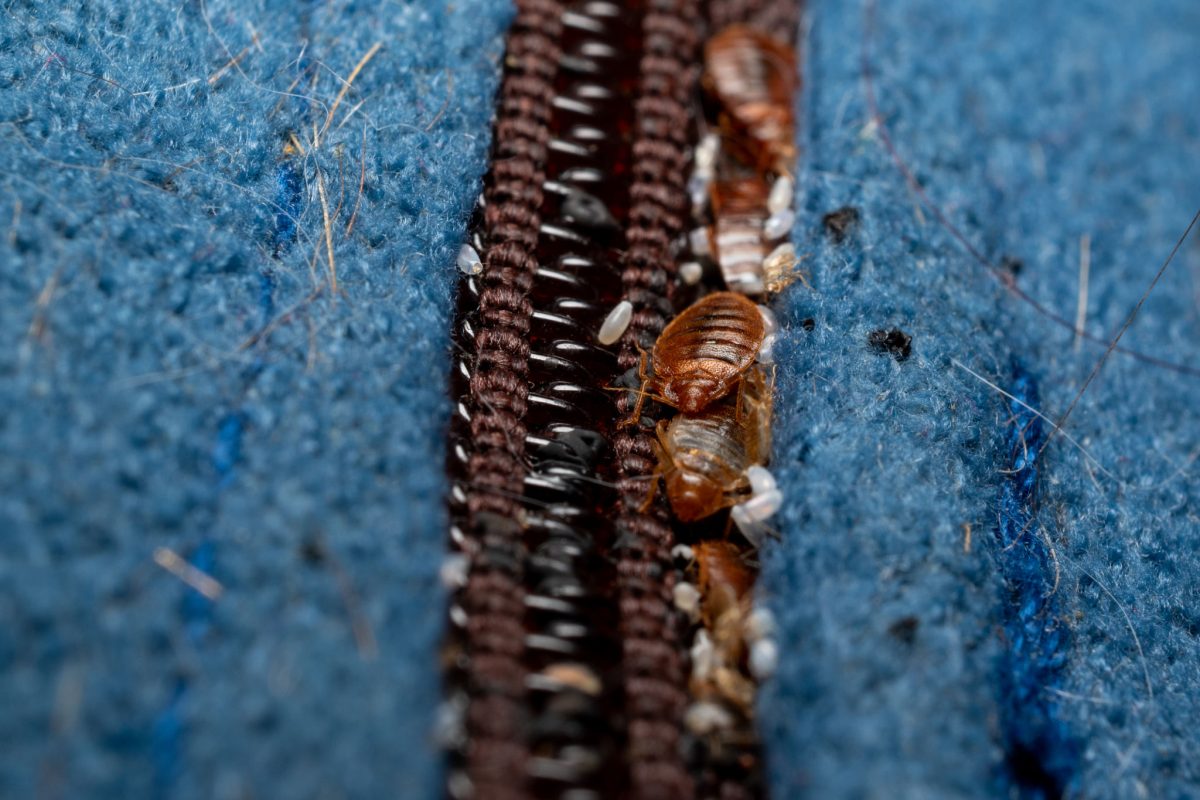
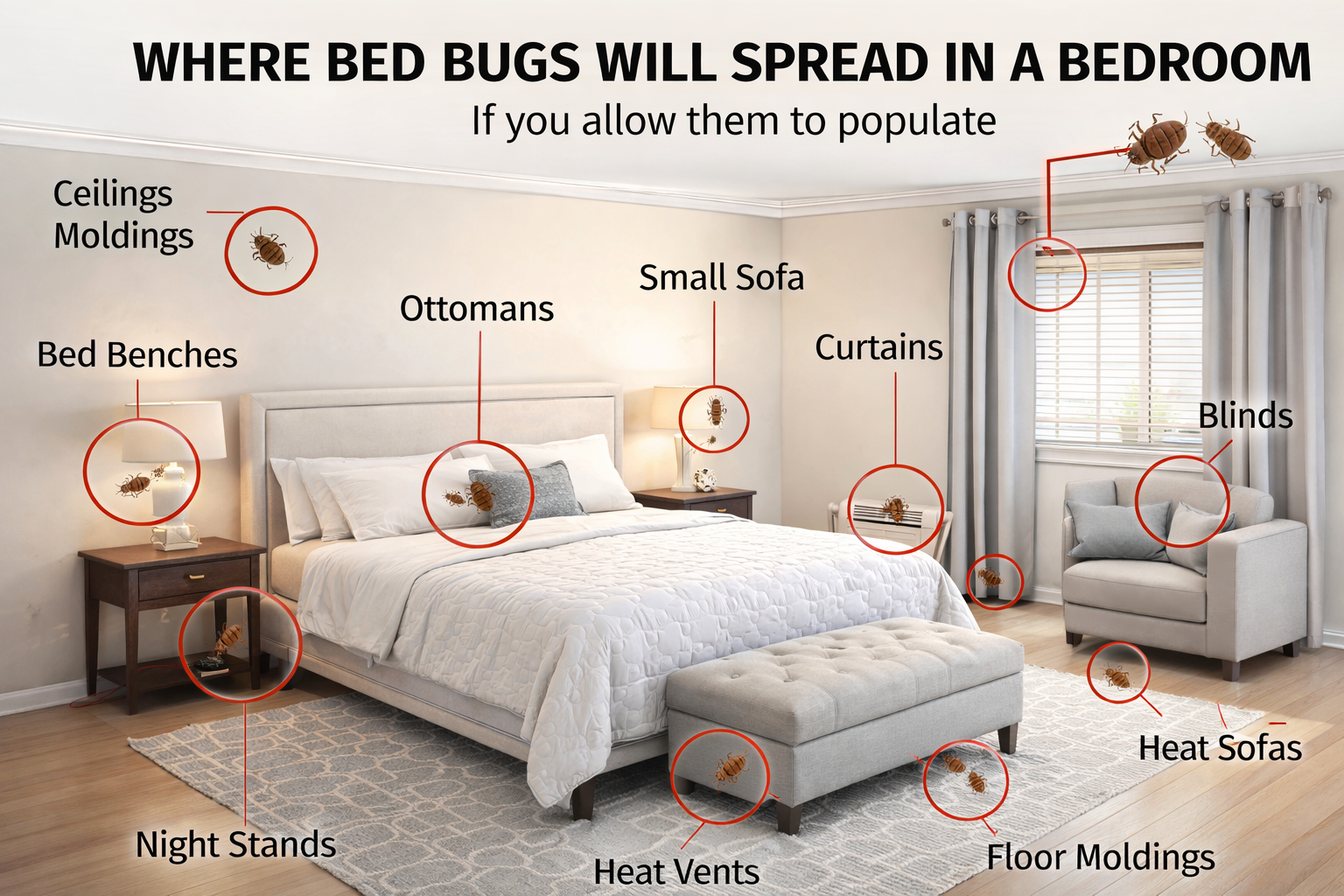
Within days the bed bugs hiding inside wall voids, behind electrical outlets, deep in furniture seams, and along baseboards hatch and restart the infestation from exactly the same locations. The customer calls back. Another $300–400 visit. The same surface treatment. The same result.
Hi-Tech Pest Control breaks this cycle. Our one-visit elimination approach is built on 40 years of experience finding every hiding spot in every Pontiac property we treat — apartments, single-family homes, rental units, group homes, and commercial buildings. We treat what other companies miss. That is why our 6-month warranty is possible — and why no other Michigan company offers it.
HOW HI-TECH PEST CONTROL ELIMINATES BED BUGS IN PONTIAC IN ONE VISIT
Our process is thorough, complete, and backed by the only 6-month bed bug warranty in Michigan.
Step 1 — Free Same-Day Inspection
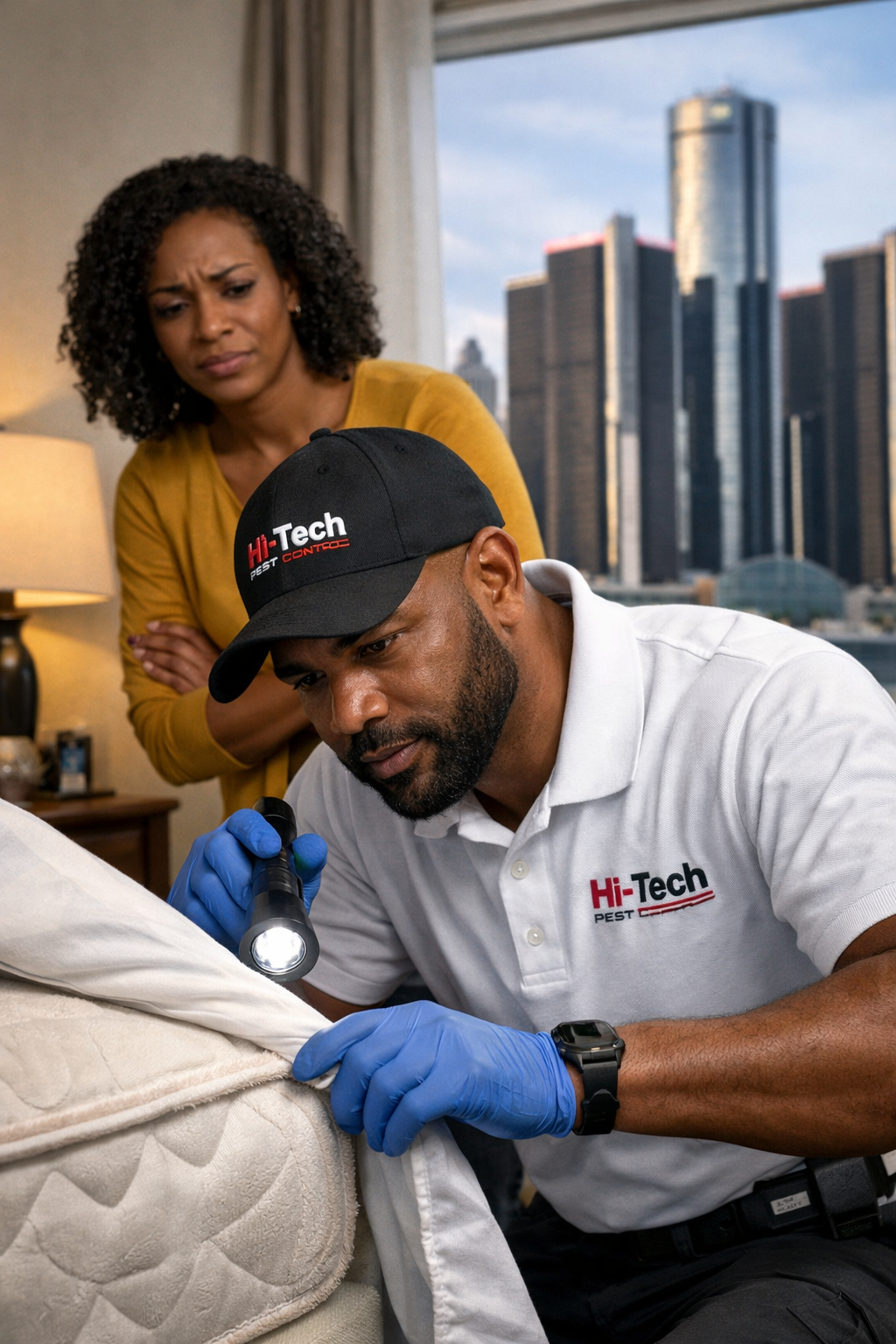
We arrive at your Pontiac property and conduct a complete inspection of every area bed bugs are known to hide. Mattresses, box springs, bed frames, furniture, baseboards, wall voids, electrical outlets, and all adjacent areas. We assess the full extent of the infestation and give you an honest quote with no hidden fees and no pressure to proceed.
Step 2 — Complete One-Visit Treatment
Using professional-grade materials and 40 years of Oakland County experience, we treat every affected area completely — targeting bed bugs at every life stage including eggs. Pontiac apartment treatments include attention to shared-wall areas and common infestation pathways specific to multi-unit buildings. Nothing is missed. Nothing is left to restart the infestation.
Step 3 — Bites Stop the Same Night
The overwhelming majority of our Pontiac customers report zero bites the very first night following treatment. This is the direct result of complete elimination rather than surface-level treatments that allow infestations to restart within days.
Step 4 — Michigan’s Only 6-Month Warranty
Every bed bug treatment we perform in Pontiac is backed by Michigan’s only 6-month warranty. If bed bugs return for any reason within 6 months of treatment we come back and retreat your Pontiac property at absolutely no charge. No other Michigan pest control company offers this — because no other company eliminates bed bugs as completely as we do.
WHO WE SERVE IN PONTIAC MICHIGAN
Hi-Tech Pest Control eliminates bed bugs for every type of property in Pontiac:
Single-Family Homes
Pontiac homeowners dealing with bed bug infestations of any size or severity. Our one-visit approach handles everything from a single affected bedroom to a whole-home infestation spread across multiple rooms.
Apartments and Rental Properties
Bed bugs in Pontiac apartment complexes require fast, discreet action to prevent spread between units. We work directly with Pontiac renters, landlords, and property managers — providing unit-by-unit elimination, tenant prep sheets, and documentation for property records.
Group Homes and Transitional Housing
Pontiac’s concentration of group homes, halfway houses, and recovery facilities makes rapid, discreet bed bug elimination a priority. Hi-Tech Pest Control provides low-odor, non-disruptive treatment that protects vulnerable residents while completely eliminating bed bug activity.
Hotels and Commercial Properties
A single bed bug complaint can devastate a hotel’s online rating. Hi-Tech Pest Control provides discreet, after-hours treatment for Pontiac hotels and commercial properties — using unmarked service vehicles and providing electronic documentation for management records.
PONTIAC NEIGHBORHOODS AND AREAS WE SERVE
Hi-Tech Pest Control provides same-day bed bug inspection and treatment for Residential, Commercial, and Industrial throughout all Pontiac neighborhoods and surrounding Oakland County communities including:
Downtown Pontiac and surrounding residential areas
North Pontiac — including neighborhoods near Huron Street and Glenwood Avenue
South Pontiac — including neighborhoods near Auburn Avenue and Lawrence Street
East Pontiac — including areas near Orchard Lake Road
West Pontiac — including neighborhoods near Telegraph Road
Surrounding communities — Waterford Township, Pontiac Township, Auburn Hills, Bloomfield Hills, Lake Orion, Clarkston, White Lake Township, and Oxford Township
PONTIAC APARTMENT BED BUG TREATMENT
sPontiac renters in apartment buildings, condos, and multi-unit properties face some of the most challenging bed bug situations in Oakland County. Hi-Tech Pest Control provides:
For Pontiac Renters:
Free same-day inspection regardless of whether your landlord has authorized treatment. Written documentation of the infestation for your property manager or landlord. Honest assessment of whether the infestation originated in your unit or spread from a neighboring one. With signs of Bed Bugs full treatments available the same day as inspection in all Pontiac zip codes.
For Pontiac Property Managers and Landlords:
Multi-unit building inspections to determine which units are affected. Unit-by-unit assessment reports with electronic documentation. Building-wide prevention recommendations to stop future spread. Coordinated scheduling that minimizes disruption to tenants. Emergency same-day response for active infestation situations throughout Pontiac.
HOW MUCH DOES BED BUG TREATMENT COST IN PONTIAC MICHIGAN?
Bed bug treatment costs in Pontiac are based on infestation severity and property size — not a flat per-room rate.
Early-stage infestations — 1 room, low severity: $500–$900
Moderate infestations — 2–3 rooms affected: $900–$2,000
Severe whole-home or multi-room infestations: $2,000–$4,000
The most important cost reality for Pontiac residents: the average homeowner or renter who goes through two failed treatments from cheaper companies spends $800–$1,200 before calling Hi-Tech Pest Control — and still has bed bugs. One correct treatment from the right company almost always costs significantly less than repeated failed treatments, replacement furniture, and months of lost sleep.
Hi-Tech Pest Control offers free same-day inspections with transparent honest quotes and no hidden fees throughout all Pontiac zip codes. Learn more about our bed bug treatment costs.
PONTIAC ZIP CODES WE SERVE
Hi-Tech Pest Control serves all Pontiac zip codes including:
48340, 48341, 48342, 48343
We also serve all surrounding Oakland County communities including Waterford, Auburn Hills, Bloomfield Hills, Bloomfield Township, West Bloomfield, Lake Orion, Oxford, Clarkston, Orion Township, Independence Township, and all surrounding areas.
WHAT PONTIAC RESIDENTS SAY ABOUT HI-TECH PEST CONTROL
“I had been dealing with bed bugs in my Pontiac apartment for months. Two other companies came out and the bugs kept coming back. Hi-Tech found bugs inside the wall behind my headboard that nobody else had touched. First night after treatment — zero bites. The 6-month warranty made me feel completely protected.”
— Marcus T., Pontiac Michigan
“Called Hi-Tech on a Sunday morning after finding bugs in my furniture. They answered immediately, came out to my Pontiac home within a few hours, and treated everything. Bites stopped that same night. I can’t say enough good things about this company.”
— Sandra K., Pontiac Michigan
“My property management company had already sent another exterminator twice and the bugs kept coming back in multiple units. Hi-Tech came in, inspected the whole building, and eliminated the problem in one visit per unit. Best decision we made.”
— James R., Property Manager, Pontiac Michigan
FREQUENTLY ASKED QUESTIONS — BED BUG EXTERMINATOR PONTIAC
How quickly can Hi-Tech Pest Control respond to a Pontiac bed bug emergency?
Hi-Tech Pest Control offers same-day bed bug inspections and treatment throughout all Pontiac neighborhoods and zip codes. We answer 7 days a week from 8:30 AM to 10:00 PM. Call 248-569-8001 and we can typically reach most Pontiac locations within hours of your call.
Does Hi-Tech treat group homes and transitional housing in Pontiac?
Yes. Hi-Tech Pest Control has extensive experience treating Pontiac group homes, halfway houses, recovery facilities, and assisted living properties. We use low-odor, non-disruptive applications that protect vulnerable residents while completely eliminating bed bug activity. We provide electronic documentation for facility records and same-day emergency response.
My Pontiac landlord is not responding to my bed bug complaint — what can I do?
Under Michigan law landlords are required to maintain habitable living conditions including addressing bed bug infestations promptly. Notify your landlord in writing by text or email to create a documentation trail. If they remain unresponsive contact Oakland County code enforcement. Hi-Tech Pest Control provides free inspections for Pontiac renters regardless of landlord authorization status — we inspect and document the infestation for you.
Can bed bugs spread between units in my Pontiac apartment building?
Yes — and this is extremely common in Pontiac apartment buildings. Bed bugs travel through shared walls, electrical conduits, plumbing gaps, and under door frames. If a neighboring unit has an active infestation it can spread to your unit without you ever bringing bed bugs home. Hi-Tech regularly treats multiple units in Pontiac buildings where infestation spread went undetected for months.
How does Pontiac’s bed bug problem compare to other Oakland County cities?
Pontiac is Oakland County’s most active bed bug market due to its density of older housing stock, multi-unit rental properties, and transitional housing facilities. While Southfield and Farmington Hills also see significant bed bug activity, Pontiac’s older residential infrastructure creates more wall voids and pathways for bed bugs to spread — making thorough professional treatment more critical than in newer construction.
CALL HI-TECH PEST CONTROL — PONTIAC'S BED BUG SPECIALISTS
Pontiac is Oakland County’s most active bed bug market. Don’t let your home, apartment, or facility become part of the problem. Hi-Tech Pest Control offers free same-day inspections throughout all Pontiac neighborhoods and zip codes — with honest no-pressure assessments and the only 6-month bed bug warranty in Michigan.
Same-day appointments available.
Free inspection with no hidden fees.
One-visit elimination — bites stop the same night.
Michigan’s only 6-month warranty.
40+ years eliminating bed bugs across Wayne, Oakland, and Macomb Counties.
Hi-Tech Pest Control
Serving Pontiac Michigan and all of Southeast Michigan since 1986